3 months ago
26
3 months ago
26
Ellie PriceNews correspondent

 Getty Images
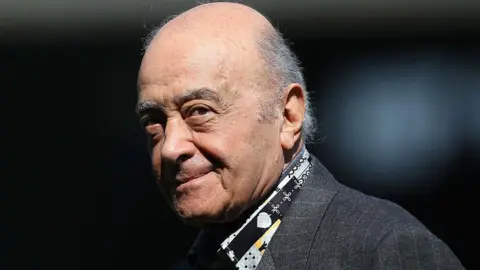
The investigation into allegations of rape and sexual abuse by the late Harrods owner, Mohamed Al Fayed, should be widened to include trafficking, a former senior Metropolitan Police officer has told the BBC.
It comes as the law firm Leigh Day has written to the force on behalf of at least 15 women seeking clarification of whether the current investigation is being considered as trafficking.
Lawyers claim the Met's Operation Cornpoppy, which is looking into what role individuals may have played in facilitating or enabling Al Fayed's offending, is not sufficiently wide in scope and that there is a failure to use all investigatory powers as a result.
They argue this means "enablers" and those who facilitated Al Fayed's behaviour are less likely to be brought to justice.
The former head of the Met's anti-trafficking unit, Phil Brewer, told the BBC he could not understand why the operation was not already a trafficking investigation.
The Modern Slavery Act - which defines human trafficking as arranging or facilitating the travel of another person, within a country or across borders for the purposes of that person being exploited - came into in force in 2015. But offences of human trafficking have existed in legislation before then and can still be prosecuted as such.
Speaking about her experiences for the first time, Anne, not her real name, told the BBC she was trafficked by Al Fayed to his "sadist" brother Salah Fayed in France.
She claims her passport was taken from her and she was flown by private jet from the UK to a job that did not exist for the purposes of abuse.
She described the network which enabled the abuse as a "trafficking factory".
"The experience of being trafficked is an experience of being conditioned and deprived of the ability to protect yourself, of being instilled with this very, very deep sense of fear and standing up and standing against these people who trafficked me and arranged for me to be raped is terrifying.
"And I need this country's institutions to stand up for me, for other victims, and to protect future victims from similar victimisation."
Anne also claims she has tried repeatedly to report what happened to her to Operation Cornpoppy, but believes her case has not been followed up sufficiently.
Another alleged victim, Rachael Louw, who has waived her right to anonymity, says she suffered abuse at the hands of Al Fayed and his brother Salah and believes she was also trafficked.
She has reported her case to French police who she said dealt with her more sensitively.
French authorities are investigating "potential acts of aggravated human trafficking… with multiple victims," in relation to Al Fayed, according to correspondence seen by the BBC.
She believes the Met should take a similar approach.
"They're missing evidence. They're just going to be missing evidence that the French are taking seriously and investigating… If the French authorities are going to be investigating it through the trafficking lens, then I do not see why it should not be the same for the Met. "
Brewer, who previously led the Met's anti-trafficking unit said it made sense to make Operation Cornpoppy a trafficking investigation, because it would expand the "investigative strategy".
He said: "When you start looking wider, the emphasis isn't on the survivor themselves in terms of their account alone, and it means that we're not just looking at one person's word against another, we then start hopefully identifying and seizing evidence that supports, corroborates the stories that they've provided."
Separately, in a letter to the force, shared exclusively with the BBC, lawyers Leigh Day said: "We appreciate the Modern Slavery Act came into force in July 2015 and that the Act itself is not retrospective in relation to historic allegations. However, it does, crucially, provide investigators a prism or lens to look at patterns of behaviour that might otherwise be investigated as 'historic sexual abuse' or 'sexual misconduct'."
Leigh Day said the force's approach was "limited".
Al Fayed died in 2023 aged 94 having never faced charges. His brother Salah died in 2010 also having faced no charges.
Al Fayed owned Harrods between 1985 and 2010, with most of the abuse alleged to have happened during that time.
A spokesperson for the Metropolitan Police, said: "The live investigation into those who could have facilitated or enabled Mohamed Al Fayed's offending continues.
"The way the Met works has moved on immeasurably, and our teams have transformed the way we investigate rape and sexual offences. We're working with partners across the criminal justice system to ensure that victim-survivors are at the heart of our response, with a greater focus on suspects and their offending.
The Met has said that the live investigation into those who could have facilitated or enabled Al Fayed's offending continues and urged anyone with information whether directly affected by Mohamed Al Fayed's actions or those aware of others who may have been involved, or committed offences, to come forward.
Harrods has told the BBC the independent external investigation it had established into whether any current employees knew about the alleged abuse "is now concluding".
It confirmed, in relation to action taken by Harrods, one employee left the business last year.