1 month ago
7
1 month ago
7
French author Jean-Baptiste Andrea wanted to be a writer from the age of nine. His parents discouraged him – although they loved art, especially literature, they did not see it as a viable career path. “They said that writers die in poverty. My mother said you have to be a god to write a book, and that I was not a god,” he tells me.
Fortunately, he ignored their advice; his fourth novel, Watching Over Her (Veiller sur elle in French), won the 2023 Prix Goncourt, France’s most prestigious literary prize. It has sold more than 700,000 copies in France alone, been translated into more than 34 languages, and is to be adapted for the screen. The English-language version has now been released. When I ask how his parents feel now about his choice of career, he jokes, “I think if I was running a bank today, my mother would be even happier than she was about the Prix Goncourt.”
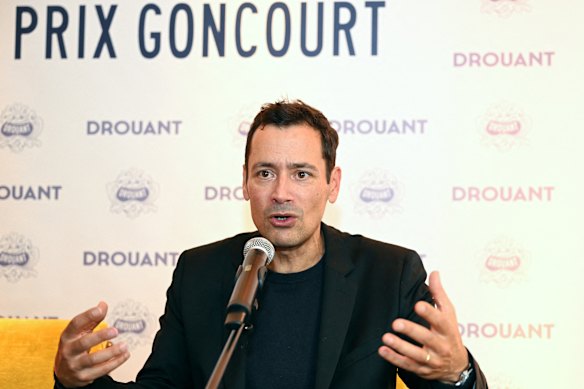
French author Jean-Baptiste Andrea, winner of the Prix Goncourt literary prize.Credit: AFP
Andrea and I meet at his hotel, the stately Malmaison, in the heart of Edinburgh’s New Town. We are both in the Scottish capital for the Edinburgh International Book Festival, and our interview takes place to the sound of bagpipes playing just outside.
Loading
In 1996, having completed two university degrees, the first in economics and political science, the second in business (to placate his parents) he began his career writing film scripts.
“I love storytelling,” he says. “When you make someone laugh, or cry, it’s fantastic. I love cinema, so I decided to write and make movies.” He directed and wrote four films over the next 10 years, starting with Dead End (2003), a French-British horror film.
It was a success, and his career was launched. Two years later, he received a call from Berenice Fugard, the English head of acquisitions at Pathe Films, asking what he was working on. That led to Big Nothing, a black comedy starring David Schwimmer from Friends released in 2006 – and to marriage to Berenice, who now works as an artist at their home in Cannes.
Loading
He became disillusioned with the movie world and decided to try writing a book. “One day, when I was out walking my dog, the idea came to me to write about a young man who runs away from home to prove he’s a man.” He wrote the entire book in three weeks, in a burst of creativity. “I felt like I had reconnected with my true self,” he says. “It gave me such joy. I remember thinking, ‘Don’t ever forget that joy’.”
What follows is a story to bring joy to the heart of any aspiring writer. His manuscript, Ma Reine, was rejected by 14 publishers, before L’Iconoclaste, a boutique publishing house, released it in 2017. It won 12 literary prizes, including for best debut novel, and sold well. “I had finished 2016 with minus €5000 in the bank, and a mortgage. Suddenly, Ma Reine was translated into 15 languages and I had €50,000 from international sales alone.” [It has not been translated into English].

Andrea at the time of his 2023 Goncourt win.Credit: Gamma-Rapho via Getty Images
He wrote his next three novels in quick succession. “I was like a bottle of champagne,” he tells me. “The cork was out, and my creativity erupted.” He published A Hundred Million Years and a Day in 2019 and Devils and Saints in 2021, with both translated into English.
But it is his fourth novel, Watching Over Her, published in France in 2023, that has launched him into the literary stratosphere. Set in Italy in the first half of the 20th century, it is a love story between Mimo, a poor fatherless Italian boy who grows up to become a famous sculptor, and Viola, the intelligent, high-spirited daughter of an aristocratic family who chafes against the restraints society imposes on her. The two meet at 13 and their (star-crossed) romance lasts a lifetime.
It is, however, more than a love story. Set against the rise of Mussolini and fascism in Italy from 1922, it raises issues about the complicity of the church and the aristocracy. Then there is Mimo himself – his career takes off once he starts to accept well-paid commissions from the fascist government. The idealistic Viola is horrified, repeatedly urging him to refuse the work.

Andrea at a Dior show during the Paris Men’s Fashion Week last year.Credit: WWD via Getty Images
This raises the topical issue of the role of the artist in society, particularly during turbulent political times. Andrea is adamant in his views.
“I don’t think artists should get directly involved in politics. The role of the artist is to show the past, so we don’t repeat the same mistakes, or to show the way to a better future,” he says. “Festivals should be about art. We (artists) can share our vision, but we must be careful. I think artists should work hard, shut up and do their talking through their books.”
In each of his novels, Andrea explores the impact of a traumatic childhood on the adult; all his protagonists have parents who are either absent or abusive. “The origin of all evil is in childhood. That’s when trauma happens that you can’t recover from. The lack of love as a child should never be underestimated.”
My mother said you have to be a god to write a book, and that I was not a god.
Asked how he feels to have won the Prix Goncourt, Andrea responds, “The day I walked into L’Iconoclaste’s office, I felt I could finally be me, professionally. I had found a place that I had been looking for forever, and that gave me a deep sense of security, satisfaction and joy. Now I live in that place every single day.” He adverts to the personal cost of pursuing a creative career: “On the day I won the Prix Goncourt, I felt like I had been fighting all my life. Choosing an artistic path is a constant fight – sometimes even against your family, as in my case.”
Loading
Andrea’s first words to the throng of journalists who greeted him as he arrived at Paris’ Drouant restaurant, where the Goncourt jury of 10 leading literary figures meet to select the winner, were heartfelt. “To all the kids who think they want to be writers or artists and think they can’t make it, I’m the proof that you can.”
How has the Prix Goncourt changed his life? It comes with a symbolic award of €10 ($18 dollars), so it’s not the money. “At the end of the day, on the day I die, the Goncourt and my sales don’t matter. What matters is: ‘Have I been true to myself and my childhood dream?’ The answer is ‘Yes’. It’s all there in my books.”
The Booklist is a weekly newsletter for book lovers from Jason Steger. Get it delivered every Friday.