3 months ago
41
3 months ago
41
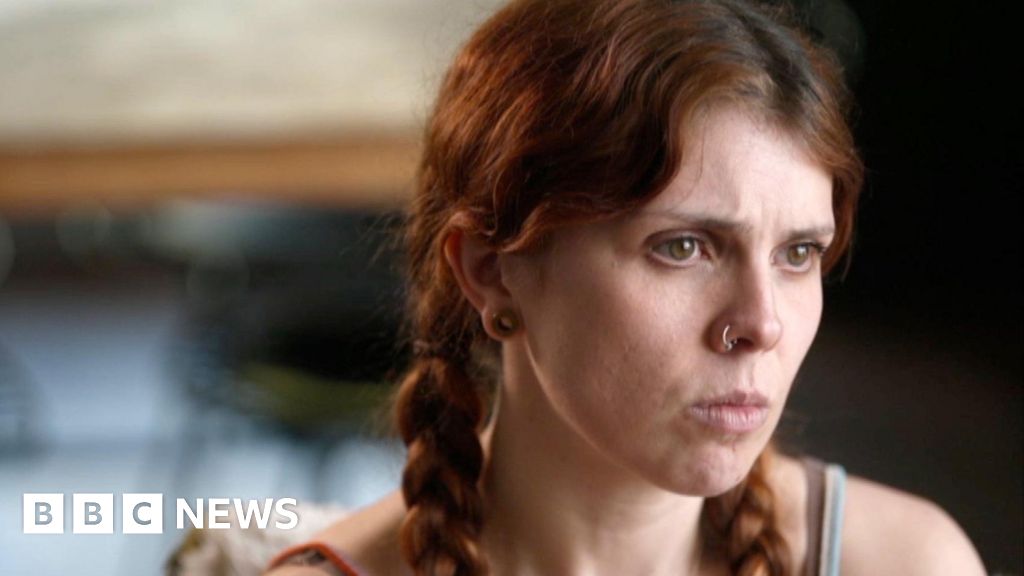
Before the paths of documentary filmmaker David Borenstein and Pavel “Pasha” Talankin crossed, Pasha was a school teacher in the mining town Karabash in Russia’s Ural mountains. It is a nondescript place of 8000 people, notable only for being one of the most polluted places on Earth.
Despite that, he loved everything about the place, from the decaying Soviet-era buildings to the winter cold that could quite literally stop a person dead in their tracks. His mother worked in the school library, sticky-taping dog-eared textbooks. His classroom was a place students could relax, listen to music and muck around.
His job as a videographer involved filming the daily goings-on at Karabash Primary School 1. But after Russia’s invasion of Ukraine, he was horrified at new orders to film nationalistic ceremonies and recruitment exercises for the military. In a rallying cry video message to the school, President Putin somewhat ambiguously states, “Teachers win wars”.
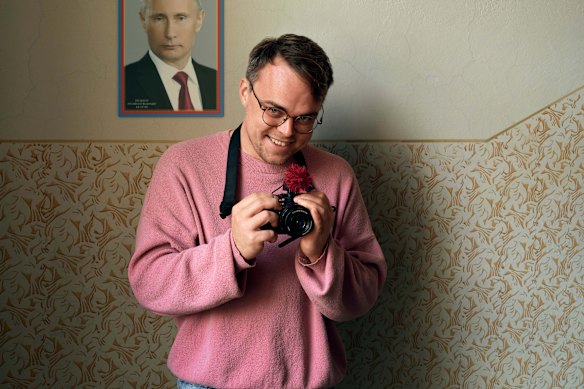
The laid-back Talankin (is there a Russian equivalent of slacker?) is not the type of figure that comes to mind when one thinks of whistleblowers or rebels who dare take a stand against a tyrannical regime. No less unusual is how this endearing film, Mr Nobody Against Putin, which is in the running for best documentary at the Academy Awards this month, came to be made and why its message resonates far beyond the Caucasus.
Talankin had come to Borenstein’s attention after responding to a “casting call” on Russian social media asking the public to report how their jobs had been affected after the full-scale military invasion of Ukraine began in early 2022.
Among the patriotic messages about people donating clothes and sending letters to soldiers was an angry reply from Talankin, which was brought to Borenstein’s attention by a filmmaker contact in Russia. It was, says Borenstein, the first of many risky things Talankin did on this project.
They started working together remotely, Borenstein in Denmark, where he lives, Talankin in Karabash. Only years later did they meet in person.
A cinematographer went to Karabash to film Talankin.
“There was a folder of material that was delivered to me by my cinematographer that was shot by Pasha, and I loved it”, recalls Borenstein. “The clips inside this folder were weird. Pasha was shooting, for example, images of him eating cabbage soup for 25 minutes, first person, of him walking around the school and saying, ‘Hi’ and shaking hands and giving high-fives to people.
“Two hours of him just walking around town again and again and again. It was really weird footage. Who thinks to shoot stuff like that? But as I was editing the material together … I just loved that material. It was amazing.
“The first-person perspective really encouraged us to understand what these transformations in Russia and in Pasha’s school meant for Pasha on a personal and psychological level, and it really helped open up new dimensions to the story.”
Borenstein knew that he had a front-seat view to what was happening inside Russian schools. “What we could see in those schools provided incredible insight into the ideological underpinnings of the invasion. This was [in] the weeks after, when the whole world was saying, ‘What the hell is happening’? We all didn’t think it was possible. And then it happened, and in real time, we were getting answers about how Russians looked at this and how the state wanted to teach it in schools.”
He says from the outset Pasha’s security was a priority.
“We saw on the footage that he was going around telling people, ‘I’m making a film with the BBC,’” says Borenstein. “But what Pasha had going for him is that nobody believed him. People just laughed. And so the BBC advised me [to not share the work-in-progress]. The consequences of getting caught participating in something like this could have been eight years in prison, it could be life in prison.”
Before becoming a filmmaker, Borenstein studied ideology and propaganda as a PhD student. He has made three films on the topic. “I think the function of propaganda is to make [people] do stupid and absurd things every single day, again and again and again, until they … stop being able to even imagine a world in which have any power to do anything different, and in which they internalise this view of themselves where their goal is to obey regardless of how stupid the orders are.
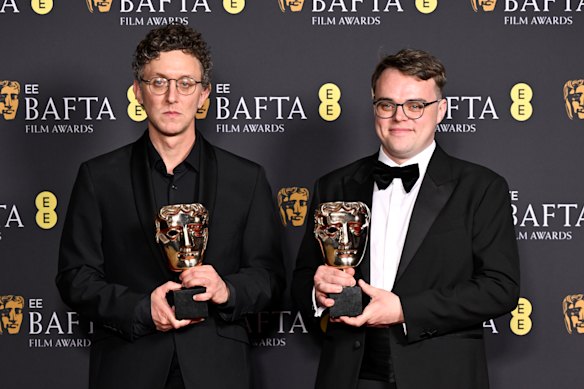
“And it seems to be precisely the kind of propaganda that is needed to send 1 million Russian soldiers to a pointless war to become casualties and deaths.”
But, he says, the “fire under myself” for making and promoting the film is Pasha. In the finished film, Talankin and Borenstein share the director credit.
“I knew I had to make it as good as possible,” says Borenstein. “Because this guy is leaving Russia and he can’t go back. When I was waiting for festivals to see if they would accept it or not, I was so nervous because what if he leaves Russia and no festivals accept this film and there’s no way of getting it out to the world?
“And now, for the last few months, we’ve been on this awards campaign. On one hand it feels silly, an Oscar campaign … On the other hand, you do whatever it takes to get people to see it because a guy sacrificed his whole life to make it happen. This is his life’s work. It’s a defining inflection point in his life. So that’s been motivating me.”
As we see in the film’s late scenes, it doesn’t let us forget the price Talankin has paid for his bravery.
“His future is a little uncertain,” says Borenstein. “It’s hard to give up your life in a town and re-establish yourself someplace so radically different. He’s learning English and after this all winds down, he’s going to have to build a new life for himself, but I have faith that he’ll be able to do it.”
Mr Nobody Against Putin is now streaming on Docplay. The Academy Awards are on Seven on Monday, March 16.
Find out the next TV, streaming series and movies to add to your must-sees. Get The Watchlist delivered every Thursday.