3 months ago
6
3 months ago
6
Melbourne doctors, nurses, social workers and activists are threatening to occupy an inner-city community clinic if planned cuts are not reversed by Christmas.
Health workers say they are prepared to run a renegade health service from a site in Collingwood to prevent it being knocked down and sold to developers.
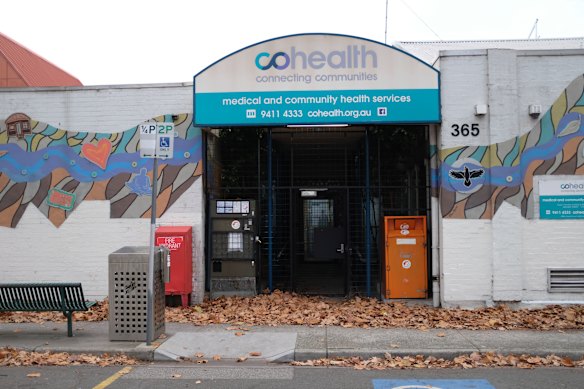
The entrance of cohealth’s community health centre at Collingwood, slated for closure.
The plan comes almost a month after cohealth’s shock announcement that it would axe GP and counselling services in Kensington, Fitzroy and Collingwood in December, before shutting down the Collingwood site altogether next year. The changes, if they go ahead in the coming weeks and months, are expected to affect more than 12,000 patients.
While Medicare rebates and bulk-billing incentives have increased this year, cohealth says it is still losing money because it is not a typical walk-in walk-out clinic, instead offering a suite of specialist services for those experiencing addiction, homelessness or severe mental health issues.
Bids for a major rebuild of the Collingwood clinic, which operates in a 75-year-old building with leaking ceilings and cracked walls, have been knocked back during budget deliberations by the state government.
Loading
Following a meeting attended by around 500 locals a fortnight ago, hundreds of locals braved bitter cold and rain on Saturday to pressure the federal government to fund an emergency bailout outside federal Melbourne MP Sarah Witty’s electorate office in Fitzroy.
When asked if a federal bailout package was on the table on Tuesday, a spokesperson for Health Minister Mark Butler told The Age the minister had “requested the cohealth board pause its decision” while conversations were ongoing.
“The department and Commonwealth officials continue to meet regularly with cohealth management and expect cohealth to provide detailed data and information to support discussion,” the spokesperson said.
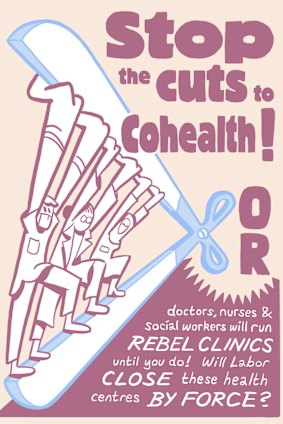
The protest poster appearing across inner Melbourne advocating for an ‘occupation’ of cohealth clinics slated to close.Credit: Ben Juers
Yarra Mayor Stephen Jolly, who is separately fighting a charge of unlawful assault, announced at the Saturday rally an escalation plan if neither cohealth nor state or federal governments move to salvage the service, which has provided free medical care for vulnerable Melburnians for over 135 years.
Jolly said the cuts amounted to the “most generalised attack on poor people” he had witnessed in decades, and accused cohealth of abandoning its core mission, noting it had recently expanded into Tasmania and has a new centre opening up in Flinders Street soon.
“These services are not the board’s to close down,” he said. “This is community health, not corporate health.”
Despite public pressure, on Monday this week patients received a text from cohealth confirming the closures were going ahead.
Jolly said rallies, petitions and public meetings would continue, but planning had turned to occupation in a worst-case scenario. Last week, posters advertising the “rebel clinics” plan began appearing across inner-city neighbourhoods, with activists taking inspiration from decades-old squatting campaigns that successfully saved both the Fitzroy Pool and Richmond Secondary College from closure, as well as the East West Link protests, which ultimately led to the project’s abandonment.
Jolly, who has been involved in all three, said: “That’s what this area is like … we put our money where our mouth is.”
Royal Australian College of General Practitioners chair Anita Munoz said she was not surprised that health workers were prepared to take action, but declined to comment on any barriers to doctors providing care in squatting situations, saying she was not qualified to provide legal advice.
“People very much care about their community,” Munoz said. “If all of those vulnerable people are suddenly without their GPs, they are going to have to use [nearby] emergency departments and urgent care centres. It’s going to be bad for everyone in the end.
“We definitely know money can be found. It’s really just about the political will to step in and save the service.”
Australian Medical Association Victoria’s president, Dr Simon Judkins, agreed.
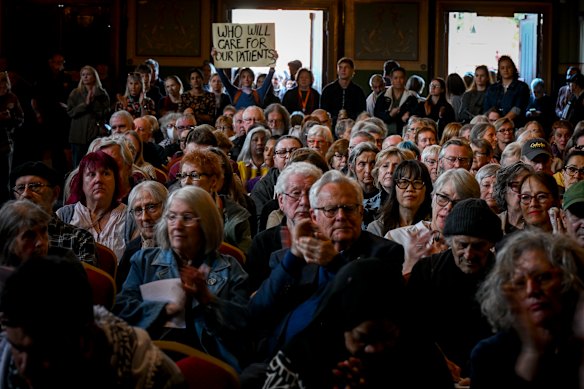
A packed Fitzroy Town Hall on October 24.Credit: Eddie Jim
“AMA Victoria hasn’t been involved in the actions being planned. [But] the message to both state and federal governments is clear: save cohealth and invest in community care for the long term.”
A cohealth spokesperson said the organisation’s highest priority was the health, wellbeing and safety of clients and staff.
“We will continue to support clients through this period and have increased staffing at the clinics to provide information and to help transition their care,” the spokesperson said.
“Our conversations with federal government to advocate for sustainable funding of these complex-care GP services, and for solutions to avoid service closures, have been active and are ongoing.”
Loading
Cohealth’s origins date back to 1889, when it was known as the Collingwood Free Medical Mission Dispensary – the first in the colony of Victoria. It was founded to help the “destitute sick” in what was once a heavily working-class area. Today, cohealth is accessible to all Victorians, but still prioritises those who are at increased risk of chronic poor health such as refugees, Indigenous people, family violence victims, former prisoners and rough sleepers.
On Tuesday, Infrastructure Victoria released a report recommending that the Allan government spend billions rebuilding major hospitals and pour extra funds into community health as part of its 30-year strategy.
State Greens MP Gabrielle de Vietri, whose seat takes in Collingwood and Fitzroy, said the report “proves that it’s the state’s responsibility to keep cohealth open”.
A spokesperson for Victorian Health Minister Mary-Anne Thomas declined to say what the state would do if the clinics were occupied, but did say the cohealth board had made it clear that the proposed Collingwood closure had nothing to do with the state’s infrastructure spending.
Coalition health spokeswoman Georgie Crozier said the state government shouldn’t sit on its hands while communities lose access to basic care.
Start the day with a summary of the day’s most important and interesting stories, analysis and insights. Sign up for our Morning Edition newsletter.
Most Viewed in Politics
Loading