3 months ago
11
3 months ago
11
Opinion
November 13, 2025 — 3.31pm
November 13, 2025 — 3.31pm
The Australian government’s rebooted attempt to clip the ticket of the big US platforms that effectively siphon advertising revenue from Australian media companies will become a riveting game of chicken.
Mark Zuckerberg’s Meta, owner of Facebook, WhatsApp and Instagram, who has been fighting contributing to Australian publishers’ coffers, in particular is likely to deploy any number of tactics to avoid paying local media companies for their news content.
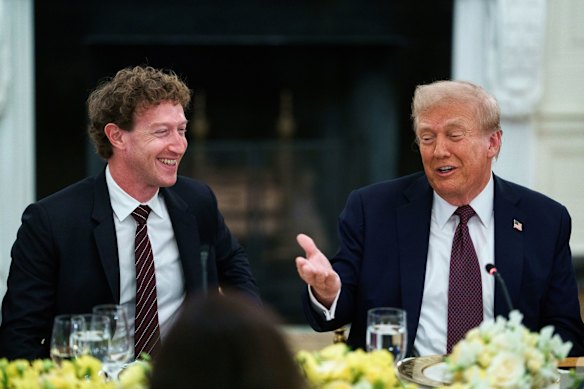
Meta chief executive Mark Zuckerberg wines and dines with Donald Trump.Credit: Bloomberg
The social media giant reluctantly signed up to the first iteration of the government’s News Bargaining Code but refused to extend this into a second term - instead opting out last year.
Zuckerberg’s most obvious manoeuvre to combat the government’s now rebooted platform tax would be to go crying to US President Donald Trump, who has been a particularly strong supporter and protector of America’s Big Tech players against attempts by foreign governments to rein in their power.
Zuckerberg understands very well the leverage of being one of Trump’s tech bro friends. He is one of a number of his ilk whose companies have taken out an insurance policy by donating to the president’s construction of a $US300 million ($459 million) White House ballroom. Others include Jeff Bezos’ Amazon, Tim Cook’s Apple as well as Microsoft and Google.
Loading
For its part, the Australian government is employing a negotiating model with the tech giants. They can strike voluntary deals with the publishers – which would cost Meta an estimated $75 million a year – or face a flat fee payable to the Australian tax office, which in Meta’s case would be more than $112 million. The government refers to this flat fee as an “incentive” as each dollar the tech giants agree to invest in local media partnerships reduces it by $1.50, until it reaches zero.
This is designed to make paying up for news content the most financially attractive option.
And while some of the tech platforms may view this as extortion, it’s for a worthy cause. The government argues that it provides protection and compensation for Australian publishers that spend hundreds of millions of dollars a year to produce original news content, which in turn is vital to a functioning democracy.
Treasury estimated 30 deals previously struck by Australian media companies with Google and Meta were worth about $200 million to $250 million a year. Meta’s abandoning the code after three years is estimated to have cost hundreds of journalist jobs.
The idea is that the government is stepping in to address the asymmetric power imbalance between companies such as Nine Entertainment (which owns this masthead) and these international behemoths, who in the case of Google parent Alphabet and Meta have sharemarket capitalisations of $US3.5 trillion and $US1.5 trillion, respectively.
Loading
It is noteworthy that the other major tech platform that signed up to the original bargaining code, Google, has continued with payments since the code’s introduction in 2021.
The proposed new law known as the Media Bargaining Incentive will capture social media and search platforms with Australian-derived revenue of at least $250 million, irrespective of whether they carry news content, according to details released by the assistant treasurer, Daniel Mulino.
Other companies snared by the legislation could include TikTok owner ByteDance, while Apple and Microsoft could be captured with their Apple News and LinkedIn platforms, respectively, if they meet the Australian revenue threshold.
The legislation has been sitting on the government backburner since the start of the year, but has reemerged since the bilateral trade talks between Anthony Albanese and Trump.
Loading
While some Australian media companies were hoping Trump would have sympathy for foreign media businesses and their economic challenges in the face of America’s big tech platforms, the US president has shown little public regard for the media in the US or offshore; it has been more like disdain. He has recently threatened to sue the BBC and is seeking damages of $US10 billion from Rupert Murdoch’s The Wall Street Journal.
Over the past three years, he has also taken legal action against CNN, the American Broadcasting Company and CBS.
Trump’s recent chumminess with Albanese could be put to the test.
The Business Briefing newsletter delivers major stories, exclusive coverage and expert opinion. Sign up to get it every weekday morning.
Most Viewed in Business
Loading