3 months ago
16
3 months ago
16
Lucy GilderBBC Verify in Washington DC

 Getty Images
Several legal experts have told BBC Verify that the second strike on an alleged Venezuelan drug boat by the US military was probably illegal, and would likely be considered an extrajudicial killing under international law.
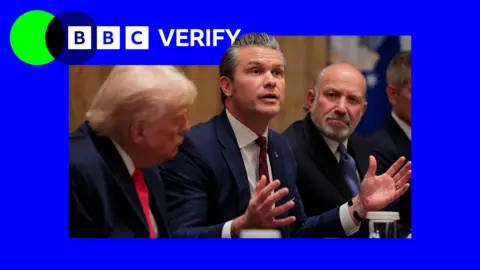
On Monday, the Trump administration confirmed that a follow-up strike on the boat - which has been criticised as a "double tap" - was ordered by US Navy Admiral Frank Bradley with the overall operation having been authorised by War Secretary Pete Hegseth.
Nine people died in the first strike on the vessel and two survivors were left clinging to the burning wreckage when it was struck again, killing them, according to the Washington Post. A US official has said four missiles were used in the operation.
The Trump administration has not denied there were survivors and has insisted the strikes on 2 September were "in accordance with the law of armed conflict".
What has the Trump administration said about the strike?
President Donald Trump posted what appeared to be footage of the first strike on 2 September, on his Truth Social platform. The 29-second clip purports to show the first attack from two different angles although the images are not clear.
The president has since indicated he would have "no problem" with footage of the follow-up strike being published.
Two months later, the Washington Post reported that Hegseth had directed the US military to "kill everybody" on board the boat during the operation. The second strike was carried out to comply with Hegseth's original command, the outlet reported.
Hegseth described that news report about the strikes as "fake news" on X.
On 1 December, after confirming there had been a second strike, White House Press Secretary Karoline Leavitt told reporters that the operation was carried out "to ensure the boat was destroyed and the threat of narco terrorists to the United States was completely eliminated".
Leavitt also said that Admiral Bradley "worked well within his authority and the law".
During a televised cabinet meeting the day after, Hegseth indicated the boat was already badly damaged by the initial blast.
"I did not personally see survivors […] that thing was on fire. It was exploded. And fire and smoke, you can't see anything," he said.
According to the BBC's US partner CBS News, Admiral Bradley was expected to say in a closed door briefing to Congress on Thursday that the survivors were attempting to climb back onto the boat before it was hit a second time.
Democratic Representative Jim Himes, who attended the meeting, told reporters that footage of the second strike showed that the survivors, while carrying drugs, were "not in the position to continue their mission in any way".
Himes also said that Bradley denied that there had been a "kill them all" order, CBS reported.
What do legal experts say about the strike?
BBC Verify has previously spoken with legal experts about US strikes on alleged drug vessels, who have said the Trump administration may have been acting illegally under international law.
This time we asked experts specifically about the legality of the second strike on 2 September.
Jessica Peake, director of the International and Comparative Law Program at UCLA, described the operation as "extrajudicial killings, in violation of international law".
The US has described its operations in the Caribbean as a "non-international armed conflict" with alleged drug traffickers. This is a type of conflict involving one or more non-State armed groups.
"The US is not in an international armed conflict with Venezuela, nor is the US in a non-international armed conflict with any criminal gang or drug cartels", says Ms Peake.
She says even if the US was involved in this type of conflict and the first attack was legal, "it would be illegal to strike a second time as 'denial of quarter' [leaving no survivors] is prohibited under customary international law".
Prof Luke Moffett, a law professor at Queen's University Belfast, told us: "These strikes are not part of an armed conflict, so they cannot amount to war crimes. If there was an armed conflict, the ordering of 'no quarter' would be a war crime under international law."
 EPA/Shutterstock
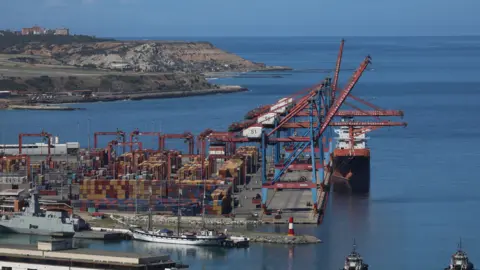
The Trump administration has described its operations in the Caribbean as a "non-international armed conflict" with alleged drug traffickers.
Some conservative analysts, including legal scholar and former Bush administration official John Yoo, have also condemned the second strike.
"If you look at the US law of war manual, which is the definitive interpretation of the way we fight, the laws of armed conflict for the United States, it says clearly that you are not allowed to give orders that say 'no survivors'," he told CNN on Monday.
A line in this manual says it is "prohibited to conduct hostilities on the basis that there shall be no survivors, or to threaten the adversary with the denial of quarter".
We approached other conservative analysts about the legal basis for the follow-up strike, such as Andrés Martínez-Fernández of the Heritage Foundation.
The senior national security analyst told us he does not believe the second strike was illegal, adding "the voices that are loudly accusing the administration of breaking law were notably silent whenever we had drone strikes under the Obama administration, which generated far more casualties than these strikes in Caribbean".
BBC Verify asked the White House which laws would permit the second strike on the boat. It has not published any legal advice it might have received ahead of the operation.
When have 'double tap' strikes been used before?