3 months ago
21
3 months ago
21
We arrive in Coonamble in remote NSW on a Friday night. We know no one. We are confident that, in three months, we will know almost everyone. We head down to the Terminus Hotel, known as “The Termo”. In the packed and noisy beer garden, we meet Scotty, a beefy farmer sporting a big bandage on his foot. Scotty’s doctor said he needed an operation to save the big toe he’d injured on his farm. But that would have meant six weeks off work. So, he told his doctor: “Just cut the thing off”.
Welcome to Coonamble.
We are here to create a piece of theatre with an outfit called Outback Arts. We’ve timed our arrival to coincide with the famous Coonamble Rodeo and Campdraft – the biggest in the Southern Hemisphere. I have never been to a rodeo and I am dead keen. Michael, my husband, predicts I will last 10 minutes, either from boredom or distaste about animal cruelty.
I stayed for three days.
At the rodeo, we began our search to find 20 people who could each tell a three-minute story, on stage, for our show, Hello, Coonamble! The stories could be tragic or hilarious, humiliating or furious – all contributing to a rich tapestry of the district. Each story had to be true. And it must have happened in Coonamble (300 kilometres west of Tamworth). Ideally, each one would be a story about a day when the world changed forever.

The town of Coonamble, home of the famous Coonamble Rodeo and Campdraft.Credit: Courtesy Hannie Rayson
The paddocks across from the rodeo showgrounds were packed with campers and caravans and tents. Four thousand enthusiasts were there, from all over the world. There were hundreds of cowboys and cowgirls. The whole event was ablaze with colour and action.
Then on the Monday, when we took up our seats in the stadium again, Michael squinted at the mounting pen, “Is that a child on that bull?”
Suddenly, the gate swung open and the snorting, bucking creature charged out into the arena. Atop the massive bull was a wobbly little kid.
This was the beginning of our education.
Where we live in Fitzroy, there is a playground being rebuilt behind our house. Caution about child safety is at such a premium, the ground under the swings is now padded. It appears that even a turn on the monkey bars requires two supervising adults.
But here, because life is hard, people value toughness. If only they knew how sooky we are in the big smoke.
Further evidence of my witlessness on the finer points of bull-riding: I just assumed that the rodeo people applied electric shocks to the bull’s or bronco’s balls to make him buck.
Then I met a man called Naka.
He explained that his broncos were like thoroughbred racehorses. He showed me a picture of his horse, Dark and Stormy. “He’s worth over $100,000. You’re hardly gonna mistreat ’im.”
And then he said: “You have trained your horse or your cow to like it. If they don’t like it, they won’t buck. No matter what you do.”
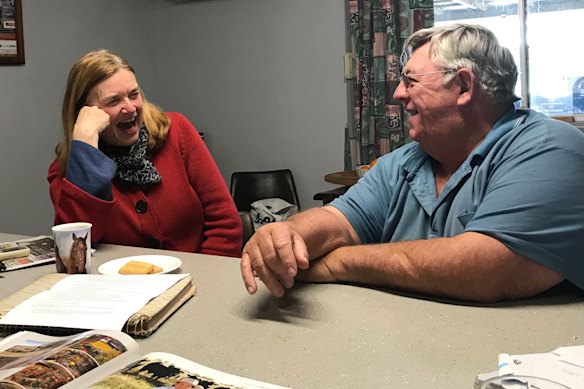
Hannie Rayson with rodeo regular Peter (Naka) Kennedy, who says a bull won’t buck ″if they don’t like it″.Credit: Courtesy Hannie Rayson
Loading
I asked Naka if he would be in our show. To my great surprise and delight, he agreed.
After that, we went to every sporting event, from the rugby to the races. We attended agricultural shows, cattle sales, town meetings, school concerts, poultry competitions, CWA meetings and fundraisers at the bowlo. When locals said they would rather stick pins in their eyes than get up on stage, we sucked it up.
We drove out of town, past fields of bright yellow canola, of swaying wheat, and vast paddocks of grazing cows, meeting farmers, agronomists, vets, environmental activists.
At the Coonamble Jockey Club, we met former champion jockey Dennis “Gooey” Firth. Gooey rode 1499 winners, in an era when the Coonamble racecourse, with its pretty white fences and gracious grandstand, drew huge crowds every week. But now, Gooey told us, “It’s all gone to Dubbo. Once, there would be up to 200 horses on the track every morning. Now they train ’em on treadmills.”
Gooey and his mate, carpet salesman Rick Murray, told us stories of their childhood when every kid had a shanghai or a rifle. Rick’s dad was the local barber and SP bookie.
Then there was Carol Stanley, the town’s courtesy bus driver. This woman should have had her own comedy show: she once started a nightclub in the Coonamble RSL at the age of 76.
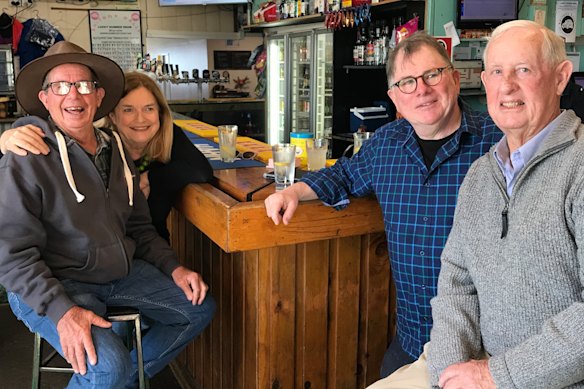
From left, former champion jockey Dennis “Gooey” Firth, Hannie Rayson, Michael Cathcart and carpet salesman Rick Murray. Credit: Courtesy Hannie Rayson
Loading
Uncle Sooty is a Wayilwan elder and artist. He is a member of the stolen generation, removed from his family at the age of four. He returned to Coonamble as an adult and started working with ceramics. He now sells his exquisite pots and vases to the Middle East and America.
Young Indigenous man Patrick began by telling us, “I come from a big family. Half of them are cops. The other half are robbers.” Patrick has seen police racism first-hand – and now he wants to join the force – to help build the momentum towards change.
Gradually, we filled our dance card.
Stories of dust storms, mouse plagues and drought filled our days.
When the drought was at its cruellest, a group of locals organised a ball and called it a rain dance. Groups of farmers met weekly for drought smokos.
We are in love with the way people can make things, fix things, solve problems. We are in awe of their strength.
Loading
Down the road at the town of Armatree, we met a sheep geneticist, Peta Brady, who recently won gold in the International Ice Swimming World Championships, held in Italy. She trained by swimming at dawn in her farm dam – which, in winter, was freezing.
On stage, lit by a stark blue spotlight, Peta said: “People often look at rural life and see barriers. Limited access. Harsh conditions. I see a mindset that’s forged in discomfort, and that’s exactly what makes us powerful.”
For many years, the rodeo man, Naka, ran a rodeo school for local kids. The local cop was very on-side. He helped find kids who were going off the rails and needed help. Naka taught them how to be cowboys. “You’re barking up the wrong tree if you think football or basketball are the answer. A game of footy [he’s talking about rugby league] is only 80 minutes. That means these kids have got all the rest of Saturday to steal a car or smash some windows. At rodeo school you’re at it all day and by nighttime you’re that stiff and sore, you’re ready for bed.”
In the main street, there is an organisation called Literacy for Life, which teaches adults to read. One of the leaders here is an inspiring woman named Sonja Sands. Sonja grew up in Tin Town, a camp that once stood beyond the edge of the town, at the meeting place of the Castlereagh River and the Warrena Creek. Her family – and other Aboriginal families – lived here in dwellings (or what used to be called “humpies”) they’d made from bits of corrugated iron, flattened kerosene tins and bush timber.
Sonja wanted to revive stories of Tin Town and she had organised a get-together of former residents. She invited us to come along – and we sat under the trees – looking across the bush clearing where the houses once stood, and listened as former residents recalled the old times here – with surprising affection. Elders shared memories, mostly fond ones, despite the struggle and the poverty and the discrimination that barred them from living in the town.
The weeks rushed by. We were now working with the storytellers to perfect their stories. We also had a choir, and a brilliant band called Castlereagh Connection. Meanwhile, Outback Theatre for Young People had partnered with us. They arranged for three graduates from NAISDA – the famous Aboriginal dance college – to develop a dance piece with local high school students.
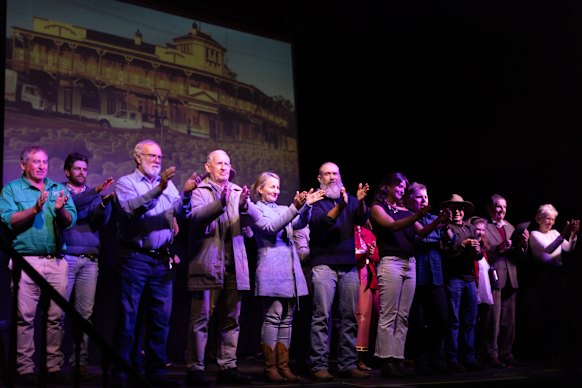
A packed stage at the Plaza Theatre for a night of storytelling in Hello, Coonamble!Credit: Courtesy Hannie Rayson
We staged the show in the art deco Plaza Theatre in the main street. It was built as a cinema in 1930. There are people in town who still remember the years of segregation in this theatre. Whites sat upstairs. Blacks sat downstairs.
And now the theatre is owned by Outback Arts, which is managed by an indomitable woman named Jamie-Lea Trindall. Like her, half the performers in Hello, Coonamble! had First Nations heritage.
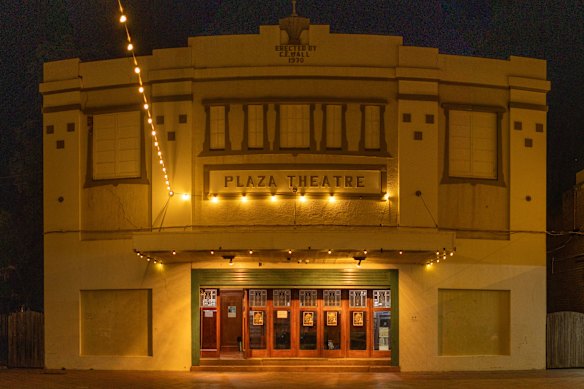
A former Coonamble resident donated $600,000 to renovate the town’s Plaza Theatre.Credit: Courtesy Hannie Rayson
Many of the 43-member cast had never appeared in front of an audience or even spoken publicly before. When Sonja and her mother, May, stood up in that theatre – and recalled the old Tin Town days – they sent shudders through the audience – so clear and so uncluttered were their memories of both good times and horrors. Somehow, they put us all in touch with a truth, a lived knowledge, that was bigger than any political manifesto.
We had full houses over three shows and every storyteller, singer or dancer took those audiences on an emotional rollercoaster. On opening night, after the choir had sung the final anthem, Jamie-Lea Trindall came on stage to make a special announcement. A former resident had donated $600,000 to renovate the Plaza, this historic jewel in the heart of outback NSW.
“It is necessary,” she explained, “to have a place where we can teach our children to perform, where we can continue to tell stories to each other, and celebrate who we are.”
The audience went wild.
Hello, Coonamble! will feature in the new season of ABC’s Back Roads series, screening on iview from March 5.
Must-see movies, interviews and all the latest from the world of film delivered to your inbox. Sign up for our Screening Room newsletter.