3 months ago
36
3 months ago
36
Whether or not that transition comes soon, Harrop is clear about what this moment demands. With global competition intensifying and expectations rising around what a major sporting event should be, the Australian Open, he says, cannot afford to stand still.
By the time the first players take to the court on the first day of the competition, the event will have already set new benchmarks - record crowds through qualifying, a 16 per cent increase to prize money cementing the Australian Open as the second-richest grand slam.

Tennis fans at Melbourne Park this week. Victoria has spent more than $1 billion to secure the Australian Open since 2011.Credit: Eddie Jim
But Harrop, now responsible for Australia’s national tennis body, is keenly aware that such success offers little protection in an increasingly competitive global sporting market where well-funded rivals target major tournaments and the executives who run them.
“No one is immune from global competition, but the heritage of the slams is extremely deep,” Harrop said.
Loading
“But we don’t take anything for granted.”
Harrop, 63, likes a social hit of tennis and first attended the Australian Open in 1988 manning an Adidas stand. While tennis purists may bristle at the tournament’s focus on food, fashion and entertainment, he makes few apologies for its evolution.
In an era of cashed-up disruptors like LIV Golf, tennis grand slams, he says, cannot rely on tradition alone.
The competition, he says, is “very serious”.
“If you look around the world, the investment in sporting infrastructure...in all sports and countries is breathtaking. Sport is the place to be.”
“People want to be engaged in playing sport, watching sport, so a lot of money flows to that and competition keeps getting stiffer.”
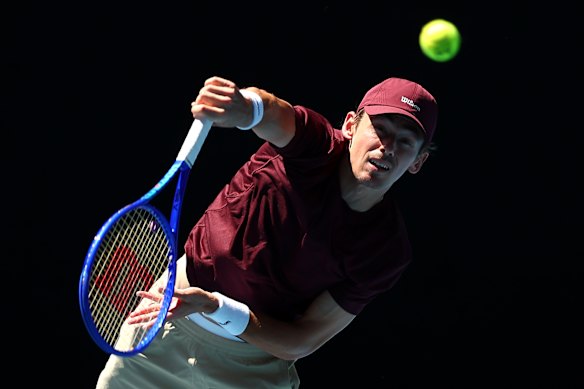
Alex de Minaur trains at Melbourne Park.Credit: Getty Images
“I think the important thing is that we keep pioneering and not copying.”
Once a tennis tournament, the Australian Open is now a cultural festival where headline bands, high-end hospitality and prestige beauty retailer Mecca sit alongside world-class matches.
But if there is one thing that may appease tennis traditionalists, it would be more singles success for local players.
Ash Barty’s 2022 win ended a 44-year drought for Australian women, but Mark Edmondson remains the last local men’s champion, in 1976.

Ash Barty celebrates winning the Australian Open in 2022.Credit: AP
It is a long way from the dominance of the Open era’s early years — and a reminder of what has been missing as the tournament has evolved.
That reality puts renewed focus on Tennis Australia’s role as both event owner and national governing body, responsible for not only organising the Australian Open but also for developing future champions.
Loading
Through its high-performance and pathway programs, TA oversees everything from junior identification to elite coaching. For Harrop, the challenge is ensuring those systems are strong enough to keep Australia’s best young athletes in tennis as competition from rival sports intensifies.
Australia’s top-ranked male player, Alex de Minaur, spent much of his formative development in Spain, while leading young prospect Maya Joint has trained primarily in the United States.
Harrop is confident tennis fans won’t have to wait too long before another Aussie wins their local grand slam, hoping de Minaur will make it to the final weekend of the tournament.
He said Australia’s challenge is not a lack of talent, but keeping elite athletes in the sport as competition from football, basketball and other popular codes intensifies.
“We want more people playing tennis,” he said.
“First, we get them [talented kids] really early. Secondly, you actually give them exposure to competitive matches...not just having a hit. Those kids with real talent like to win.”

Maya Joint switched to Australia from the US.Credit: Getty Images
According to Tennis Australia, participation continues to grow with more than 1.35 million Australians playing tennis in 2024–25, driven by increases in school programs, junior engagement and casual games. Under his chairmanship, Harrop wants tennis to become the most played sport in Australia.
“We’ve got to build the base of the pyramid,” he said.
Loading
Harrop’s push to grow participation and improve facilities is grounded in a belief that access to sporting infrastructure matters. Growing up on a dairy farm on the west coast of New Zealand’s North Island, he was not exposed to elite tennis programs, but his local community hall had a table tennis table.
By the time he was a teenager, he was playing national tournaments.
But elite sport wasn’t his path. After studying business at university in Dunedin, Harrop started working at IBM - where he met his wife - before joining global strategy consulting firm Bain & Company.
His passion, he says, has always been addressing challenges and innovating.
“It’s how do you grow a business that customers just want more of?”
That philosophy now shapes his approach to Tennis Australia.
“I think that’s our reputation as Tennis Australia, as an innovator.
“I am serious when I have an aspiration...for it to be the best event in the world. I don’t see why it can’t be.”
Read more on the Australian Open