2 months ago
17
2 months ago
17
James Massola is right in claiming that Anthony Albanese’s refusal to call a royal commission into the Bondi massacre defies logic (“Albanese’s rigid refusal defies logic”, December 26). Unlike Port Arthur, a lone-wolf attack, Bondi appears to involve potential intelligence failures by federal agencies that a state inquiry may lack the authority to investigate. A NSW commission could struggle to compel federal witnesses testify or examine the nationwide rise in antisemitism highlighted by incidents like the recent Melbourne rabbi’s car firebombing and the synagogue bombings there. Support for a federal inquiry extends far beyond Coalition politics, including a former High Court chief justice, an ex-intelligence chief, a former governor-general and even former Labor MPs. Albanese’s poll numbers, plummeting 15 points, confirm public sentiment. While the Coalition’s rhetoric has sometimes been simplistic, its demand reflects community expectations. Precedents exist: Jacinda Ardern ordered a royal commission after Christchurch, and Albanese himself has pushed for inquiries into robo-debt and banking. A federal royal commission is the appropriate response. John Kempler, Rose Bay
The primary responsibility of any government and prime minister is to keep their citizens safe. As we reflect on the loss of 15 innocent lives at Bondi, it is clear that, in this instance, our government and prime minister have failed us. On behalf of all Australians, it beggars belief as to what could possibly excuse or preclude a full and transparent inquiry to understand how and why this happened and to ensure all possible steps are taken to at least minimise any chance of a recurrence in the future. No matter how long this takes, we owe it to all future Australian generations. Rob Sinclair, North Sydney
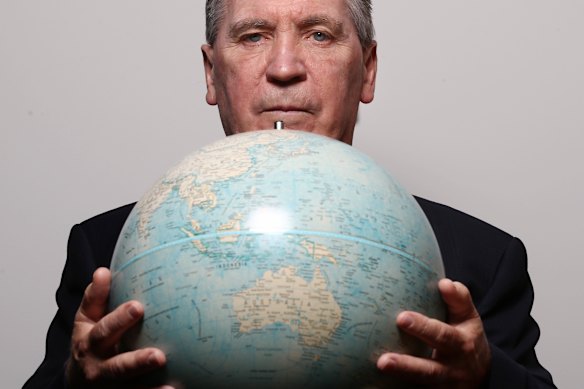
Dennis Richardson Secretary of the Defence Department at the Russell Offices in Canberra on Wednesday 23 March 2016.Credit: : Andrew Meares
Does it have to be one or the other, regarding a review of federal law enforcement and intelligence agencies by former defence secretary Dennis Richardson or a royal commission into the lead-up to and investigation into the awful massacre of Jews at Bondi? The Richardson investigation maybe the shorter one than the royal commission but it could be the more thorough. Have both. Get cracking with the Richardson one while setting up the longer-term royal commission. Sheila Meixner, Yass
Just as James Massola finds Albanese’s response to the Bondi massacre baffling, I find Massola’s article even more puzzling. Albanese’s main objection is that a royal commission would take too long, yet Massola fails to address it. He then correctly says that whereas at Port Arthur there was a lone gunman, in the Bondi case there was a “potentially glaring intelligence failure by security agencies”. Surely, if this is the case, then Dennis Richardson, as a former director general of security, would be the ideal person to carry out such a review. The chief of ASIO, Mike Burgess, has welcomed it, and the report will be made public in April, so do we really want to wait for a royal commission that could take years? Peter Nash, Fairlight
A royal commission would likely have a result in a couple of years. Lawyers would love it and, in the end, the findings would be “an act of pure bastardry committed by a pair of dipsticks”. There you go, I’ve saved the taxpayers $30 million and instantly delivered their verdict. Albanese is too smart for the money-hungry. Wolf Kempa, Lithgow
There is much debate about the implementation of a royal commission into the horrific murder of Jewish people in Bondi. While eschewing the concept of moral equivalence, I note that the Royal Commission into Aboriginal Deaths in Custody commenced in 1987. It investigated 99 deaths and lasted about four years, finding systemic issues and making 339 recommendations to address the appalling over representation of Aboriginal people in the prison/justice system. Since the handing down of the report, there have been more than 600 deaths of Aboriginal deaths in custody. As the numbers of Aboriginal deaths in custody increases, the accountability for those deaths declines, regrettably from an extremely low base. The systemic and personal racism that contribute to those deaths is still ingrained in our society, in our culture. Personally, we all have a responsibility to confront racism, Islamophobia, antisemitism or prejudice based on sexual orientation. Systemically, a royal commission’s recommendations are only as strong and effective as the commitment of governments to implement them. However, it is increasingly obvious that those who have the commitment don’t have the power; those who have the power don’t have the commitment. Graham Fazio, Cootamundra
All assemblies?
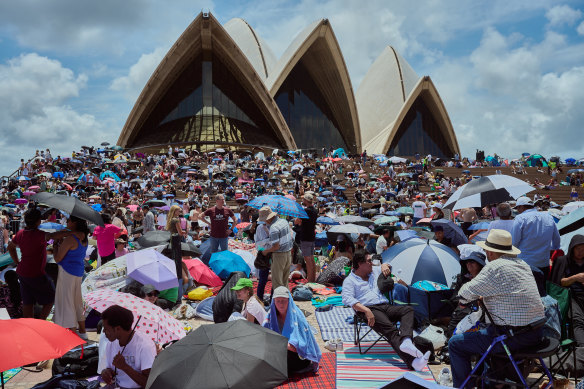
Crowds gathering at Opera House forecourt, ahead of New Year’s Eve celebrations in Sydney on December 31, 2024. Is it goodbye to all that?Credit: Flavio Brancaleone
So, the police commissioner has exercised his new powers to ban public assemblies across Sydney for the next 14 days (“Minns defends snap decision two-week ban on protests”, December 26). I guess no one will be gathering harbourside to watch the New Year’s Eve fireworks then, or going to the fifth Ashes Test at the SCG starting on January 5. Ross Duncan, Potts Point
Violence is born early
Much has been said about gun control for community safety (Letters, December 26). However, American research has found that prolific exposure to violence occurs well before adulthood, at the time when children’s brains are developing. Specifically, pre-schoolers were found to typically see about 10,000 acts of televised cartoon violence each year. Children in year 6 had already seen some 8000 screen murders and, by age 18, young people had witnessed about 200,000 graphic acts of “entertainment” violence. Further, to quote Rudyard Kipling, “Words are the most powerful drug used by mankind”. Harsh and abusive language used towards a child can also adversely affect their developing brain. The negativity may be internalised, shaping the child’s sense of self-worth, with deleterious future repercussions. Such findings indicate that prevention of adult violence needs to start in the earliest years of life, with the healthiest possible developmental conditions. Barbara Chapman, South Yarra (Vic)
I applaud your correspondent for his excellent suggestions and recommendations for more stringent electronic gun control in Australia. His recommendations should not be rocket science to our governments either. They should start in the new year by increasing the police budget tenfold and increasing and encouraging young Australians to join the force by improving wages and conditions. Our police force does an excellent job under very trying and dangerous situations as it is. Llieda Wild, Eastwood
Like smoking, who in 2026 really needs to own any guns? Bill Sheaffe, Caniaba
Recognition in tragedy
Bondi Beach exemplified the highest Australian values that define us (“PM announces Bondi honours list, Israeli president to visit”, December 26). Many individuals and groups acted as one in response to a declared terrorist attack on the innocents. There were more stars than there are stars to give. A panoply of awards exists to recognise the bravery and courage shown on that Sunday. The Cross of Valour will lead the official honours list now under consideration. Other awards will follow for those equally deserving. Foreign nationals are also eligible. A special case exists to award a Group Bravery Citation to individuals or groups. Mike Fogarty, Weston (ACT)
I nominate Australia’s Jewish community as “Australian of the Year”. If the prime minister won’t break protocol and bring himself to make such a declaration on Australia Day, he should announce the 15 souls who lost their lives on December 14 as joint Australians of the Year. Riley Brown, Bondi Beach
Enough political finger-pointing
As usual, Waleed Aly presents us with a clear picture of our options (“Standing together on shaky ground”, December 26), and that is politicians have got to show leadership and empathy with both sides of the argument. Just promoting your team’s view is not the answer and never will be. All party leaders need to get this message and give us a united and well-thought-out response, or get out of the way and stop damaging our country. The majority of the population agrees on the need for unity, so politicians have to get off their soap boxes and provide it now. Ian Ferrier, Long Jetty
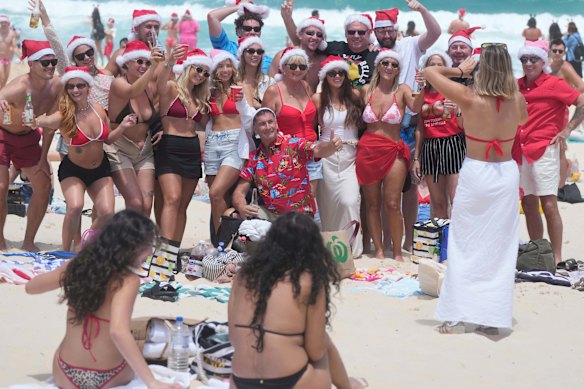
A better Bondi, standing together to celebrate ChristmasCredit: AP
Waleed Aly has a knack of getting to the heart of a matter. “Standing together” seems to mean different things depending on who uses the term. For the desperate-to-be-relevant Coalition, standing together appears to mean blaming Labor, for everything. Labor appears less sure of how to stand together. Bipartisanship appears to be a distant memory. Terrorism has made the ground shaky. While we as a community are trying to come to terms with this criminal Bondi tragedy, we will be better served by fringe politicians saying less. We don’t need finger pointing, we need people who will listen and act appropriately. Whatever type of commission of inquiry we have, its relevance and importance will be determined by whether its recommendations are relevant and whether they will be implemented. Geoff Nilon, Mascot
The article by Waleed Aly provides the best lens through which to view and analyse the Bondi tragedy and the environment in which it has taken place. He espouses putting oneself in the other’s shoes. This is made difficult by the widespread lack of knowledge of the history leading to such strong feelings of the different groups. Extremist views do not arise from nuanced arguments, they are derived from promotion of fear and hate and seeing the other as a lesser form of humanity. Politicians in responding to this complex situation in a positive way could profit from reading Aly’s article. Louise Dolan, Birchgrove
Waleed Aly encapsulates in his brilliant piece all that this country needs now more than ever. Where the politics will fail us, particularly at the federal level and where, in our passion to express ourselves on different sides of debates, we become blind to the humanity in each other. When quiet reflection might help calm and heal, we see more strident cries from many who desire neither calm nor healing. Brenda Kilgore, Red Hill (ACT)
Waleed Aly reminds us that grace is unconditional. Grace is unconditional love and respect. “Grace doesn’t ask whether someone is worthy of empathy.” The people who show grace are those who are grateful for what they have been given unconditionally. We need politicians more grateful for what they have received. Mark Porter, New Lambton
Educate to fight hate
It’s such a pity that the influence of One Nation types of attitudes drove a couple of boneheads to stick up racist slogans at the pharmacy in St Marys (“Community rallies against racist hate”, December 26). Ultimately, it’s education, understanding and compassion that needs to win out or our society will become more and more divided. Tim Herborn, Blackheath
No one should be surprised or shocked any more that a pharmacy at St Marys was targeted with a racist sign by a white supremacist party just because the owner is Asian. But many are and it’s the average Aussie in the street who has either been ignorant about the high level of racism or refused to believe it is a problem and a serious threat to social cohesion. And yet, in the article, the chemist Veronica Nou is noted as having “endured racist attacks for decades”. There are many Veronicas among us who continue to be victims of hate and racist abuse but feel powerless to do anything to stop it. This has been fuelled recently by some politicians with their rhetoric for their own political gain without any repercussions to them and leaving communities to live in fear. Con Vaitsas, Ashbury
No tax to private schools
Reconciling the exorbitant enrolment fees to private schools with the current “crisis in living”, housing costs and general living expenses is beyond mere reckoning (“The elite private schools charging thousands in enrolment fees”, December 26). Families, it appears, are prepared to make sacrifices, but at what cost? And they have not even begun paying fees. This behemoth of an education system in NSW, with its separations of wealth, academic, social and religious ideology, has the potential to tear us all apart. A serious focus into our educational structures, priorities and outcomes should be prioritised to ensure an educational system that functions for all children. Janice Creenaune, Austinmer
Private school enrolment fees are certainly about “enriching” the school experience. It’s hard to justify those fees without a castle shaped library or a performing arts centre to show parents what their money buys. Be honest, elite private schools are in the business of selling status and privilege, indistinguishable from expensive handbags or luxury cars. Michael Berg, Randwick
We mark the days of our lives with seasonal events such as the first sighting of a hot cross bun, the start of the NRL season, the first call of a koel or a front page story in the Herald about the cost of private school fees. I don’t care how much they charge, only that if they can raise vast sums through application fees alone, then they don’t need my taxes to add to their coffers. They aren’t exclusive because of unique pedagogical insight but simply because they’re expensive. John Bailey, Canterbury
Rock ‘n’ roll with e-bikes
Good luck to your correspondent (Letters, December 26) standing firm against e-bikes. Within the parameters of respectful behaviour there’s a possibility your suggestion might work; its absence is the prompt for your “take back” tactic in the first place. Expecting to reason with the unreasonable is as commendable as knowing section 150 of the NSW Road Rules Act 2014. I suspect, however, that both would be cold comfort in a hospital bed. Suzanne Saunders, Wadeville
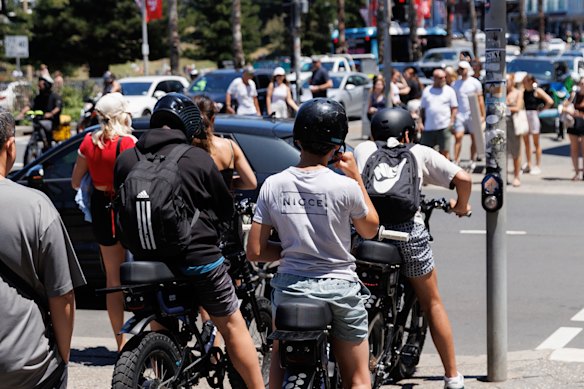
E-bikes in the beachside Sydney suburb of Bondi: Know where, or if, you standCredit: Max Mason-Hubers
Just this week I was walking with a friend on a footpath in Barangaroo when a group of young men on e-bikes came riding along the path towards us. I flung myself to the side to let them go past, but my friend just kept walking the same line and they swerved around her. She’s decided to make a stance that she won’t be intimidated by them. It was very rock ′n’ roll. Lisa Clarke, Watsons Bay
Welcoming strangers
Barney Zwartz (“The essence of Christmas: Welcome stranger”, smh.com.au, December 25) is correct to an extent, and he is right to group all three monotheistic religions together in this context. Except that such a welcoming attitude to “strangers” is not the province of the monotheistic religions alone. It’s been a cross-cultural thing going back millennia, since well before the development of Judaism, the original monotheistic religion covered by Zwartz. It dates from the time – well ahead of the “monotheistic” religions – when societies began to fragment as their members began to relocate to find new, more bountiful locations to live (the first migrants). They were the original “strangers”, and the locals as they passed – probably “migrants” themselves – habitually felt an obligation to take them in along the way, perhaps because none of them knew when they themselves might be back on the road themselves. Paul Ellercamp, Forster
Well may our political leaders call for calm and express longing for world peace in these troubled times, but when religious beliefs are part of the mix, they are blowing in the wind. Consider if you will the tried-and-true conclusions of notable philosophers on this subject. Sigmund Freud diagnosed religion as a neurotic illusion. Christopher Hitchens maintained religion poisons everything. Bertrand Russell stated that undoubtedly religious beliefs can lead to cruelty and perpetuate inhumanities. Richard Dawkins was on the money when he concluded: “When one person suffers from a delusion it is called insanity. When many people suffer from a delusion, it is called religion.” I have long concluded that if it were possible to remove religion from the equation, then, and only then, could we embark on a pathway to world peace. Joy Nason, Mona Vale
Too hot for Christmas
Your correspondent (Letters, December 24) wishes to move Christmas to a cooler time of year. During my travels many decades ago, I met a European woman who was astonished to learn that December-February were summer months in Australia. She declared that this was unthinkable and that we should rename our months. Anne Sowey, Dover Heights
PINned by anger
Please, God, forgive me when I recite the Lord’s Prayer during this holy period. I find myself unable to forgive. I feel nothing but anger towards the person who thought it was a good idea to use one-time PIN codes to “confirm identity”, and even more anger toward those who decided to impose this system on everyone, everywhere. Mokhles Sidden, South Strathfield
Buns for peace

They’re back!Credit: Jennifer Soo
After the most fraught and challenging day of year comes our reward: hot cross buns are back in season! Peter Fyfe, Enmore
- To submit a letter to the Sydney Morning Herald, email [email protected]. Click here for tips on how to submit letters.
- The Opinion newsletter is a weekly wrap of views that will challenge, champion and inform. Sign up here.