3 months ago
9
3 months ago
9
Nearly 10 years ago, on a cloudy and stuffy afternoon at North Byron Parklands, Stu Mackenzie and the many-headed musical hydra known as King Gizzard & the Lizard Wizard strode on stage at Splendour in the Grass. Without so much as a nod to the rabid collection of fans that had gathered at the front of the stage, the band blasted off into Robot Stop, the opener of their recently released album Nonagon Infinity.
For the next hour, it was on. The band’s eighth album, Nonagon Infinity was conceived as an infinite loop, designed to be played straight through (and on and on, if the band felt like it) with no pause for breath. The proggy psych-rock ricocheted around the amphitheatre as the band tore through the album in a sweaty frenzy, Mackenzie hurtling around the stage between deploying peels of distortion from his guitar.
The band raced to the finish line as the hour ticked down. Finally, spectacularly, as the very last minute of their allotted set rolled around, they flew out of closing track Road Train and back into the opening bars of Robot Stop. The loop was completed. The crowd went wild. Welcome to the Gizzverse.
It was one of the most memorable sets of those Splendour years, and it’s but a small example of why King Gizzard & the Lizard Wizard have become one of Australia’s most beloved rock exports of the last decade. Certainly they are our most prolific, having released a dizzying 27 studio albums since their debut 12 Bar Bruise landed in 2012.
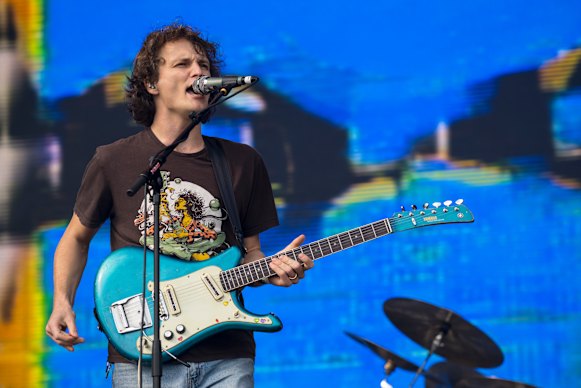
King Gizzard frontman Stu Mackenzie onstage in Paris last year.Credit: Getty Images
But saying King Gizzard is prolific is a bit like saying Cristiano Ronaldo is handy with a football: it doesn’t exactly capture the full picture. Across those 27 records, the band – comprising Stu Mackenzie, Joey Walker, Michael Cavanagh, Lucas Harwood, Cook Craig, and Ambrose Kenny-Smith – has relentlessly shape-shifted, each album an exercise in excavating their musical obsessions. Among their releases is a metal record about the climate apocalypse (Infest the Rats’ Nest), a dream-pop flirtation (Butterfly 3000), a looping synth record (The Silver Cord), and not one but three albums dedicated to exploring microtones (Flying Microtonal Banana, K.G, and L.W).
You could fall into the aforementioned infinite loop of Nonagon Infinity, or explore the seven different musical scales as dissected in Ice, Death, Planets, Lungs, Mushrooms and Lava (the first letters of each word correspond with one of the scales). They released five albums in 2017 and repeated the feat in 2022. On top of all this, there are the dozens (and dozens) of live recordings that the band throws online for their rapt fan base. If you woke up tomorrow as a new King Gizzard fan, you’d have years of material to dig through.
Their fans (known as the Weirdo Swarm) follow them from show to show, Grateful Dead-style, picking apart new releases in Reddit forums, sharing bootlegs, and designing unauthorised merch (something the band enthusiastically encourages). The band goes on the road for months at a time, clocking up marathon sets that can run for three hours and feature such diversions as Mackenzie shaving his head on stage, running into rivers, and fans sitting down and “rowing” in the crowd. After hundreds of shows and a decade on the road, Mackenzie has come to know many in the Weirdo Swarm.
“There are a lot of [fans] that I would know by first-name basis,” Mackenzie says down the line from his home in Melbourne on a late September evening. “It’s extremely cool. It’s honestly very abstract. When you can talk to people, that’s when it feels real. The bigness of the band or the fan base and all of those things … I’m not sure it’s good for me to think about. It doesn’t actually make me feel good, it just makes me feel like I’m floating in space.
“But I love speaking to people,” he says again, after a pause. “Everybody has a story to tell and that’s when it feels quite magical … and real.”
It’s been more than two years since Australian audiences have had the chance to pinball in a heated King Gizzard mosh or jump into a fake rowboat on the floor, but this December they’ll get their chance again. The band will return to Australian stages for seven shows along the east coast in support of their latest album, the orchestral excursion Phantom Island. They’ll team up with various symphony orchestras in venues including the Sydney Opera House and Melbourne’s Sidney Myer Music Bowl, while also playing a handful of more “traditional” (if such a thing exists with King Gizzard) rock shows.
Phantom Island began life in much the same way as the band’s other albums, with the first sketches of the tracks falling out of sessions while the band were creating another album, 2024’s Flight b741. The songs had potential, Mackenzie and the band thought, but something was missing.
“It felt like we had two separate personalities or identities within the songs and so we split ’em in half,” Mackenzie explains. “We finished b741 and the other half sat there waiting for the spark of inspiration to shock it back into existence and make it wake up and come alive.”
‘Being somewhere that makes you feel shitty about your own art, it’s just not a recipe for making anything.’
Stu Mackenzie on the band’s decision to remove their work from SpotifyThe bolt of inspiration first struck in 2023, when the band met some members of the Los Angeles Philharmonic backstage at the Hollywood Bowl. Eighteen months later, they had the opportunity to play some shows alongside orchestras around the US; suddenly, the band thought about dusting off those old tracks to see if they could find a new life. Mackenzie linked up with British conductor and arranger Chad Kelly, and the two set about trying to align their different musical brains.
Loading
“Certain things were easy and certain things were hard,” Mackenzie admits. “But Chad and I both speak the language of nerd. Our language is completely different, and our context for the way music works and the architecture of music is very different. But we did find a way of talking about all this stuff with each other, and we found our flow maybe more easily than either of us thought we would.”
The pair also bonded (of course) over their shared love of microtones. The resulting album is one of the best in the band’s recent catalogue, the lavish orchestral arrangements breathing life into tracks like the funky, horn-laden Deadstick or the epic rock opera Spacesick. Lonely Cosmos, with its shimmering strings and woodwinds, is a particular highlight. Its off-kilter instrumentation is a favourite of Mackenzie’s as well.
“I always joked with Chad that I’m illiterate and I read rock, but I learnt to read the [orchestra] charts enough,” he laughs. “But if you look at the charts [for Lonely Cosmos], they are written in a strange way where he’s telling the strings players to play a little out of time and a little out of tune with each other. We then had the strings play over themselves and overdub over themselves quite a few times. It just kind of created a cool, three-dimensional atmosphere.”
Creating the tracks in the studio was one thing, bringing them to the stage was another. As previously noted, King Gizzard aren’t the kind to stick to a plan in their live shows, so inserting an entire orchestra into the equation was going to be a challenge. Mackenzie admits everyone is still “figuring it out”, but there’s room in the arrangements for the band to fly off the leash.
“We also have moments where the orchestra can take a moment and we cue them back in. You can actually build in a decent amount of improv,” he says enthusiastically. “We have parts of the charts where we say ‘tenor sax improvise on B flat’.”
Adding to the challenge is that for most of their Phantom Island shows, the band is working with a different orchestra nearly every night. Often their only rehearsal will be at soundcheck a few hours before the show, and usually they’ll only get to run through half the songs.
“Sometimes if we’re very lucky, we play two cities close together,” says Mackenzie. “We can use the same orchestra for two nights, but for the most part they’re rocking up with the charts. A lot of them have had a look, but we’re playing them together for the first time at soundcheck. If we’re very lucky, we get to run over the whole set together. Usually, it’s about half and then the rest you cross your fingers for.
“But they’re really amazing orchestras,” he continues. “They’re just such pros and it does come down in a big part to your conductor and having that person in between band and orchestra who is just so integral in tying it all together.”
You’ll find Phantom Island on most of the usual platforms, but one place you won’t find it – or any of King Gizzard’s music – is Spotify. In July, the band announced they would be removing their entire catalogue from the streaming service in protest of Spotify founder and executive chair Daniel Ek’s investments in the arms industry. Ek and his venture capital firm Prima Materia recently led a 600 million-euro investment in Helsing, a German defence company which specialises in military AI tech. The news sparked enormous backlash, and many artists have since deserted the platform, including British outfit Massive Attack.
“Leaving Spotify felt like a personal decision in most ways, really,” Mackenzie says. “It felt like, ‘Do you know what? We don’t feel good about being here.’ We can only make music under the pretense that it makes us feel good. And being somewhere that makes you feel shitty about your own art, it’s just not a recipe for making anything.
“So it felt like quite a simple equation and all of the other noise around it … it felt secondary to, ‘I personally don’t like this platform because of A, B, and C, well-documented reasons, and I’m just ready to not be here.’ And whatever the consequences may be is fine.”
As for whether Mackenzie sees this as a genuine turning point, he’s unsure. “I don’t know, to be honest,” he says after a pause. “The music industry is always changing. It’s always in flux. It’s always shifting. It always feels radical, it always feels like the whole thing is going to fall apart at all times. I don’t really know what’s going to happen.”
Loading
Shortly after leaving Spotify, the band shared their entire catalogue on the online music store Bandcamp and invited fans to “name their price” – essentially, giving all their music away for free. Within days, the band occupied the first 27 slots on the bestsellers list. A couple of months on, a handful of their records are still in the top 10.
“I think someone who likes analytics would really like to log into our shit right now and have a peek,” Mackenzie laughs, when asked if leaving Spotify might actually be financially beneficial for the band. “Maybe ask in a year, or two years, or maybe 10 years. I think doing stuff like this sets other things in motion that you can’t predict. But that’s exciting to me.”
Album number 27 is in the bag, but in classic King Gizzard fashion, there are many more coming down the pipeline. The band is constantly working on new material – usually a few albums at once – and Stu says they’re in a particularly “experimental” phase at the moment. But after so many albums and concepts and diversions, what is the magical thing that keeps driving them?
“I think that thing has changed over the years, and we have continually found new things and new reasons to do it,” Mackenzie says. “I think that actually is the thing. We feel compelled to do it, and even when it’s hard, you become creative about what the reason is that you have to get together.
“Underscoring all of that is that we are just really good friends. Sometimes we have disagreements, sometimes it’s hard, sometimes it’s a shit day. Sometimes you don’t do anything worthwhile, but we get to do it altogether. We’ve become more grateful for that over the years … and what a privilege that is. I feel compelled to work because I just feel lucky to be here.”
King Gizzard & the Lizard Wizard will perform with the Sydney Symphony Orchestra at the Sydney Opera House on December 2-3; the Queensland Symphony Orchestra at Brisbane’s Princess Theatre on December 9-10; and Orchestra Victoria at Melbourne’s Sidney Myer Music Bowl on December 12. They will also perform rock shows at Sydney’s Enmore Theatre on December 4-5; Brisbane’s Fortitude Music Hall on December 7; and Melbourne’s Sidney Myer Music Bowl on December 13.