3 months ago
16
3 months ago
16
Author Drusilla Modjeska, 78, often writes about artists; Julie Rrap, 75, is an Australian artist who once thought of being a writer. Having shared the picnic rugs of mutual pals for years, the pair finally became friends in 2018.
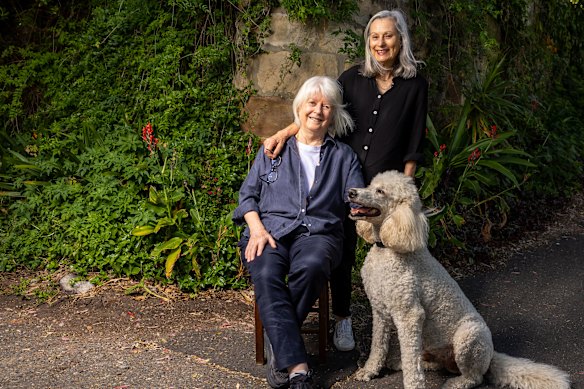
Drusilla Modjeska (left) and Julie Rrap with Julie’s dog, Cirrus. Drusilla calls the poodle “her gentleman caller”.Credit: Sam Mooy
Julie: When Drusilla embarked on her latest book [A Woman’s Eye, Her Art], a friend suggested we meet up to discuss my practice and her writing. We just started having these very wide-ranging conversations: art, politics, the need to keep reasserting the position of women. At some point, we began going for fish and chips at the local pub. Then we started getting takeaway so my dog, Cirrus, could be included. Drusilla is in love with Cirrus. He is the only dog allowed on her couch; she gives him tiny pieces of cheese. She calls him her gentleman caller.
The thing about Drusilla is that she’s a slow reveal. She appears to be this lovely, benign character; very gentle. But there’s also a mystery to her; she’s quite mischievous and stealthy. I remember inviting her to dinner with a bunch of artist friends and, afterwards, they all realised they’d revealed things to her that, actually, the rest of us didn’t even know. She’d got all this information out of everyone, but so gently no one was aware of it. It was fascinating.
The same thing applies to her writing. She’s pretty masterful; she knows exactly what she’s doing, what she wants to convey. But she’s always saying, “Oh, I’m just a mouse. I don’t speak up.” One day I said to her, “You are not a mouse. Stop saying that: you’re f---ing lying! I’ve seen you be a lion.” Now, we joke that she’s the mouse that roars.
‘Drusilla’s a slow reveal. She appears to be this lovely, benign character. But …’
Julie RrapWe’ve actually had very similar paths in life. Both our parents separated at a time when people really didn’t do that; until I met Drusilla, I was always the only person of my generation that I knew of whose parents had split up. Neither of us had children, but we both have nieces we’re very attached to. Both of us have had plenty of boyfriends and done all that, and now we find ourselves living on our own. We often discuss that: it’s great to control the TV and stay out all night, but who’s got your back? I think we’ve probably been a bit of a comfort to one another in that sense. We’ve even talked about how if we’re sick of living in our places, maybe we could get two apartments in a block. We won’t, but it’s interesting that we talk about it.
Drusilla always says that the last thing her family could ever have imagined was her becoming a writer. And the last thing my family would’ve ever thought of is me being an artist. Even though my mum went to art school and my brother is an artist, when I started making art, it wasn’t taken seriously. Both Drusilla and I invented our own lives. I always say that to her: we have nothing to regret.
[Becoming friends in your 70s isn’t] like in your 20s when you want everything to be dramatic and neurotic and interesting. We’ve both lived through lots of dramas, so that’s not where we’re at. Actually, lately we’ve been having lots of conversations about death. The other night we were talking about dying and I said to Drusilla, “I reckon if we were having this conversation 30 years ago, it’d be exactly the same, but we’d be talking about sex.” And we both just cracked up laughing.
Drusilla: I’ve known Julie from around the traps for forever. Sometimes I think, why on Earth didn’t we realise we should be friends two decades ago? On the other hand, it has been very wonderful, at this juncture in life, to suddenly find her.
She was the catalyst for the book. I’d been thinking about it for 20 years, then one day, when we were just getting to know each other, we met for tea and I came home and thought, “F--- it, this is happening now.” And I wrote the beginning that day.
Julie’s practice is to ask the same questions as women artists have always asked: what is it to be free – to escape the male gaze? As a young artist, Julie was super-beautiful – she’s still gorgeous – so she caught the male gaze: she couldn’t get away from it. So how do you push back?
She’s very clever – she did a double major in English literature at university – but she’s also just great fun to hang out with. We both really need a wife and a chef, but given we don’t have either, fish and chips is very important. Cirrus gets very grumpy if we leave him outside the pub, so we started coming back to my place and he comes in and lies on the couch and has his cheese. He really is almost human.
The similarities of our lives are quite extraordinary. As five-year-olds – her in northern NSW, me in Hampshire in the UK – we were both obsessed with being ballerinas. It’s funny we both started there – we were terrible dancers! – but we were very imaginative, so maybe that was it. And then – I don’t mean to be boastful – but we are both quite clever, and we were both incredibly lucky that we had
access to free education. And then we haven’t had children, but we both have these nieces who greatly enrich our lives. I think we both feel we would’ve been awful mothers, but we like to think we’re pretty good aunts.
Loading
We’re in touch a lot. If Julie didn’t answer a text within the day, I’d be dead worried. Actually, we’ve been talking about how we must get keys to each other’s houses. We each have other people with keys, too, but if Julie couldn’t get out of the bath, I’d certainly want to be there. And if anything happened to me, I would want Julie. She’s the sort of person you want if there’s a real crisis.
There’s not anything I couldn’t talk to her about. We came into our adulthoods in the ’70s, out there marching for progress: we thought we were gaining ground we couldn’t lose. But now, I think we’ve realised we’re in a battle that can flow back against us at any moment. Julie is a comfort – knowing she feels the same way. There’s a wonderful word that one of the artists in my book uses about a very, very important friend: she calls her a “sister soul”. We found each other late, but I do feel that Julie and I kind of are sister souls.
To read more from Good Weekend magazine, visit our page at The Sydney Morning Herald, The Age and Brisbane Times.
Most Viewed in National
Loading