3 months ago
18
3 months ago
18
Australians want decisive action to repair social cohesion and confront antisemitism, but a new Resolve poll shows most voters remain unimpressed by the Albanese government’s response to the Bondi terror attack.
The latest Resolve Political Monitor, conducted for this masthead, finds voter support for banning extremist Islamic organisations, stronger hate speech laws and tougher immigration screening to identify antisemitic views remains above 70 per cent.
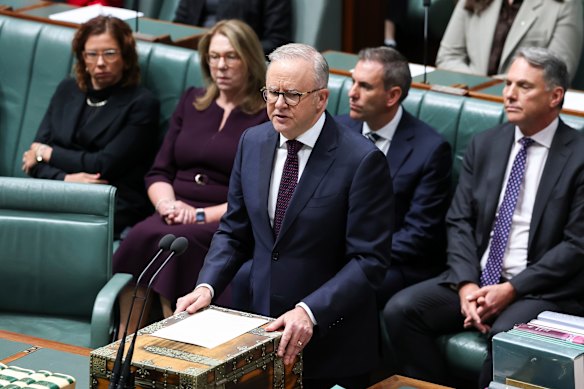
Prime Minister Anthony Albanese gives a speech on the Bondi attack on Monday.Credit: Alex Ellinghausen
Support for a federal royal commission into antisemitism also rose sharply since late December, climbing 13 points to 61 per cent, with the majority across all party demographics – Labor, Liberal, Nationals, Greens, One Nation and independent voters – believing it was necessary.
A notable finding is that while most people back a national inquiry, the majority of respondents (71 per cent) would have preferred its scope to examine all forms of racism, rather than focusing solely on antisemitism.
The increased support comes amid heightened community concern about rising tensions following the Bondi terror attack in December, where 15 people were killed at a Hanukkah celebration, and ongoing debate over the government’s proposed hate speech and gun law reforms. Parliament returned on Monday to hear condolence motions for the Bondi victims, while debate for the legislation will be held on Tuesday.
Support for banning extremist Islamic organisations has jumped from 72 per cent to 81 per cent in just a few weeks, while 80 per cent now want tougher immigration measures to weed out those with antisemitic or extremist views.
Support for action on hate speech remains strong in principle (73 per cent) but the poll also reveals unease about how such laws would operate in practice.
There is softer support for anti-vilification laws than there was in late December – dropping from 66 per cent to 63 per cent. This suggests people are wary of the potential impact on free expression and the risk of unintended consequences once new powers are enforced. However, support remains 14 points higher than in May 2024.
Loading
“This headline reaction to a generic proposition needs to be pitted against the real-world repercussions, real or potential, of policing free speech,” said Resolve director Jim Reed. “Where do we all agree to draw the line?”
Half of Australians (51 per cent) support compulsory holocaust education in schools, while 56 per cent believe pro-Palestine marches should be banned.
But despite Prime Minister Anthony Albanese’s decision to introduce new laws and call a federal royal commission following weeks of resistance, confidence in the government’s handling of the issue remains weak.
Just 37 per cent of respondents rate social cohesion in Australia as good, while only 29 per cent believe the government’s response has been strong. Fewer still – 32 per cent – say the prime minister’s response has been good, placing him behind NSW Premier Chris Minns and Opposition Leader Sussan Ley on the same measure.
The poll of 1800 voters was conducted between January 12 and 16. It has a margin of error of 2.3 percentage points.
Reed said voters were signalling a clear hierarchy of concerns, with antisemitism seen as the most immediate threat even as broader anxieties about racism persist.
“There are broader social cohesion issues to be considered here, but voters recognise that antisemitism is the immediate one. That’s why we find increasing support for a raft of measures to tackle it,” Reed said.
Loading
The poll suggests voters broadly support most of the government’s proposed responses despite fierce political fighting, largely reaffirming attitudes recorded in December, including backing for tougher hate speech laws and measures aimed at preventing extremist violence.
However, there are signs of growing caution, particularly on gun reform, where opposition has edged up since the end of last year.
The number of voters who want to toughen gun laws dropped 10 percentage points from 76 per cent to 66 per cent in a few weeks, as both One Nation and the National Party took strong stances opposing change.
But support remained strong for restricting gun licences (73 per cent), limiting the number of guns an individual can own (81 per cent), tougher regulation on high-powered guns (84 per cent), placing time limits on license (82 per cent) and creating a national database so they can be tracked (86 per cent).
“Most Australians still see the need for gun reforms, but One Nation seems to have enabled and picked up a growing minority who think this might be a distraction that affects their freedoms. This is one of those policies that’s not a vote winner, but can lose you some vote on the margins,” Reed said.
About half (49 per cent) of voters believe preventing crime generally should be the number one priority of governments, with 45 per cent saying the priority needed to be on preventing terrorism and terrorist attacks.
Most Viewed in Politics
Loading