3 months ago
84
3 months ago
84
 Image source, Getty Images
Auckland FC were A-League champions in 2025 but, because Australia compete in the Asian Football Confederation and New Zealand in the Oceania Football Confederation, had to pass up a spot in the AFC Champions League Elite
ByAlex Bysouth
BBC Sport Senior Journalist
Eight clubs, seven countries and an opportunity to face the world's best for the winner.
A trailblazing new competition kicks off in Oceania this weekend - but could a similar cross-border league follow in Europe?
The OFC Professional League contains two clubs from New Zealand and one each from Australia, Fiji, Papua New Guinea, the Solomon Islands, Tahiti and Vanuatu.
It will be the first professional league in Oceania since Australia switched to the Asian Football Confederation in 2006, meaning the winners will qualify for Fifa's annual Intercontinental Cup - pitting the champions of each confederation together - and the expanded Club World Cup.
The first round of fixtures begin at Auckland's 50,000-seater Eden Park from 17 January, with four more venues hosting stages before a play-off in May.
OFC Professional League head Stuart Larman says there is huge support for football across the region and expects to see crowds of more than 10,000 in Fiji and the Solomon Islands.
The confederation is paying for flights, accommodation and transportation to help sides focus on developing their squads, brand and role in the community.
The hope, of course, is that the competition flourishes.
"A lot of things have to fall in place before I think we're ready to expand," says Larman. "But certainly the dream is to get to a larger number of clubs.
"The success of the league will depend on strength of the clubs - so all have strong community links or ingrained community involvement.
"That's going to be key for them to have financial success, with big portfolios of commercial partners and a strong team off the pitch which is then generating a lot of money to invest in the first team and youth programmes."
It could also prove a scouting haven - a previously untapped pool of players who now have pathways into the professional game and a competitive environment in which to develop.
"People will be surprised at the quality," adds Larman.
"The best players in each country are going to get 17 highly competitive matches guaranteed - that is going to be an enormous jump, because more regular, highly competitive football always improves the quality of a player."
 Image source, OFC Media via Phototek
Vanuatu international Jordy Tasip will represent the newly formed Vanuatu United in the OFC Pro League - they will join New Zealand's Auckland FC and South Island United, South Melbourne (Australia), Bula FC (Fiji), PNG Hekari (Papua New Guinea), Solomon Kings (Solomon Islands) and Tahiti United
Could this happen in Europe?
Maksims Krivunecs starts with a disclaimer - he is not the biggest fan of cross-border leagues, although he is the man trying to pioneer one.
"I feel it is a necessity," says Krivunecs, president of Latvia's top-flight Virsliga, who is proposing a 'Baltic League' he hopes would also include Estonia and Lithuania.
Independent analysis has backed up Krivunecs' "quite worrying" evaluation that the Virsliga is struggling to keep pace with Europe's top 30 leagues.
"The domestic broadcasting deal is the main fuel for any league in the world to develop clubs, the league and the interest for the competition and unfortunately we have zero broadcasting deal," he says.
"We're very limited with resources. We don't have a big sponsorship market."
With Latvian football also competing with ice hockey and basketball for fans' attention, clubs largely rely on savvy transfers and passionate investors - which is why many have only been formed or reformed in the past 10 to 15 years.
"In this kind of environment you cannot even plan ahead for multiple years," says Krivunecs. "Because if something happens with the investors' main business, the first thing to disappear is support to the clubs.
"We all want to build clubs with communities, that have a heritage, history, because that's how you make the product."
Krivunecs has had to be innovative in trying to develop that "product" and generate interest - fantasy football, statistics, quizzes, predictions, full licensing on Football Manager. He has looked into streaming games on YouTube and collaborating with influencers on Twitch and TikTok.
But his biggest play is the cross-border Baltic League - one he believes would generate revenue, develop players and help clubs grow on the European circuit.
It is not a completely original prospect, there have been iterations before including between 2007 and 2011, but not in this format.
"The cross-border would allow us to create more competitive games," says Krivunecs, highlighting the difference in strength between the top and bottom Virsliga clubs. Indeed, RFS beat Ajax in the Europa League last year.
"We created the roadmap - a common structure, common product, common distribution and marketing."
How would a Baltic League work?
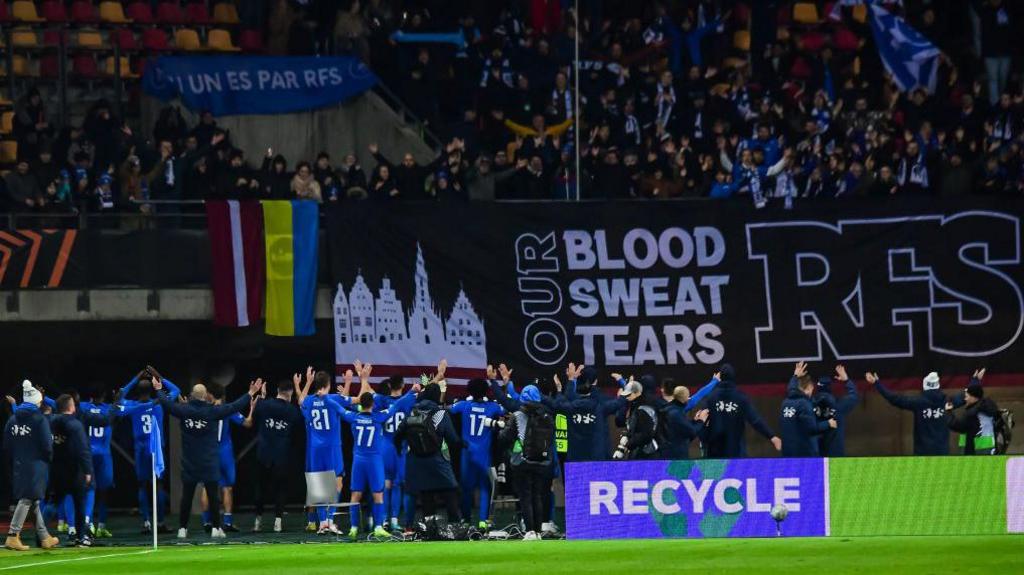 Image source, Getty Images
Krivunecs projects a Baltic League would have the commercial potential to generate around 5m euros a season
Clubs in Latvia's 10-team top flight currently play each other four times. A Baltic League would see that reduced to single home and away fixtures before the top four split to face the corresponding finishers from Lithuania and Estonia.
Carrying over points earned against the other three clubs from their country in the first half of the season, Latvia's four would then face those from Lithuania and Estonia home and away to establish each country's champion, runner-up and so on.
Such a format is important for each nation to keep their current Uefa competitions places - if the leagues were to merge completely, those would be reduced.
An overall Baltic League winner would be crowned, however, earning additional prize money.
The bottom six in each country, meanwhile, would compete to decide who is relegated and who goes into a play-off for a European spot against the fourth-best team - effectively guaranteeing each club has something to play for until the end.
"All these games are super important," says Krivunecs. "Only two spots are neutral. And most important is that all games are more or less against a similar [level] opponent."
Krivunecs believes Uefa would consider the feasibility of a cross-border league if the nations involved request it.
He says the project has full support from Latvian clubs and authorities, but is yet to fully convince those in Estonia and Lithuania.
"The more we talk, the more we explain, the more information we bring to their clubs, the situation is changing," he adds.
"What I believe is possible is in the next three years to go with the Lithuanian clubs together to show how it could work. And then Estonia could join.
"And with a perfect situation, if we want to maximise the market, maybe in future Finland could join because the level of the football is quite similar there."
Could more leagues combine?
 Image source, Getty Images
Three Canadian teams already play in Major League Soccer, while in 2021 Fifa president Gianni Infantino discussed the idea of also merging with Mexico's Liga MX
A handful of Welsh teams have long featured in the English leagues but other nations have looked into more defined structures in the past decade.
Belgium and the Netherlands commissioned a feasibility study for a proposed 'BeNeLiga' in 2019 - suggesting it could help close the gap on Europe's top five leagues amid fears the Eredivisie and Belgian Pro League were fading.
Proposals for a split-season model were mooted, but in 2022 it was decided there was insufficient Dutch support for the project.
Various proposals for an 'Atlantic League' have also rumbled in the background since the turn of the century, initially including teams from the Netherlands, Belgium, Portugal, Scandinavia and Scotland.
"I have spoken with Ajax, Feyenoord, Porto, Rangers and Celtic. They are interested," former PSV chairman Harry van Raaij told BBC Radio 5 Live in 2000.
European football's governing body responded by revamping the Uefa Cup with a group stage, but proposals - this time including the Republic of Ireland - re-emerged in 2016 as an alternative to the Champions League.
Those plans, however, have gone cold since Celtic said in 2020 they were no longer interested. One figure involved in those talks believes it is unlikely they will be revived, but suggests there could be a future at youth level.
Englishman Larman, now based in Auckland but who previously lived in Japan and has worked on projects in more than 100 countries, says cross-border competition is something he has regularly discussed with colleagues, especially in Asia.
"It made more sense because those countries could not sustain a professional league with a large enough number of teams," he says.
"I always felt that Wales, Northern Ireland and the Republic of Ireland would make sense - they would play their regular season and then the best teams play a final stage.
"They would be much more competitive over time and you get better crowds, it builds the clubs and makes clubs more professional."
Krivunecs adds: "I believe currently the Baltics is the best place for the pilot project. If we show the success of this competition, it might trigger different discussions."