3 months ago
7
3 months ago
7
“It was one of those nights after which we must conduct a headcount of our colleagues at EU Delegation,” Katarina Mathernova, the EU’s ambassador to Ukraine, posted on Facebook. “We are still counting and praying that everyone is alive.”
Loading
EU foreign policy chief Kaja Kallas told Reuters that the corruption scandal was “extremely unfortunate” and said that Kyiv should “take it very seriously”.
Ukraine’s two main anti-corruption agencies, the National Anti-Corruption Bureau and the Specialised Anti-Corruption Prosecutor’s Office, announced the wide-ranging corruption investigation – which could ensnare associates close to Zelensky – during the week.
Over the summer, Zelensky’s office tried and failed to effectively neuter those watchdogs, triggering mass protests in Ukraine and rare public condemnation from Brussels. He eventually backed down from his efforts to curtail the independence of the agencies.
In the scheme described by investigators this week, perpetrators netted about $US100 million ($153 million) in kickbacks from contracts signed by state nuclear energy company Energoatom.
Detectives said some of the contracts were for building structures to protect energy installations as Russian missile strikes have decimated the Ukrainian power grid, leading to electricity outages and cutting off heat as the weather turns cold.
Ukrainian Energy Minister Svitlana Grynchuk and Justice Minister German Galushchenko resigned on Wednesday at the president’s request over the scandal. Tymur Mindich, the president’s former business partner – who was implicated as a central figure in the scheme – has fled the country.
European leaders are now warning Kyiv to pursue a crackdown and demanding answers, even as they offer reassurances that they will keep supporting Ukraine’s defence and developing plans to use frozen Russian assets to do so.
The timing of the revelations, however, hardly could be worse as Zelensky appeals to European supporters for fresh funding. New rules allowing young Ukrainian men not yet subject to the military draft to travel outside the country have also led to a torrent of recent arrivals in European nations.
Loading
Merz said Ukrainians, particularly young men, should “serve in their country” instead of leaving for Germany.
According to Interior Ministry figures, the number of Ukrainian men ages 18 to 22 entering the country rose from 19 per week in mid-August to between 1400 and almost 1800 per week in October.
Ukraine’s promise to curb pervasive corruption is under scrutiny as a condition to secure EU aid and to move forward with its bid to join the bloc.
Since the Trump administration scaled back US support, Zelensky’s European partners have become Ukraine’s chief providers of financial and military aid, and they are brainstorming ways to inject Kyiv with money as it faces a budget crunch. One proposal is to tap the roughly $US200 billion in immobilised Russian sovereign assets, but the effort has faced numerous hurdles.
Ukraine has long struggled with a troubling legacy of corruption dating from the Soviet era and the early years following the Soviet Union’s collapse. Ukrainian citizens have taken to the streets in outrage, including in the Orange Revolution in 2004-2005 and the 2014 Maidan Revolution, to denounce corrupt officials and demand democratic reforms.
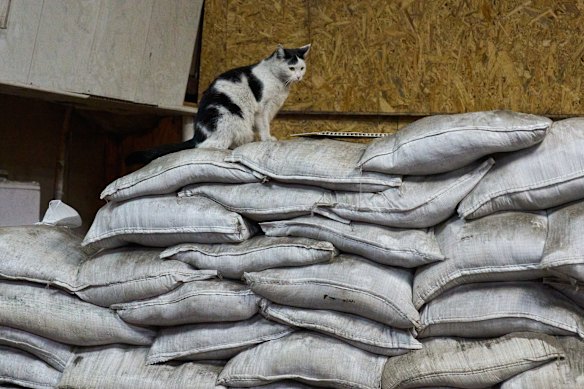
Sandbags protecting a control panel at a damaged power plant, following Russia’s recent missile and drone attacks in an undisclosed location in Ukraine on Thursday.Credit: AP
European officials said they had little choice but to continue supporting Ukraine against Russia’s brutal attacks while simultaneously urging Kyiv to eradicate graft.
Asked if the disclosures had shaken EU confidence, Lithuanian Finance Minister Kristupas Vaitiekunas responded in blunt terms: “Maybe, but what other options do we have?”
Vaitiekunas said Ukraine is fighting “for its own freedom and the right to choose the way they live,” and so “despite the scandal, there are no other options”.
Loading
Since Russia launched its 2022 invasion of its neighbour, the EU and its member states have given more than $US200 billion to Ukraine in financial, humanitarian and military help, including as grants, loans and in-kind support, according to the bloc’s figures.
The EU has previously suspended aid disbursements to Ukraine over stalled reforms, including this summer. Before the latest probe, EU officials pointed to previous corruption concerns and pledged to track all cash disbursements if the bloc gives Ukraine access to the giant stash of Russian money.
European officials have focused on the Russian assets as leaders contend with taxpayer fatigue, economic woes, a US pullback and alarm bells about a Ukrainian budget crisis next year.
But the plan, which Moscow strongly denounces, has deadlocked, largely over reservations about the legal, financial and political risk from Belgium, where most of the frozen money is held.
EU leaders postponed a decision on accessing the money at least until December, as the European Commission tries to address Belgium’s concerns and to develop alternatives to seizing the Russian money.
Commission President Ursula von der Leyen said Thursday that other options include joint borrowing backed by the EU budget or an agreement for nations to “raise the necessary capital by themselves”.
EU diplomats say the commission is floating the idea that member states dig into their pockets as a way of pressing the message that using the immobilised funds is the easiest approach.
“It’s completely fair to discuss all the consequences of doing something, but it’s important to remember that the consequences of not doing something, of Europe failing Ukraine, will also have an impact,” Danish Economy Minister Stephanie Lose told reporters.
“We don’t grow money on trees,” Lose said. “It’s also a reflection of how difficult it is to find viable options.”
The embezzlement scandal in Ukraine, however, has provided ammunition to sceptics of European aid for Kyiv, chief among them Hungary’s Kremlin-friendly prime minister, Viktor Orban, who has sought to block both EU funding and membership for Ukraine.
“A wartime mafia network with countless ties to President Zelensky has been exposed,” Orban posted on social media. “This is the chaos into which the Brusselian elite want to pour European taxpayers’ money.”
US critics of financial support for Ukraine also have often cited the issue of corruption.
As part of the country’s EU accession bid, Ukrainian authorities should commit to improving how they oversee state-owned enterprises and public procurement, said Mercier, the commission’s spokesman for EU enlargement.
He said Kyiv also needs to build a solid track record of enforcement, “in particular as concerns high-level corruption cases”.
Joining the EU, the world’s biggest trading bloc, takes years and is contingent on the EU monitoring governance, anti-corruption and other reforms.
In reports on the progress of candidate countries, the commission this month praised Ukraine for advancing reforms in wartime, but it also warned of “limited progress” on combating corruption.
Washington Post
Get a note directly from our foreign correspondents on what’s making headlines around the world. Sign up for our weekly What in the World newsletter.