The United Kingdom and Norway are forming an alliance to "hunt Russian submarines" and protect communication lines in the North Atlantic Ocean, as part of a new defense agreement between the two countries, the U.K. government announced on Thursday.
The agreement will see the British and Norwegian navies work side-by-side. Central to the deal is a new joint fleet of anti-submarine warships — in response to a 30% increase in the presence of Russian ships in U.K. waters over the last two years, according to the U.K.'s announcement. The fleet includes eight British vessels and at least five Norwegian vessels.
"At this time of profound global instability, as more Russian ships are being detected in our waters, we must work with international partners to protect our national security," U.K. Prime Minister Keir Starmer said in a statement. "This historic agreement with Norway strengthens our ability to protect our borders and the critical infrastructure our nations depend on."
John Healey, the U.K.'s head of defense, said the pact, called the Lunna House Agreement, will allow the two countries to "patrol the North Atlantic as one, train together in the Arctic, and develop the advanced equipment that will keep our citizens safe now and into the future."
Healey and Tore Sandvik, the head of defense in Norway, signed the agreement in London on Thursday.
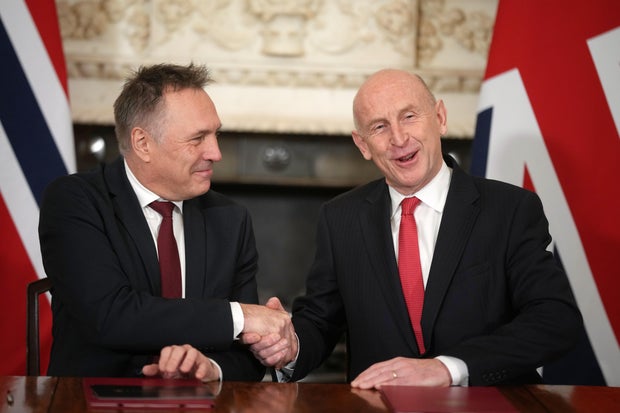 Norway's Minister of Defence Tore O. Sandvik, left, and Britain's Secretary of State for Defense John Healey shake hands during the signing of a strategic defence agreement in Downing Street in London, Dec. 4, 2025.
Alastair Grant/AP
Norway's Minister of Defence Tore O. Sandvik, left, and Britain's Secretary of State for Defense John Healey shake hands during the signing of a strategic defence agreement in Downing Street in London, Dec. 4, 2025.
Alastair Grant/AP
The naval alliance will mainly patrol an important maritime region between Greenland, Iceland and the U.K., and monitor the area for Russian activity, the U.K. government said. In addition to surveillance, the fleet will be tasked with defending the U.K.'s underwater cables and pipelines, which are responsible for overseas communications as well as electricity and gas transports and are located in that portion of the North Atlantic.
"The agreement provides for closer integration between Norwegian and British forces, cooperation on frigates, and joint drone projects in the High North," said Norway's ministry of defense.
With the agreement, British forces will also have a larger role in Norway's defense with heightened presence and more training of British Royal Marines in Norway.
"Both navies will operate as one – sharing maintenance facilities, technology and equipment to create truly interchangeable forces able to deploy rapidly wherever needed," the U.K.'s announcement said.
The announcement came as air crews were tracking Russian vessels operating in U.K. waters, including the Russian intelligence ship Yantar, which was detected several weeks ago at the edge of U.K. maritime territory just north of Scotland, according to British officials.
Starmer welcomed Norwegian leader Jonas Støre to the U.K. on Thursday, convening at an air force base in northern Scotland. Starmer said at the base that the U.K. must "remain vigilant to the ever-present threat" that Russia poses to the country, BBC News reported.