3 months ago
26
3 months ago
26
Washington: The United Nations Security Council has approved US President Donald Trump’s peace plan for Gaza, paving the way for an international security force to enter the beleaguered Palestinian territory, as well as the formation of a governing Board of Peace
Thirteen countries on the Security Council supported the plan, while two permanent members - Russia and China – abstained, but did not exercise their veto power. Russia had circulated an alternative proposal, which prompted fears it might have blocked the proposal.
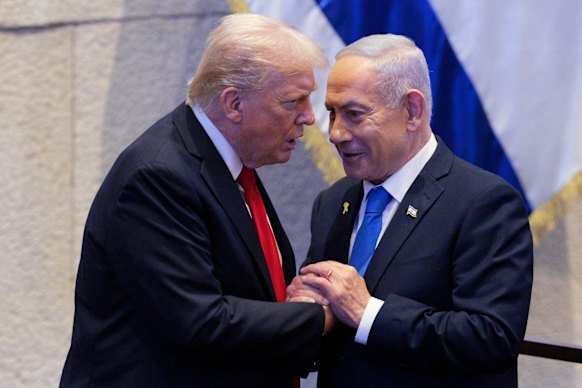
Donald Trump with Benjamin Netanyahu at the Israeli Knesset in October.Credit: AP
Trump commended the result as “one of the biggest approvals in the history of the United Nations” and “a moment of true historic proportion”. He also confirmed he would chair the Board of Peace, whose makeup is otherwise still unknown.
“Congratulations to the World on the incredible Vote of the United Nations Security Council, just moments ago, acknowledging and endorsing the BOARD OF PEACE, which will be chaired by me, and include the most powerful and respected Leaders throughout the World,” he posted shortly after the vote.
The resolution effectively endorsed Trump’s 20-point peace plan unveiled in September, which led to a ceasefire between Israel and Hamas in October, following two years of war prompted by Hamas’s attack on Israel on October 7, 2023.
Arab and other Muslim countries that expressed interest in providing troops for an international stabilisation force had signalled that Security Council authorisation was essential for their participation.
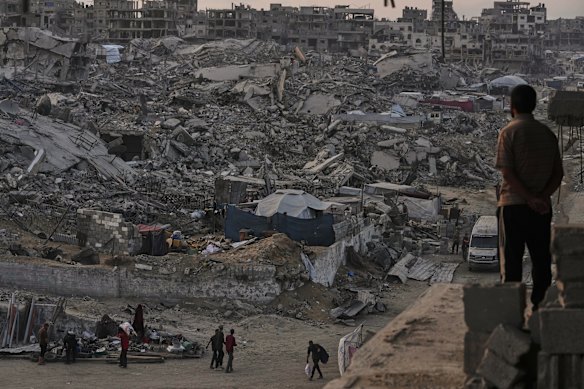
Gaza City on November 11, 2025.Credit: AP
The resolution authorises the force and the Board of Peace, until the end of 2027. It does not stipulate the board’s structure or membership.
The US ambassador to the United Nations, Michael Waltz, thanked the council for supporting a “historic and constructive resolution”, describing Trump’s plan as a “bold pragmatic blueprint” to chart a new course in the Middle East.
During nearly two weeks of negotiations, Arab nations and Palestinians pressed the US to strengthen the original language about Palestinian self-determination.
The US ultimately revised the resolution to say that after the Palestinian Authority – which now governs parts of the West Bank – makes reforms, and after redevelopment of the devastated Gaza Strip advances, “the conditions may finally be in place for a credible pathway to Palestinian self-determination and statehood”.
Loading
The final resolution added: “The United States will establish a dialogue between Israel and the Palestinians to agree on a political horizon for peaceful and prosperous coexistence.”
A statement issued several days ago by the US mission to the UN said the resolution had support from Qatar, Egypt, the United Arab Emirates, Saudi Arabia, Indonesia, Pakistan (which is currently a Security Council member), Jordan, and Turkey.
Waltz said the stabilisation force, which will include troops from Muslim-majority countries such as Indonesia and Azerbaijan, would secure Gaza’s streets, oversee demilitarisation, protect civilians and escort aid through safe corridors.
“This resolution is no mere paper promise; it’s a lifeline … It dismantles Hamas’s grip, it ensures Gaza rises free from terror’s shadow, prosperous and secure,” Waltz said.
“Every day without this [peacekeeping] force, aid trucks lie idle, children starve, and the extremists regroup to try to maintain control.”
with AP
More to come
Get a note directly from our foreign correspondents on what’s making headlines around the world. Sign up for the weekly What in the World newsletter here.
Most Viewed in World
Loading