1 month ago
13
1 month ago
13
Say what you will about this period of insanity in the United States, but it is at least giving us some great movies: Civil War, Eddington, One Battle after Another.
All speak to the sense of a country fragmenting under the pressure of its internal tensions and contradictions, and all are bold, challenging and often brilliant pieces of filmmaking.
A US in freefall has all the vital ingredients for great narrative – conflict, peril, uncertainty, tension. It’s a pity it has such real consequences for hundreds of millions of Americans, not to mention the rest of us, but it makes for terrific viewing.
The big issues are often addressed in American cinema and television obliquely, through metaphor and allegory and myth. The western, superhero movies, film noir – all can be read as Hollywood putting the country’s core beliefs under the microscope. After all, what is the Marvel movies’ mantra “with great power comes great responsibility” if not America reflecting on its self-appointed role as the world’s policeman?
That role, though, has been all but abandoned in Donald Trump’s America. So, too, has the core belief in “truth, justice and the American way”. Those very concepts are now bitterly contested within America. Whose truth? Whose justice? Whose American way?
That contest is at the heart of Paul Thomas Anderson’s One Battle After Another. The worldviews held by the movie’s antagonists are so diametrically opposed that they could almost be describing alternative universes. If the film has a position, it is arguably the sensible centre. But that’s not a view anyone really articulates on screen.
The multicultural left is, quite literally, on the run here from a right with a white supremacist agenda. A shadowy cabal has infiltrated the corridors of power, a highly politicised police force (whose members are dressed like soldiers) is deployed against immigrants and people of colour, and the country teeters on the brink of authoritarian rule.
Anderson starts the story with a lengthy prologue, set 16 years before the main events, in which a leftist group stages attacks against symbols of corporate capitalism, including banks and the electricity grid. “Ghetto” Pat Calhoun (Leonardo DiCaprio) is an explosives expert, his partner Perfidia Beverly Hills (Teyana Taylor) a highly sexual anarchist who crosses a line when she executes someone during a bank heist. She crosses another when she turns informant on her gang after being captured, and yet another when she skips out of witness protection before she can testify.
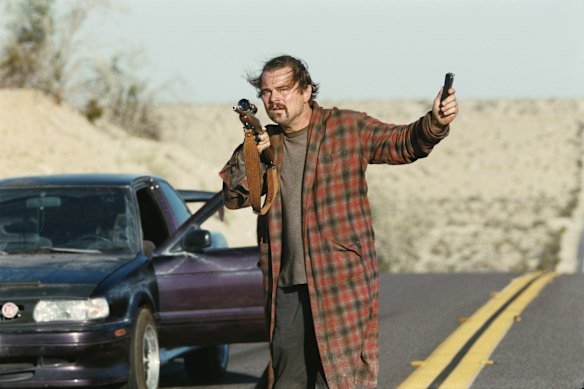
Leonardo DiCaprio as Pat Calhoun’s alter ego Bob Ferguson.Credit: AP
It’s impossible to say if the film is set in the present day, a near-present day, or some time a little further down the line, but its tensions feel entirely of the moment. That is remarkable given the fact Anderson has been working on bringing the story, based on Thomas Pynchon’s 1990 novel Vineland, to screen for 20 years.
What is clear is that the left has been neutered. Sixteen years on from that action-packed opening (whenever it is set), Pat is now living under the guise of Bob Ferguson, a pot-smoking alcoholic recluse bringing up his daughter Willa (the superb Chase Infiniti) in a cabin in the woods, clinging to his ideals but struggling to master their gender identity updates (his wrestling with the appropriate pronouns for one of Willa’s friends is one of the movie’s funniest moments).
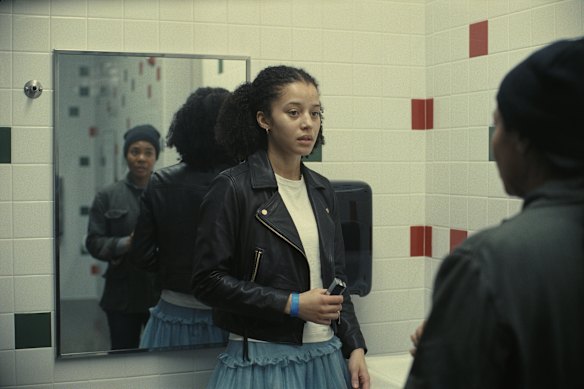
The moment the past catches up with Willa (Chase Infiniti) in One Battle After Another.Credit: Warner Bros
He has raised his daughter to be on alert, to not have a mobile phone (because of the risk of being tracked), to remember at all times the code phrases – mostly derived from Gil Scott-Heron’s 1972 proto hip-hop jazz track The Revolution Will Not Be Televised – with which his former colleagues from the activist group the French 75 will make contact in an emergency.
When the worst happens, though, Bob is a mess. He’s too stoned to remember the passwords, he’s forgotten to charge his 1G phone, and he doesn’t have the time or inclination to change out of his red tartan dressing gown. He goes on the run, initially to save himself but ultimately to save his daughter, with Sean Penn’s tightly coiled Colonel Lockjaw in hot (and often hilarious) pursuit.
One Battle After Another is a comedy, but it’s also a tragedy. It’s about the costs of failed idealism, the burden inherited by the children of the revolution that never came, and about the gulf that has opened between opposing notions of American identity: a give-me-your-poor inclusiveness on one hand, and an only-the-pure white nationalism on the other.
Even at its darkest, though, it’s always funny; even at its most kinetically comical, it’s always serious.
Much the same is true of Ari Aster’s Eddington. A pitch-black satire of America during the COVID pandemic, it tackles conspiracy theories, wellness cults, Antifa, bad-faith actors pretending to be Antifa, and far-right gun culture as it strives to paint an all-encompassing portrait of a country at war with itself.
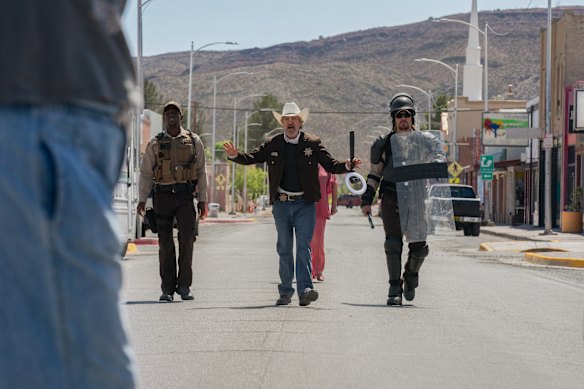
Joaquin Phoenix (centre) is the sheriff who picks and chooses which rules to enforce in Eddington.Credit: A24
Its opposing forces are represented by the sheriff of the small town of Eddington, Joe Cross (Joaquin Phoenix), and its mayor, Ted Garcia (Pedro Pascal). Joe is supposed to uphold the law, but his rejection of mask-wearing mandates is just the first step on a journey down the anti-authoritarian rabbit hole that eventually has him in full vigilante mode. Ted is supposed to make the laws on behalf of the people he represents, but there’s a sneaking suspicion that he might be more interested in lining his own pockets.
As in One Battle …, identity politics play a key role here. Debates about structural racism, white privilege, white guilt and white exceptionalism play out on the streets, on TV, in the mayoral campaign that pits Joe against Ted. The supposedly autonomous indigenous Pueblo community, meanwhile, is marginalised throughout.
Aster’s overall position appears to be that COVID heightened an already existing fragmentation in American society, with isolation and the increasing reliance on social media pushing people further towards the extremities. The sensible centre collapsed, leaving opposing forces unable to agree on even the most basic concepts, and utterly failing to share a common language.
It brings to mind the words of William Butler Yeats’ Second Coming, a short but intensely powerful poem written in 1919, in the aftermath of The Great War and amid the worldwide influenza pandemic that wiped out millions of people.
Things fall apart; the centre cannot hold;
Mere anarchy is loosed upon the world …
The best lack all conviction, while the worst
Are full of passionate intensity …
Those words feel utterly relevant to the present day.
The absence of an agreed truth is at the heart of Alex Garland’s Civil War, too. Here, he literally has truth seekers – journalists, aligned to no cause other than recording, as dispassionately and objectively as possible, the events that are unfolding – in the midst of an attempt to overthrow the president.
They are en route to Washington, hoping to interview the authoritarian right-wing occupant of the Oval Office before he is overthrown by rebels. Their journey takes them through a country torn apart by competing ideologies, belief systems and values. They find themselves facing execution at the hands of a far-right militiaman (a terrifying Jesse Plemons) who judges them un-American.
In all these films, what is being portrayed is the collapse of a common ground, an agreed notion of what a decent society looks like. In Eddington, the chaos serves the interests of shadowy corporate players; in One Battle … (as in TV’s The Handmaid’s Tale), it is the fertile ground out of which a white nationalist theocracy can emerge and seize control. In Civil War, the chaos is merely the state of play, from which order may or may not re-emerge.
There’s not a lot of comfort to be taken from any of these, though there are thrills and laughs to be had. But as portraits of a modern America at war with itself, they each make for incredibly compelling viewing, and they are an invaluable record of a moment of absolute insanity from which we can only hope the country, and the world, will soon emerge.
One Battle After Another is in cinemas now.
Must-see movies, interviews and all the latest from the world of film delivered to your inbox. Sign up for our Screening Room newsletter.