2 months ago
14
2 months ago
14
Sensor Dynamics founder Nick Parker said the technology, which had been trialled for the past 18 months, is further advanced from that used on regional highways in NSW or around Sydney’s Port Botany.
He said that during the trial of the cameras in Melbourne’s inner west, he was shocked at the size and frequency of heavy vehicles using suburban streets. “You have got lovely residential streets with semi-trailers coming down them,” he said. “It is really no good at all.”
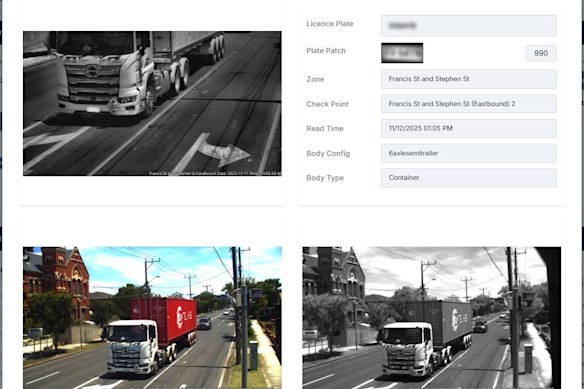
Information about trucks detected by the AI-powered cameras will be accessed by the National Heavy Vehicle Regulator.
Images captured by the cameras will be analysed by roadside AI and transmitted to an Equinix data centre in Melbourne which the National Heavy Vehicle Regulator, the agency responsible for regulating and licensing all vehicles with a mass exceeding 4.5 tonnes, will access through a secure portal.
Parker said information from the cameras would not be uploaded to the cloud or shared with offshore databases.
Loading
While the $10.2 billion tunnel project is the headline-grabbing change to Melbourne’s freight industry and roads in the western suburbs, Horne said the government’s decision to lease 29 hectares of the old Melbourne Markets site on Footscray Road for a truck marshalling and container storage facility would also reduce the amount of driving time trucks spend returning empty containers to the port.
Most of the container trucks which currently rattle through the inner west are loaded with empties.
Horne said the proliferation of 26-metre high-performance freight vehicles (HPFVs) on Melbourne roads and disruption to global freight and logistics caused by the pandemic, as well as how goods are warehoused, had significantly changed the logistics of Melbourne’s freight task from what was envisioned when the tunnel project was first proposed. In 2014, there was just one HPFV registered in Victoria compared to more than 5700 today.
The HPFVs, which weigh more than 68.5 tonnes, are too heavy to use the West Gate Bridge.
Horne said Melbourne’s population growth was adding pressure on to the city’s warehousing capacity, as there was an estimated 4.5 square metres of additional warehousing space required for every new resident.
“You can see that through the volumes coming through the port,” she said. “They had their biggest year last year with 3.2 million TEUs (20-foot equivalent units) and that trajectory is continuing to grow.
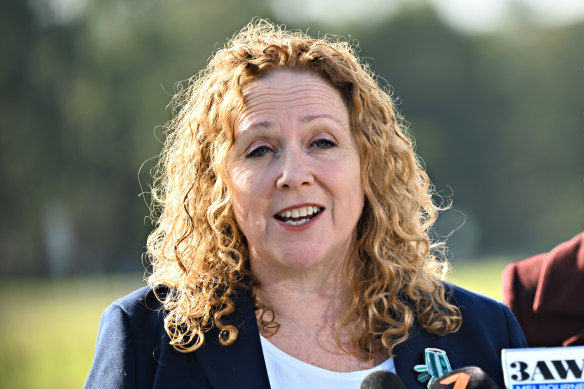
Victorian Ports and Freight Minister Melissa Horne.Credit: Joe Armao
“That is symptomatic not only of our growing city but that disruption that happened in the supply chain. That hasn’t been a Victorian phenomenon. It’s a global phenomenon.”
The idea of a second major road crossing over the Maribyrnong River and dedicated truck routes to the port was first proposed in 2008 by the East-West Link Needs Assessment group chaired by Sir Rod Eddington. In the proposal, daily truck movements in and out of the port were forecast to either double or more than triple from 9000 to between 18,500 and 29,500 by 2035.
The changing nature of Melbourne’s truck fleet to much bigger vehicles capable of taking more containers has meant that, even though the amount of freight coming into the city has steadily grown, the number of daily truck movements is largely unchanged.
The Port of Melbourne, in its soon-to-be published Port Development Strategy for the next 30 years, forecasts truck traffic to and from its docks will grow at between 2 and 3 per cent a year. The government’s most recently published Victorian Freight Plan predicts the freight task to grow faster than the city’s population and more than double between 2020-21 and 2050-51.
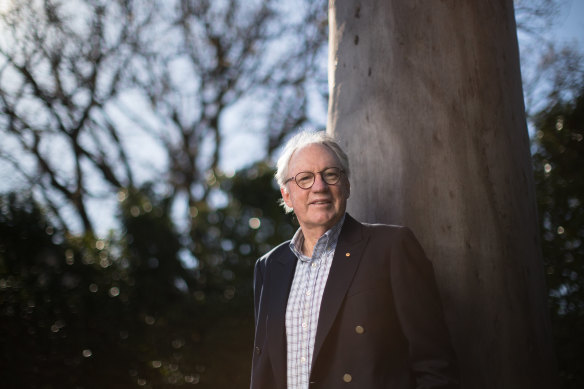
Sir Rod Eddington in 2020. He says the top recommendations to Melbourne’s transport system he made in 2008 have been realised.Credit: Jason South
Eddington said the West Gate Tunnel, despite years of political disagreement about the project, had delivered both the east-west road crossing and key elements of the truck action plan recommended in his report.
When added to the Metro Tunnel, which opened this month, the Regional Rail Link built a decade ago and electrification of the Sunbury rail line, the opening of the West Gate Tunnel means the top five recommendations from the seminal Investing in Transport report have been realised.
Eddington said that eventually, the final piece of the east-west road project – a tunnel connecting City Link and the Eastern Freeway – would need to be built to take pressure of the Domain and Burnley tunnels.
Loading
“If you take the Burnley and Domain tunnels out of Melbourne’s infrastructure tomorrow, the city would be gridlocked,” he said. “The bottom line is, you have got to do north of the city what we have done south. It will improve liveability substantially because it takes traffic away from key parts of metropolitan Melbourne and gives much greater certainty to travel times.”
Horne, when asked whether she agreed, said the picture would become clearer over the next five years once the North-East Link road project was completed, the Beveridge Intermodal Freight Terminal built north of Melbourne and greater rail capacity to the port established.
“Governments into the future will be able to say, ‘What else do we need to do in moving thing around the network?’” she said. “Unless we are doing it efficiently and driving productivity, the city grinds to a halt.