3 months ago
41
3 months ago
41
Scott Pendlebury spent the summer training to be redeployed as a defender, after more than 400 games as a midfielder.
He then spent nearly the whole first quarter of the first game of the new season on the bench before coming on as a forward. He then immediately had a hand in the Magpies’ first three goals.
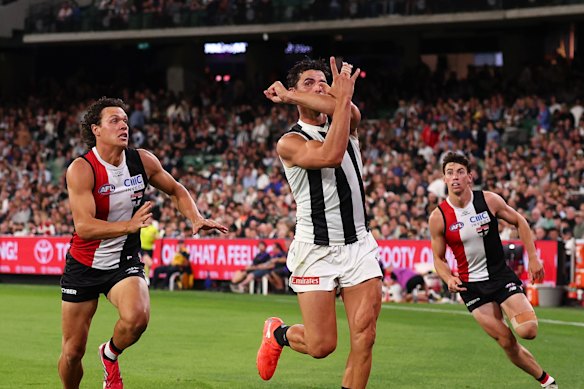
One of the goals the sparingly used veteran Scott Pendlebury set up, this one with a look away handball.Credit: Getty Images
At quarter-time Collingwood’s fitness head Jarrod Wade observed that Jordan De Goey had, according to Craig McRae, “blown up his GPS” running numbers in the first term. So De Goey, a player whose injury history has him now in a permanent state of management, was benched for almost the entire second term.
Pendlebury also sat out 12.5 minutes of the second quarter and finished the game having played just 55 per cent of the match.
When Saints coach Ross Lyon was asked post-match about Pendlebury’s impact, he fussed about with papers of stats as he asked the reporter how many disposals Pendlebury had. He then answered his own question, saying the veteran had just one kick for the first half and drily added that he and his coaches had not spent time discussing him.
Perhaps they should have, for Pendlebury had a career-high five score assists and 10 score involvements.
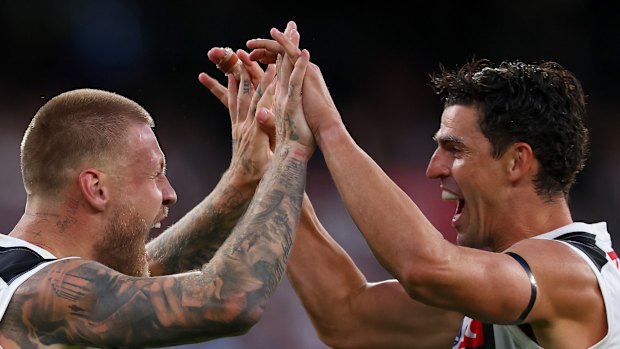
Power play. Jordan De Goey and Scott Pendlebury used to effect off the bench.Credit: Getty Images
In Sydney, in the first match of the season, Tom Papley spent the first 18 minutes and 58 seconds on the bench before crossing the white line. He finished having played 57 per cent game time, and kicking a goal (though it was not exactly an exclusive goalkickers’ club for the Swans on Thursday night).
On Friday night, Jyhe Clark spent even less time on the ground than Pendlebury, just 50 per cent, while the Suns were sparing with midfielder Alex Davies (59 per cent game time) as they tried to maximise their prime midfielders’ time on the ground.
Managing the bench meant most teams took a retro approach and left a defender, normally a key back, on the ground for the entire match to allow the aerobic midfielders to use up their rotations. Billy Frampton, Callum Wilkie, Rory Lobb and Connor Idun all played 100 per cent of game time while Harris Andrews had just a few minutes on the bench (97 per cent of game time).
Hawthorn held Finn Maginness back to 56 per cent game time. The Dogs kept young Jordan Croft off the ground for the last quarter, and he played just 46 per cent of the match though whether that was for form or fitness was uncertain.
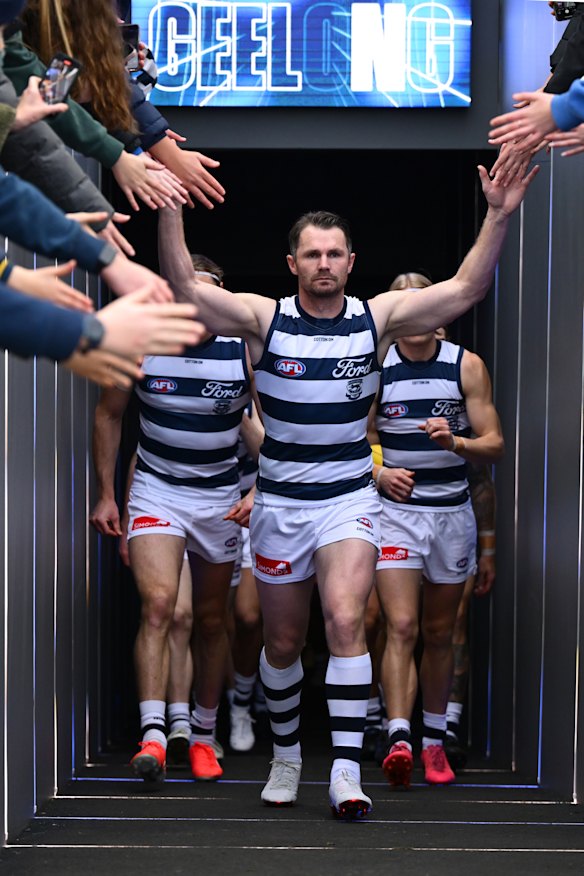
The new expanded bench could help maximise the impact of veterans like Paddy Dangerfield.Credit: Getty Images
Clubs spent the summer debating how to handle the extra player on the bench this season after the AFL dispensed with the sub and just made it a fifth player on the bench who could be used at any time. The AFL did not increase the number of interchange rotations available.
Some coaches took the view that adding the fifth player into rotations would cut into the amount of time the better players spent on the ground. Instead, they treated the fifth player on the bench as the one who would play reduced minutes just as the sub used to, but the advantage this year would be they could pepper those minutes through all four quarters.
That approach favours the older, slower, players like Pendlebury being held back until the heat in the game subsides. It also favours using power players like De Goey in short bursts.
Loading
The change favours using players who are returning from injury or carrying an injury, like Papley on Thursday night, in bursts. It favours a player like Patty Dangerfield, who is both a veteran and a power athlete, being able to come back into the team and be used like Pendlebury/De Goey.
The expanded bench was a subtle but profound change in the opening sample of games.
Players adapted quickly and without rancour to the last disposal out of bounds free kick between the arcs. Without the discretion of an umpire weighing a players’ intent, it made the free kick clear.
Surprisingly, there were slightly more throw-ins on average this opening round compared with last season (37.4 up from 34.1) despite the last disposal between the arcs rule.
While the ruck rule change led to more frees being given at centre bounces and some hesitation and uncertainty among ruckmen, overall the number of ball-ups was way down on last year, from an average of 36 per game to just 22 per game in opening round.
Keep up to date with the best AFL coverage in the country. Sign up for the Real Footy newsletter.
Most Viewed in Sport
Loading