The ongoing U.S.-Israeli strikes and Iran's retaliatory attacks have disrupted flights across the Middle East and beyond as countries in the region closed their airspace.
More than 2,400 flights were canceled Sunday across airports in the Middle East, according to flight tracker FlightAware. Airports in Dubai and Abu Dhabi in the United Arab Emirates, and Qatar's capital, Doha, and Manama in Bahrain were among the airports closed.
Emirates Airlines suspended all flights to and from Dubai until at least Sunday afternoon. The Qatar airport was closed until at least Monday morning, according to Qatar Airways. Israeli airspace also remained closed on Sunday. Israeli airline El Al said it was preparing a recovery effort to bring home Israelis stranded abroad once the airspace reopened.
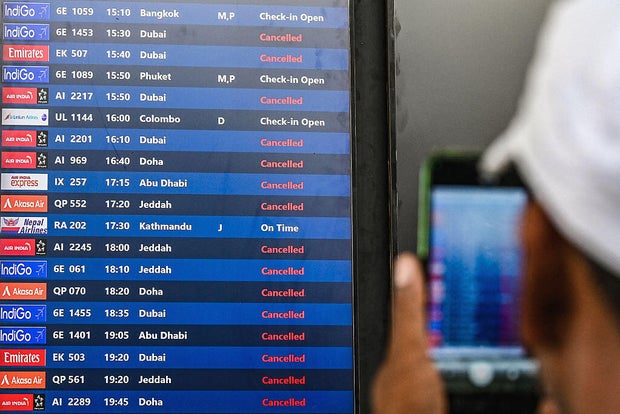 A passenger takes pictures of a flight information board at the Chhatrapati Shivaji Maharaj International Airport in Mumbai after India's two largest private carriers IndiGo and Air India suspended flights to all destinations in the Middle East.
Punit PARANJPE /AFP via Getty Images
A passenger takes pictures of a flight information board at the Chhatrapati Shivaji Maharaj International Airport in Mumbai after India's two largest private carriers IndiGo and Air India suspended flights to all destinations in the Middle East.
Punit PARANJPE /AFP via Getty Images
United Airlines canceled all flights departing the U.S. to Tel Aviv through March 6 as well as their corresponding returns "due to the closure of the airspace in the region." Flights to and from Dubai were canceled through March 4, the airline said Saturday evening.
Emirates, Qatar Airways and Etihad typically have about 90,000 passengers per day crossing through the airport hubs and even more travelers headed to destinations in the Middle East, according to aviation analytics firm Cirium.
"For travelers, there's no way to sugarcoat this," said Henry Harteveldt, an airline industry analyst and president of Atmosphere Research Group. "You should prepare for delays or cancellations for the next few days as these attacks evolve and hopefully end."
Airlines flying over the Middle East will have to reroute flights around the conflict, with many heading south over Saudi Arabia. That will add hours to those flights and consume additional fuel, adding to the costs airlines will have to absorb. So ticket prices could quickly start to increase if the conflict lingers.
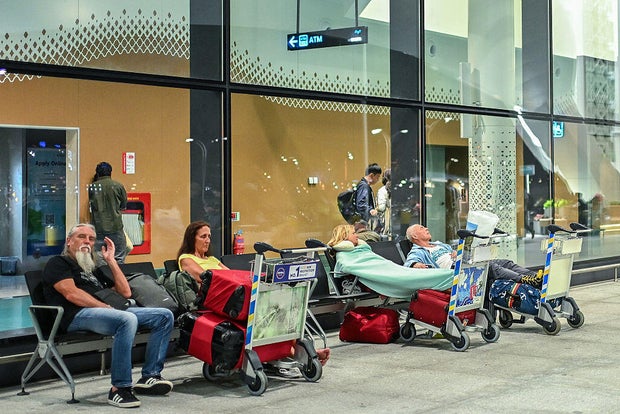 Stranded passengers wait at Velana International Airport in Male on March 1, 2026, after several flights to the Middle East were canceled.
Mohamed Afrah /AFP via Getty Images
Stranded passengers wait at Velana International Airport in Male on March 1, 2026, after several flights to the Middle East were canceled.
Mohamed Afrah /AFP via Getty Images
Mike McCormick, who used to oversee air traffic control for the Federal Aviation Administration, said over the next few days these countries might be able to reopen parts of their airspace once American and Israeli officials share with the airlines where military flights are operating and how capable Iran remains at firing missiles.
"Those countries then will be able to go through and say, OK, we can reopen this portion of our space but we'll keep this portion of our airspace closed," McCormick said. "So I think what we'll see in the next 24 to 36 hours how the use of airspace evolves as the kinetic activity gets more well-defined and as the capability of Iran to actually shoot missiles and create additional risk is diminished due to the attacks."
The situation was changing quickly and airlines urged passengers to check their flight status online before heading to the airport.
Some airlines issued waivers to affected travelers that will allow them to rebook their flight plans without paying extra fees or higher fares.
In:
What we know after U.S., Israel attacks in Iran
What we know after U.S., Israel attacks in Iran
(00:56)