3 months ago
19
3 months ago
19

September 2, 2025 — 5:00am
Seven wonders within Fatehpur Sikri, India
This monumental Mughal capital 37 kilometres outside Agra was founded in 1571 but lasted scant decades. The magnificently mournful ruins are one of India’s most underrated sights.
1 Make a grand entrance through Victory Gateway
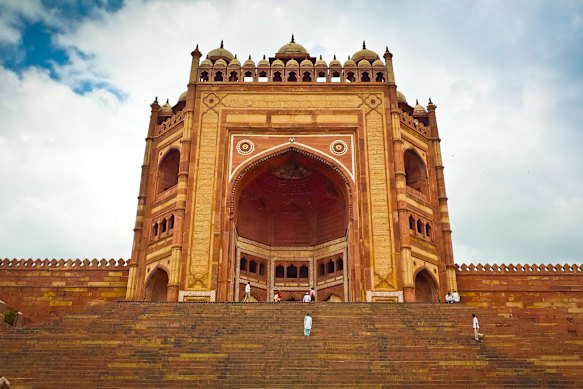
As you lurch out of Agra, dodging cars and camel carts, your first sight of this ruined city is an immense hilltop gateway, one of the world’s biggest, wobbling like a mirage in the heat. Victory Gateway was built in 1602 from red sandstone and white marble to commemorate Emperor Akbar’s military triumphs, although its Persian inscription warns the world doesn’t last. This by itself qualifies as a mighty monument, and the views are splendid.
2 Pause in admiration inside the mosque
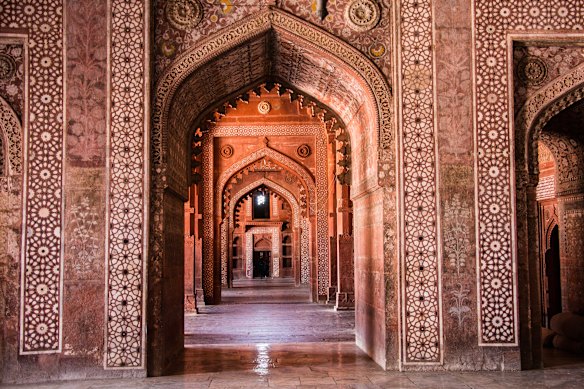
Step through the gateway into the courtyard of the Friday Mosque and you get the first impact of this tremendous ensemble. Everything is built of red sandstone, everything outsized, and yet the decorative detail – window frames, balconies, roof brackets – wonderfully carved. The mosque is one of India’s finest and largest and centres on the tomb of a Sufi, inlaid with mother-of-pearl. Local women come to tie strings on the marble lattice in hope of being granted children.
3 Check out the architecture in the Audience Hall
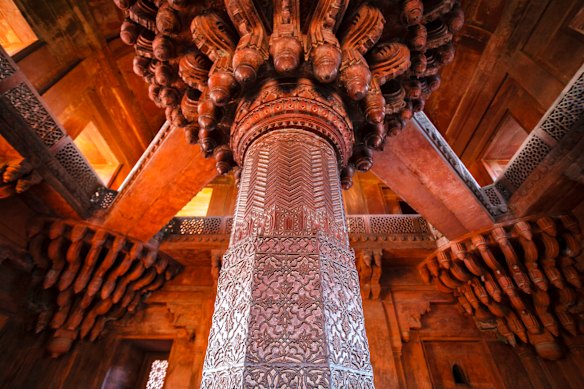
This gloriously startling building in the royal quarter is where Akbar consulted advisers. The Diwan-i-Khas has wall recesses that served as bookshelves for royal documents and texts. However, your eyes will surely be on the enormous and wildly ornate octagonal pillar of the main hall, which rises from the centre of the room like the handle of an umbrella and props up an elevated walkway that resembles the balcony in an opera house.
4 Look up in the Imperial Treasury
Fatehpur Sikri shows wide Hindu, Islamic and Persian influences but this genius building next to the Audience Hall takes inspiration from Jain temple architecture and decorative sculpture. Stone safes are concealed in the walls, but gaze up: the brackets that hold up the ceiling are embellished with mythical elephant-headed sea monsters, said to guard treasures in the depths of the ocean. In the fields behind, don’t miss the odd-looking spiky tower erected in memory of Akbar’s beloved elephant Hiran.
5 Enjoy the faded frescoes in Mariam’s House
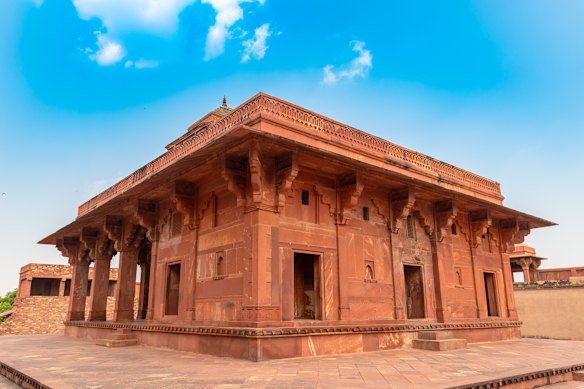
The harem complex has several fine pavilions, some showing Turkish influences and others covered with depictions of swans and horses. The carvings and fretwork are so fine in places you could mistake sandstone for wood. If you’re pressed for time, head straight to Mariam’s House, perhaps the best example. As a bonus, it has bright and sometimes surreal gold-tinted frescoes – look out for the diaphanous woman riding a gigantic parrot.
6 Wander through the other imperial quarters
This is the most impressive part of Fatehpur Sikri, erupting in columns, latticed screens and elaborately decorated architectural elements, and graced with ornamental pools and clipped gardens. Persian verses loop across the emperor’s bedroom or House of Dreams, although judging from his innumerable concubines Akbar spent scant time on sleep. The pool below the elevated kiosk cooled the bedchamber. This is just one of numerous buildings that might take an hour or two to admire.
7 Close your guidebook and get lost
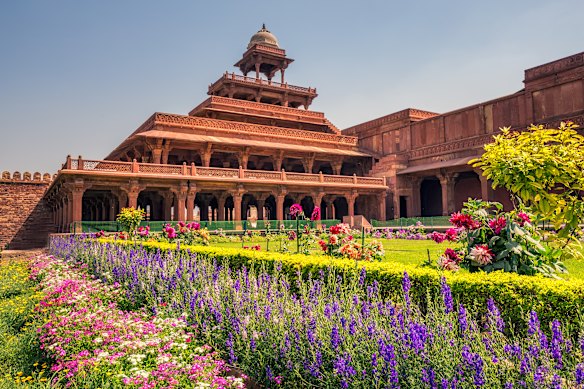
Fatehpur Sikri was planned in the smallest detail: servants’ quarters, lavatory blocks, fountain drainage, masonry rings to hold silk canopies for courtyard shading. Take time to inspect the detail and soak up the melancholy magnificence away from the main visitor axis. Birds wheel overhead and squirrels sun themselves on walls. In the late afternoon the sandstone turns crimson, then orange and subtle pink before the light fades on this abandoned city of lost dreams.
The writer travelled as a guest of Incredible India incredibleindia.gov.in and Malaysia Airlines malaysiaairlines.com
Sign up for the Traveller Deals newsletter
Get exclusive travel deals delivered straight to your inbox. Sign up now.