3 months ago
22
3 months ago
22
This Perth bridge has been named among the nation’s best. So how will it fare in ‘the Oscars of engineering’?
Western Australia is a wonderland for the nation’s leading engineer – but there is one project that made her geek out.
Speaking on a recent trip west, Engineers Australia chief engineer Katherine Richards named the Boorloo Bridge was one of the nation’s best, crediting the project for overcoming major technical hurdles – including Perth’s “extraordinary” winds.
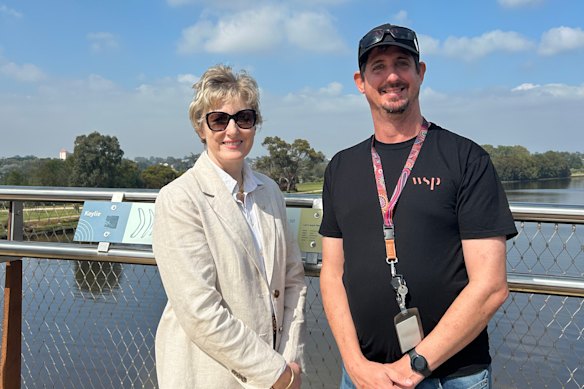
Engineers Australia chief engineer Katherine Richards with WSP bridge modeller Brent Burgess during her recent visit.
“If I can be a bit of a geek for a moment, it’s technically quite challenging to be able to design a structure which met all of those social aspects, but also could deal with the extraordinary wind that comes through Perth, and to be able to deliver it in a way which is sustainable and also represents best practice in construction,” she said.
“The WA engineers did very well.”
Richards, a former Navy admiral, visited the bridge during a recent visit ahead of its entry into the national Engineers Australia excellence awards next week, which she dubs “the Oscars of engineering”.
If it wins, it will mean the second time a West Australian project has won the coveted prize in as many years, after the Fitzroy River Bridge crossing project won Australian Project of the Year in 2024.
“I think the thing about this bridge is that it is the ability to weave in and to be respectful of indigenous input and to carry that through into design. That has not always been the case with our heavy infrastructure across our nation,” Richards said.
“It just goes to show that it’s probably a bridge in more ways than one.”
The bridge pylons were designed using Aboriginal cultural elements, including a boomerang and digging sticks.
It was built by a consortium including WSP, Civmec and Seymour Whyte for a cost of $187 million – $50 million over the original budget.
Loading
It opened in December 2024 and won the WA project of the year, which now pits it against projects like the 460-metre Kangaroo Point Bridge in Brisbane and the Sydney Metro City Line.
When it comes to her favourite project in WA, Richards jokes that she doesn’t want to put the different disciplines off side.
“I need to be very careful in that when I talk to our beautiful roads engineers, they always tell me that a bridge just connects sections of roads and when I talk to our beautiful bridge engineers, they just tell me that roads are what lead you to a bridge,” she said.
WA features eight of the 20 projects on the Australian government’s major projects list with a total cost of about $122 billion, which Richards said made the state one of the most exciting places for engineers.
“I think it is fair to characterise WA, as has often been said, as the home of mega projects, you really are,” she said.
“You’ve got half of Australia’s major projects and all of those projects demand engineers. They demand engineers who can design and create and take things from concept through to delivery.”
But with this activity, she warned engineers were in high demand and, without a sufficient level of engineering in the early stages of these projects, projects were more likely to experience cost blowouts.
“Where the engineer brings most value is in those conceptual stages of projects. It’s in getting the requirements right. It’s in getting the design right. It’s in getting thorough costings. This is where engineers really, really earn their pay,” she said.
STEM uptake dropped from 70.7 per cent in 2019 to 68.9 per cent in November 2024, despite the WA government embarking on a strategy to bring the levels of year 12s studying at least two STEM subjects up to 85 per cent over that same period.
Loading
Richardson warned this was an issue for the state’s infrastructure pipeline.
“We do have declining mass literacy in Australia and Western Australia is no different to the other states and territories in that respect,” she said.
“What we do need to do is see that investment in our maths teachers, and we need to encourage our kids into studying the higher levels of maths, and we need to stop maths being elitist or something just for smart kids.
“We need to say that everybody benefits when they study maths, because it’s the linkage from maths through to the STEM jobs, which are going to grow by about 14.5 per cent in 2026 alone.”
Start the day with a summary of the day’s most important and interesting stories, analysis and insights. Sign up for our Morning Edition newsletter.
Most Viewed in National
Loading