3 months ago
45
3 months ago
45
Grow or die. The logic of capitalism has, under the rule of Peter V’landys, become the logic of rugby league. It explains everything from the big picture initiatives – expansion into Perth and Port Moresby, the Las Vegas adventure, the ceaseless manufacture of hyperbole – to the small-town brawls like the Parramatta-Zac Lomax affair gone bad.
If rugby league doesn’t grow, it faces extinction. But what if that shibboleth of capitalism is just wrong? What if everything that sustains the National Rugby League’s success is local, tribal, even individual? What if its prosperity depends, ultimately, on satisfying a very particular niche? What if its very localism is what fires the imagination of followers and the young elite players who choose it above other sports? What if the endless-growth narrative is an empty ego trip? If we recognised this radical alternative as the truth, would rugby league be any worse off?
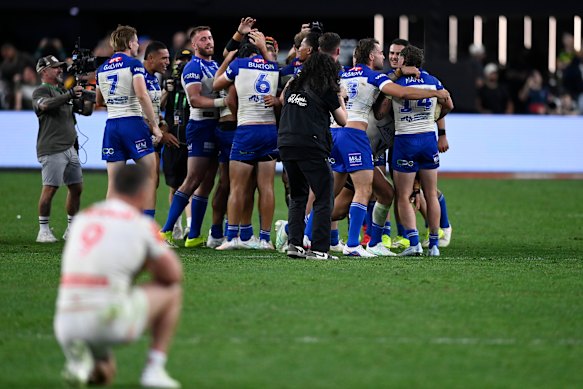
New ground, same rivalry: Canterbury sink the Dragons in Las Vegas.Credit: Getty Images
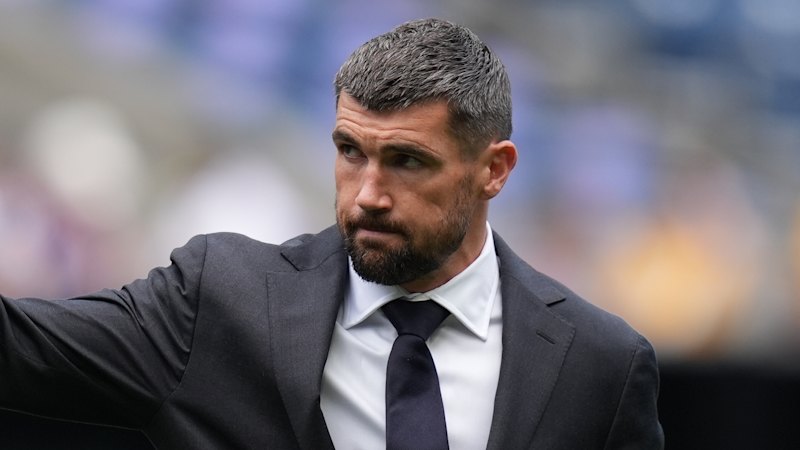
The growth imperative is the subtext for the Lomax saga. The player’s story – Lomax wanted out of St George Illawarra because they were no good, he went to Parramatta until he figured they were no good, he was conned by a fake rugby competition that was definitely no good, and then he tried to get into the Melbourne Storm because they are proven good – is a fable straight out of Aesop.
But the real undertow beneath the Lomax toing and froing is that the NRL will need 60 new potential first-grade players in the next two years as the Perth Bears and PNG Chiefs enter the competition, and it doesn’t want to lose one of Lomax’s quality. It is anxious that it is spreading the talent pool too thinly. From the league’s point of view, a fair outcome would have been for Lomax to strengthen a weaker team for 2026 and then sign with the Bears for 2027.
But here came the collision between the NRL’s grand strategic aims and the blood feuds and individual desires that make the game so compelling. Parramatta, who still feel dudded about losing the 2009 grand final to a Storm club that was cheating the salary cap, didn’t want Lomax to join Melbourne. Friday night’s match shows how right they are.
With Lomax on the wing, the Storm might have won by 70 points and thrown even more salt onto the Eels’ wounds. The weaker clubs who might benefit from having Lomax don’t want him because, with the evidence before them, they doubt his commitment. If his club isn’t doing well, he hasn’t been the type to hang around. Lomax has flirted with switching to rugby union, but would be paid about one-third of what he was getting at Parramatta. The kid’s become a poster boy for bad choices.

Zac Lomax leaves the Supreme Court.Credit: AAP
The result – Lomax goes off and plays rugby somewhere – is exactly what the NRL doesn’t want. It can’t afford to lose talented players at this expansionary moment. Or can it? Maybe it can. Maybe Lomax won’t be missed one iota. Maybe the growth strategy isn’t a tail that can never wag the rugby league dog. Maybe rugby league prospers because there is something structural in the game and the passions it arouses that can survive the loss of individual stars.
Still, the grow-or-die story persists. But it’s not as if the NRL hasn’t expanded before. It’s not as if there aren’t lessons to be flamboyantly ignored.
To exhume the corpses of Super League’s Western Reds and Adelaide Rams for a moment, what we see are a couple of pieces of tinsel to help sell television rights in the 1990s. If games were shown in Perth and Adelaide, the N in the NRL could mean something. The expansionary optimism helped win a few bucks from broadcasters before the Reds and Rams collapsed under the weight of their own fabrication.
Loading
Likewise, the periodic American excursions. Who can forget the 1987 State of Origin match in Los Angeles? Or, to put it another way, who can remember it? The present-day Las Vegas junket is reaching its predictable vanishing point, with even V’Landys admitting that his hopes to penetrate the American sports gambling market may “take a lot longer than we thought it would”.
That is, the one per cent of that market he originally aimed for was a number plucked out of thin air. NRL Las Vegas turns out to be a promotional exercise for rugby league on the eastern seaboard of Australia. Where rugby league lives. Where it thrives. Where it has been a blindingly successful football code for a century. Where it shows no sign of weakening. Where, maybe, just maybe, its future lies. What a revolutionary idea.
The PNG venture, powered by government subsidy, is at least an attempt to deepen rugby league’s existing roots rather than build new ones. Its considerable obstacles are going to be logistical more than emotional. The Perth project will face the same difficulties as the those that killed the Western Reds: cost, distance, and the competitive strength of Australian Rules and rugby union in the west. The primary difficulty for both will be sustaining patience through years of struggle. As Parramatta have shown in the Lomax drama, Sydney clubs will not willingly sacrifice their own interests for the “greater good” of expansion. Why? Oh yeah, they bloody well want to win.
In the push and pull between expansionary dreams and holding faith with the beating heart of a game, one rugby league fact is repeatedly overlooked. “Grow or die” is a generator of economic activity, a slide in a sales pitch, a make-work program for energetic administrations – but in the final wash-up, it’s just an illusion. It might be a useful illusion, but the failure to grow is not an actual existential threat.
Rugby league does so well on the eastern seaboard of Australia because it’s a great spectacle with deep tribal local roots. Its successful expansions have been into existing rugby league territory in Queensland (including Melbourne), the suburbs of Auckland, the ACT and New South Wales. Its ambitions to go broad may satisfy certain egos and help sell media rights, but it has succeeded, and succeeded again, when it has gone deep. As the Moose used to say, put down the glasses. Enjoy what’s right in front of us.
Leave global politics to the denizens of chairmen’s clubs and first-class travel. Occupying a niche market in a tiny faraway corner of the globe is nothing to be ashamed of, and at this pivotal moment in history and technology and the bursting bubble of growth capitalism, niche is nice; experience shows that it’s the best thing rugby league has going for it.
Most Viewed in Sport
Loading