2 months ago
16
2 months ago
16
The Penrith Panthers were for Shaun Mielekamp, like many youths growing up in the Mount Druitt region, a beacon of hope. Even if he rarely watched them play more than 40 minutes of football.
“When I was young I used to love to go to the Penrith Panthers games, but with very little money, I had to wait until the gates opened at half-time,” Mielekamp says.
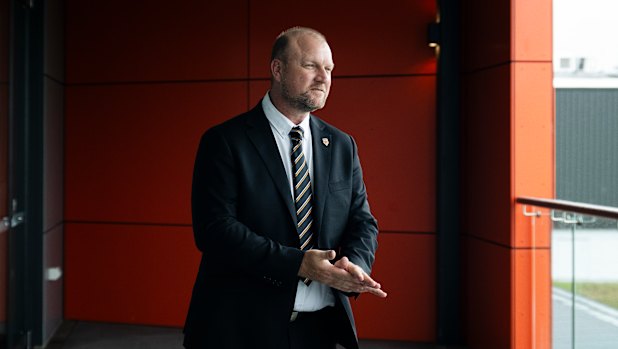
Interim West Tigers CEO Shaun Mielekamp.Credit: Janie Barrett
“So I’d wait until half-time and go catch the back end. That was my safety place at the time … It was a refuge from life.
“I was alone, it was a tough time; domestic violence background, issues at home. I was homeless for a while. It was tough ...
“What sport gave me at a young age, and what it meant to be part of that club, part of that community, sticks with me to this day. It was really a key part of what got me through some tough times.”
It’s often said that sport has the power to change lives. For Mielekamp, who was on Friday appointed as the interim chief executive of Wests Tigers, it’s not a platitude. Which is why he is making good on his promise, in every spare moment since taking over the top job from Shane Richardson, to personally share his blueprint for the Tigers with disgruntled fans.
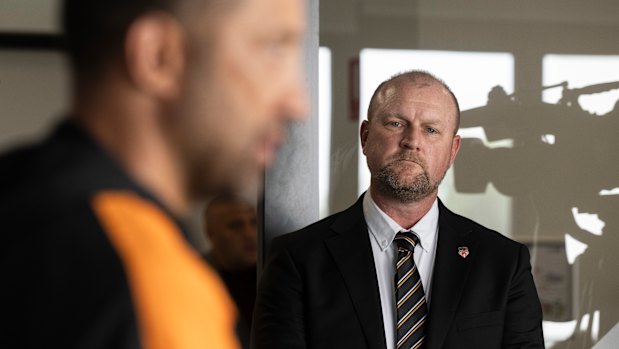
Shaun Mielekamp and Tigers coach Benji Marshall.Credit: Janie Barrett
“As part of your membership you do have a voice and you have the opportunity to come and meet me,” Mielekamp says.
Many view the chief executive role at Wests Tigers as a poisoned chalice. Richardson, a grizzled veteran with more than three decades of administrative experience, walked away after deciding he couldn’t work with the Tigers’ 90 per cent owners, the Holman Barnes Group. It has been a fortnight of unprecedented factionalism, even by Wests Tigers standards: the four independent directors sacked by HBG – including chairman and former NSW premier Barry O’Farrell – were grudgingly invited back onto the board, at the behest of the NRL.
Mielekamp, however, is undeterred. The former Central Coast Mariners chief executive has made a career out of turning around seemingly lost causes. Out of necessity, he took on his first job at the age of 16 while still at school, at a Foot Locker store in Mount Druitt. Three years later, while juggling his university studies, he was asked to run the level-five store at Westfield Parramatta.

New Tigers boss Shaun Mielekamp had his first break in business running a Foot Locker store.
After haemorrhaging financially for five years – and with a profitable Foot Locker outlet operating downstairs – Mielekamp was tasked with holding the fort before it was scheduled to be wound up in six months’ time. Yet, he turned the store’s fortunes around to such an extent that it is still trading today.
“That moment was really the start of my business career,” he says.
That success led to promotions up the company chain, including a transfer to New Zealand. But just as he returned to Sydney to start a family, while en route to a Panthers game, he saw an advertisement in Big League magazine for a merchandising manager role at South Sydney. Intrigued, it soon led to his first meeting with Richardson, who was running the Rabbitohs then. But first he had to impress the big boss.
“There’s a real key person in the plan for merchandise,” Richardson told Mielekamp. “And you’ve gotta go see him at the end of Woolloomooloo Wharf.”
“So then on a Sunday I was there with Russell Crowe,” Mielekamp recalls.
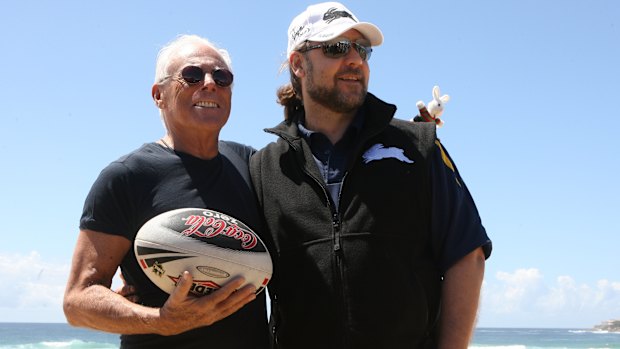
Fashion designer Giorgio Armani and Russell Crowe at Maroubra beach in 2007.Credit: Anthony Johnson
“In the space of 48 hours my life had changed dramatically, from moving countries and getting involved in sport.”
So began a varied and colourful career in Australian sports administration. Few have left a bigger mark from a marketing perspective. At the “Pride of the League”, Mielekamp was responsible for the white and black Rabbitoh motifs, the hoodies, the Bunnies bumper sticker, working with Mark Courtney on the infamous Book of Feuds and bringing to life Crowe’s vision of an Armani-clad club.
“I had to fly the tailor from Milan to come over and fit up Nathan Merritt and the crew,” Mielekamp says.
Then came the chance to work for the team he grew up supporting after being headhunted by the Panthers. Bouncing between a number of roles, and realising that 74 per cent of the Penrith fan base at the time was male, Mielekamp came up with what would become his key contribution.
In their round 14 Women in League clash against Manly in 2009, the Chocolate Soldiers became the Pink Panthers. But after copping a 20-6 hiding at home, the iconic pink jersey almost didn’t make another appearance.

Paul Alamoti – wearing Penrith’s now-famous pink jersey – celebrates the Panthers’ grand final win.Credit: Getty Images
“[Then-Penrith coach] Matty Elliott said to me, ‘Mate, we are never wearing that again,’” Mielekamp says. Elliott eventually came around, fans bought in and huge sums were generated for the club and charity.
“I was pretty emotional when they wore it in the grand final; that was actually a really nice moment for me,” Mielekamp says.
There have been other moments that have showcased Mielekamp’s marketing flair. Like when the NRL took umbrage that Penrith’s game-day sponsor Oak milk was infringing on the rights of its premiership backer Telstra.
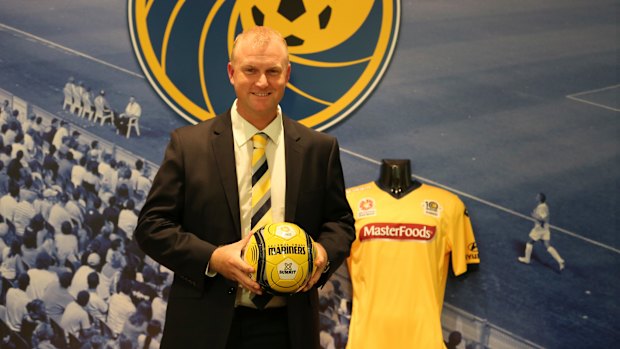
Shaun Mielekamp when he was named as the Mariners CEO.
The Panthers were adamant the Oak fridge was going nowhere and, in a cheeky bid to leverage even more publicity, vowed security guards would be employed to keep a constant vigil. The only issue? There were no security staff rostered on when a newspaper was due to arrive to photograph the infamous fridge. Unfazed, Mielekamp found some spare security clothing, donned it himself, alongside another staffer, and hammed it up for the photographer in front of a fridge filled with two cartons of flavoured milk.
At the Western Sydney Wanderers, Mielekamp was instrumental in initiatives such as the Red and Black Bloc. And when he shifted to Central Coast Mariners – where he signed only a three-month contract and stayed for nine years – he pulled off one of his most audacious stunts, luring sprint legend Usain Bolt for a series of cameos that garnered worldwide attention.
But it was at his time at the Mariners, where he became chief executive, that Mielekamp proved himself as an administrator of substance. The A-League franchise, at the time, was on the precipice. Under Mielekamp it not only survived, it thrived.
Loading
“Ultimately we ended up winning the comp, the Asia Cup, built a strong connection with the community, a strong DNA of the club, a really strong pathway that produced players, sold a lot of players, kept the club financial, kept the club through COVID, produced coaches,” he says.
“It is nice to see that there’s still some of that DNA and fighting spirit in there.”
Which is why Mielekamp believes, of all the fixer-up jobs that he’s undertaken, the Tigers is the easiest.
“This is in a better state than all of them,” he says.
“In all fairness, yes, there’s a lot of outside noise. It looks really crazy, but I look at this and go, from what I’ve been through, I’ve got so much confidence to deliver here … A bit of unity, a bit of stability and some good communication, and this is actually an easy one.”
Most Viewed in Sport
Loading