3 months ago
32
3 months ago
32
By Nadia Russell, Katie Lawrence and James Jennings
January 20, 2026 — 8.57am
MUSIC
VIAGRA BOYS
The Hordern Pavilion, January 18
Reviewed by JAMES JENNINGS
★★★½
If “brain rot” – a slang term for mental decline caused by over-consumption of trashy online content – was a band, it would be Sweden’s Viagra Boys. The post-punk group’s name alone is dredged from the depths of an email spam folder, and lyrics cover hedonism and satirise internet fringe conspiracy theories in equal measure.
Like a jester set to entertain the court, half-American, half-Swedish singer Sebastian Murphy arrives on stage in a pointy elf hat, shirtless and heavily tattooed (the ink on his forehead says “lös”, Swedish for “loose”). He looks ready to snarl over sub-two-minute punk songs, but thankfully Viagra Boys have more going on than cliche.
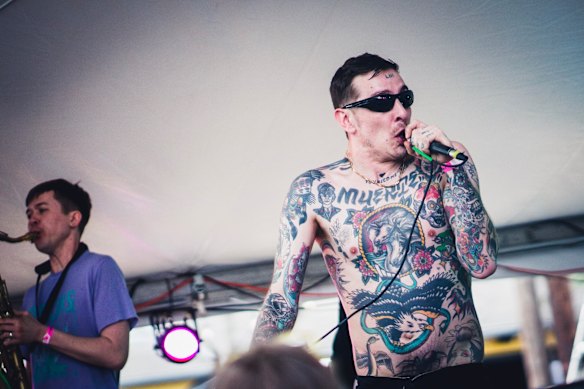
Sebastian Murphy’s stage persona comes from the Jon Spencer school of “deranged Southern preacher”.Credit:
What differentiates Viagra Boys from the punk rock pack – and something that’s hammered home in a live setting – is just how danceable the music is. Four-on-the-floor, disco-adjacent drumbeats abound, with songs like Research Chemicals, Ain’t No Thief and Down in the Basement – which is drawn out into a feverish rave up – keeping everyone moving.
The danceable grooves, synth bleeps and Murphy’s lyrics making fun of human stupidity and hypermasculinity (Sports, Man Made of Meat and Troglodyte, to name a few) position Viagra Boys as a modern version of Devo, hellbent on satirising a generation of terminally online miscreants.
Like those New Wave masters of mocking mankind’s foibles, Viagra Boys are adept at crafting mutant pop songs that make them difficult to pin down. The six band members on stage – including a saxophonist who occasionally sets his instrument to “unrelenting skronk” – do a good job of twisting the songs into interesting shapes and throwing in a few curveballs along the way (see: a flute being whipped out on Uno II).
There are a few minor speed bumps – Murphy, whose stage persona comes from the Jon Spencer school of “deranged Southern preacher”, disappears offstage for a period due to “technical difficulties with [my] body” (related to drinking milk, he says), and the sluggish Worms perhaps isn’t the best choice for a closer after such an energetic set.
The track before it, Return to Monke – named after an internet meme, naturally, and about returning to the jungle to live like a primate – does a better job of encapsulating Viagra Boys’ darkly humorous take on human devolution. If we are indeed heading backwards into some kind of societal collapse, tonight proves these Swedes are the perfect band for the soundtrack.
DANCE
ECHO MAPPING
Sydney Town Hall
January 17 to 19
Reviewed by KATIE LAWRENCE
★★
In devastating timing, I find myself at the dregs of my pinot gris, watching a man slick with sweat rub his own torso, wondering how much more I will have to endure without the buffer of fermented grapes. This is Echo Mapping, a sound-movement duet by composer Jack Prest and dancer Azzam Mohamed.
Echo Mapping is resolutely minimalist. Both performers wear plain T-shirts and loose pants. The only set is a music desk; a standing microphone is brought on and off the performance space like it has lost its blocking notes. There is also a trumpet, which proves to be the highlight.
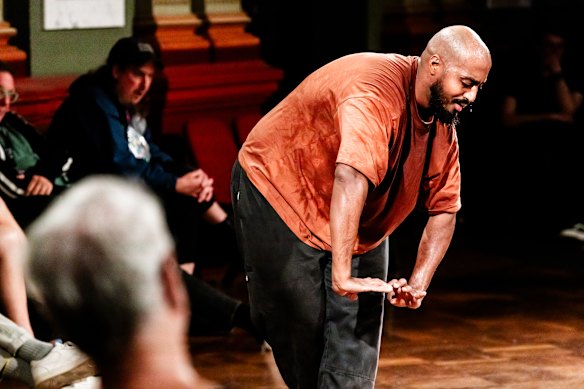
Echo Mapping is resolutely minimalist.Credit:
The movement vocabulary is repetitive: crouching, clapping, stomping, contorted spasms and clawed hands, often travelling across the diagonal. There is a recurring motif of Mohamed dragging his hands across his mouth, like the creature from Pan’s Labyrinth, or miming the frantic consumption of an invisible flute.
The score blends chanting, horns, electronic hums and Mohamed’s own guttural bellows. The program notes promise “the cathartic power of music embodied”. At times, that intention lands. At others, the two performers seem to be attending different events, with Mohamed breaking into a jaunty 1920s jive while Prest plays something closer to The Sounds of Tibet.
The deeper issue is the work’s apparent indifference to its audience. What unfolds reads less like an exchange than a closed circuit: two artists absorbed in their own world, while the room looks on. There is something galling about watching what feels like a private improvised jam session while a rain-soaked audience sits politely, performing its own stoic endurance piece, reluctant to be the first to question whether this is, in fact, for us.
The house lights remain on throughout. For critics, who usually spend performances scribbling into our laps in the dark, this creates an exposure; the audience becomes part of the stage. Like a baby scanning a parent’s face for cues of safety or danger, I find myself reading the room. A man with a mullet twirls his hair. A woman in a cocktail dress looks concerned or bemused, or possibly both.
At the end, I take a small, informal poll. The man on my right loved it: “I saw myself in it.” The woman on my left did not: “It reminds me of artists back home who take themselves so seriously.”
Between those poles, Echo Mapping settles, for me, at two stars.
MUSIC
THE LAST DINNER PARTY
January 17
ICC, Sydney
Reviewed by NADIA RUSSELL
★★★★
How many shows make it feel like you might be entering a cult?
Enter, The Last Dinner Party. The alternative rock band brings theatrics, drama and horror to a show spanning nearly two hours. For that time, the stage becomes a church – quite literally, with the set featuring arches and details straight out of a Gothic European cathedral, framed by white curtains.
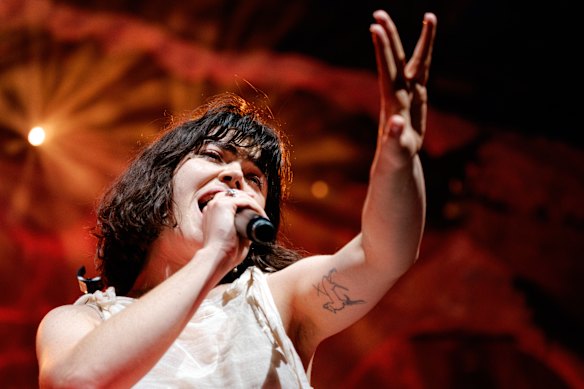
Abigail Morris steals the show with her voice and stage presence. Credit: Richard Clifford
The band, formed in the UK and comprising five members, has one Aussie among them, Georgia Davies who plays bass. Davies is given a moment to speak to her hometown audience, paying a beautiful tribute to the original custodians of the land and telling how much she loves her home country.
It’s moments like these that make this band phenomenal – Abigail Morris might be the lead singer, but the entire band gets their individual moments to shine. Keyboardist Aurora Nishevci leads vocals for I Hold Your Anger and Gjuha, while guitarist Lizzie Mayland sings Rifle, Morris joining later to support. Lead guitarist Emily Roberts takes on guitar solos, mandolin and even the flute throughout the show, and Davies recites a powerful monologue at the start of the unreleased Big Dog.
The group is strongest during the haunting chorale for Woman is a Tree. The disconcerting harmonies sung by all five hold the room in suspense. The high point of this moment is continued by the beautifully personal Gjuha, then Rifle, the songs moving mesmerisingly between languages – Albanian, French and English – and emotions.
Though the band are strongest as one, Morris is show-stealing as she frolics around the stage, even when she trips and falls she recovers with grace and humour. Her voice is rich with a hint of raspiness, and never falters. Sail Away is stripped back to a piano and her vocals showcasing her beautiful vibrato. She is an emotive and expressive singer, adding to the story of each song.
In the latter half of the show, the songs slow down and the crowd feels a little less attentive, but it doesn’t take long for things to pick up when Roberts strums the iconic guitar riff-off Sinners, getting the audience cheering. The Last Dinner Party is a feast for the ears.
The Morning Edition newsletter is our guide to the day’s most important and interesting stories, analysis and insights. Sign up here.
Most Viewed in Culture
Loading