2 months ago
18
2 months ago
18
Sydney’s supply of new jobs will be turbocharged around dozens of residential and transport hubs under critical plans to guide development for an extra 1.2 million residents in the next 20 years.
The Minns government’s draft Sydney Plan cements its strategy to organise the fast-growing population around more than 40 “interconnected centres” to provide most jobs and services.
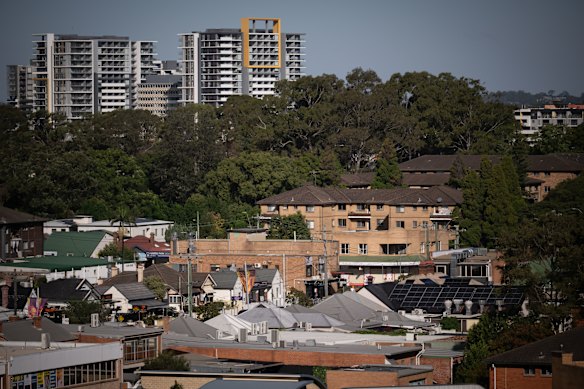
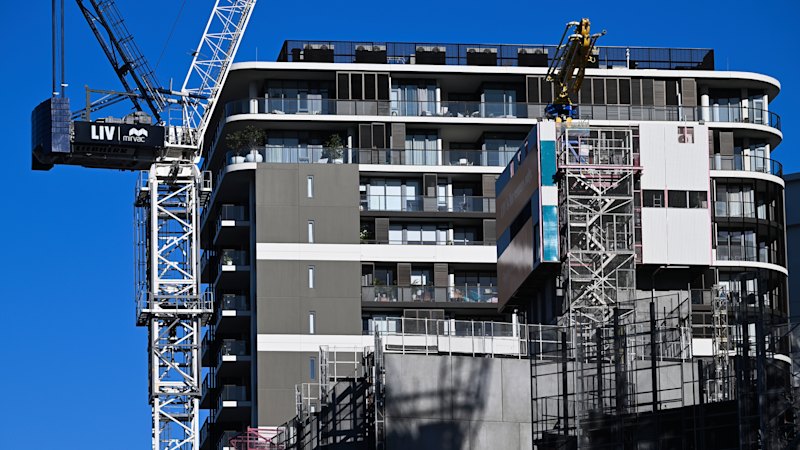
The NSW government wants to arrest Sydney’s urban sprawl and build more homes around train stations.Credit: Wolter Peeters
Those centres would be spread across the city and anchored by the Sydney and Parramatta central business districts, as well as the emerging city of Bradfield near the future Western Sydney Airport.
Planning and Public Spaces Minister Paul Scully said the plan, released on Wednesday, would guide land use planning, and housing and employment growth in 33 local government areas in Sydney. Scully said it would provide “long-term certainty for residents, councils, businesses and investors”.
“It delivers clear direction on how and where new jobs and homes should be located to make living in the city more affordable while driving the growth of Australia’s largest economy,” he said.
Loading
The draft plan builds on the Minns government’s major changes to planning legislation aimed at arresting the sprawl of housing on Sydney’s fringes by increasing density near train stations and bus interchanges under its transport-oriented development and low- and mid-rise housing policies.
The state government is aiming to deliver 377,000 new homes by mid-2029 as agreed under the National Housing Accord, although it has conceded it may miss its targets. Sydney is expected to contribute 264,000 of those homes. The targets are part of the federal government’s push to deliver 1.2 million homes in the same period, which is already about 60,000 homes behind schedule.
The government said most residential density would continue to be concentrated near existing infrastructure and amenities in Sydney’s east.
“Population will continue to be highest in the east of the city due to existing infrastructure over the next 20 years and beyond, while the west is expected to see an increase in growth in the long term as new areas become more serviced and more liveable,” the draft plan said.
The draft strategy also emphasises the scale of the planning challenges ahead in a fast-growing city predicted to be home to 6.5 million people in the next two decades. It said a growing and changing population, as well as rising housing costs, increasingly affected residents’ living choices.
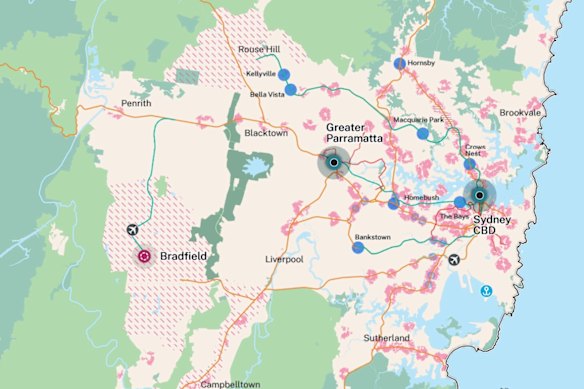
The draft Sydney Plan envisages 43 “interconnected centres” for homes, jobs and services, anchored by the established Sydney and Parramatta CBDS, as well as the emerging city of Bradfield near the future Western Sydney Airport.Credit: NSW government
The city’s current 5.3 million population is forecast to surge by 23 per cent by 2045, an increase largely driven by overseas migration. An ageing population means nearly half a million people will be aged 65 or older, and shrinking households have driven more families to choose apartment living.
“Accessibility to a choice of affordable housing, jobs and services have an impact on the opportunities available to people.
“While commute times vary across the region, imbalances in housing and location of jobs extend these commutes for many people, particularly for communities in the west.”
Scully said that, as well as planning for housing growth, the government wanted to build homes close to employment centres.
“Protecting and strengthening employment and industrial lands will further provide critical spaces that support jobs, local manufacturing, innovation and economic prosperity,” he said.
The plan forecasts the city’s working age population will increase by nearly 19 per cent in the next 20 years, while employment is expected to surge by about 700,000 jobs in the same period.
It said the rapid jobs growth would “open additional opportunities in business services, education, health and manufacturing industries to become even more accessible in the west as new transport infrastructure comes online.”
The draft strategy is one of four regional plans that will be prepared to guide future development in NSW.
Loading
It will be open for consultation until late February, and finalised next year. Councils will have to modify their local planning controls to fit with the plan.
Once finalised, the document will replace the regional plan released by the former Greater Sydney Commission in 2018. It planned for a metropolis of three separate but connected cities: the “Eastern City” near the CBD, the “Central City” around Parramatta and Olympic Park, and the Western City.
The plan mandates the five-year housing targets set by the state government for the 33 councils. Every council must have an affordable housing contribution scheme in place by 2027.
Urban Development Institute of Australia NSW chief executive Stuart Ayres said both greenfield homes and new units, underpinned by clear local council housing targets, would be critical to boosting supply.
“The draft plan highlights the need to keep delivering infrastructure to support housing growth.”
Planning Institute of Australia NSW president Sue Weatherley said the plan was “a mechanism to align growth, infrastructure and investment”.
“These reforms can set the foundations for more liveable, resilient and equitable communities, but only if they are shaped through shared vision, shared responsibility and genuine collaboration.”
Start the day with a summary of the day’s most important and interesting stories, analysis and insights. Sign up for our Morning Edition newsletter.
Most Viewed in National
Loading