3 months ago
26
3 months ago
26
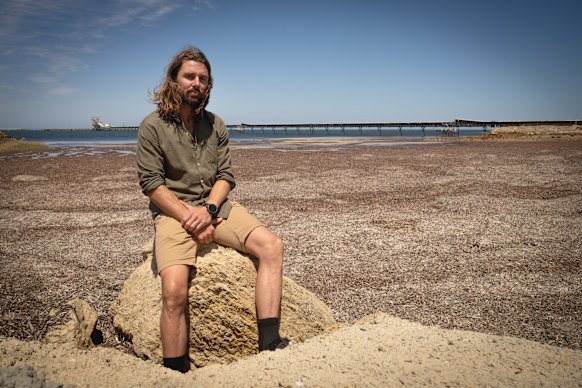
We have just begun a macabre beachcombing expedition on a remote stretch of coastline with local Lochie Cameron when we find our first mummified sea dragon.
It won’t be our last.
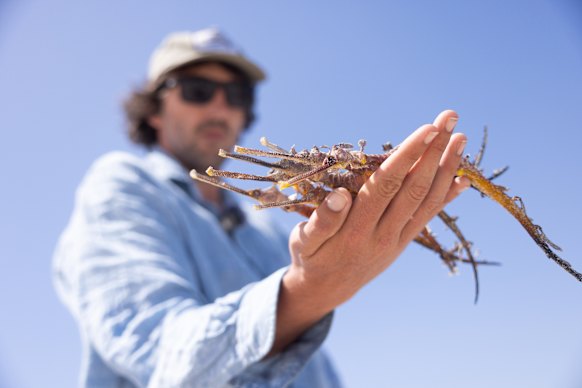
In 80 metres of this remote stretch of beach, in the dazzling heat of a summer’s day, we collect 11 sea dragons, and four leafies – the diminutive marine state emblem of South Australia.
The bloom might have receded from Adelaide’s beaches, but on the remote Yorke Peninsula and Kangaroo Island a new ground zero has emerged – almost a year after the first blush of the state’s worst algal bloom signalled ecological disaster.
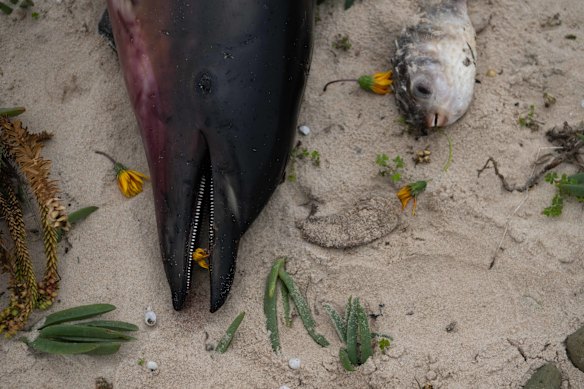
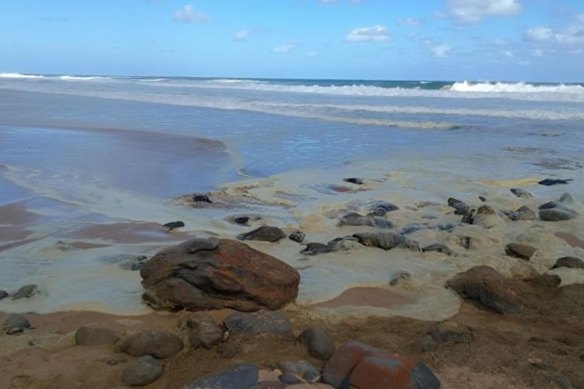
The shoreline at Corny Point, on the western edge of the “boot” of the peninsula, is littered with the bloom’s debris. We unearth puffer fish, leather jackets, crabs, and millions of snail and invertebrate shells.
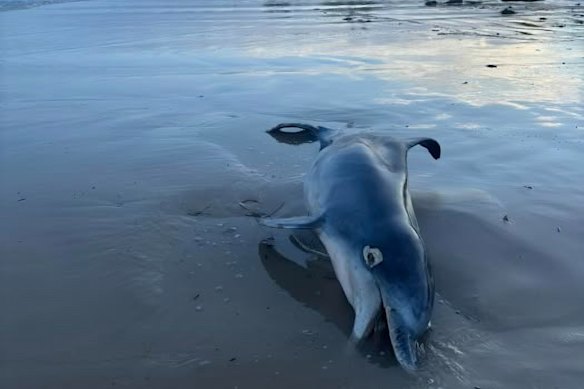
Not far from where we stand dolphins, fiddler rays, flathead and sharks have washed ashore, gasping for breath or already dead. Last week more than a dozen flailing stingrays beached themselves in front of distressed locals, who tried in vain to save them.
Footage taken by Point Souttar local Andrew Polgreen showed about 15 stingrays swimming towards shore, affected by the toxic bloom. They all died.
“It’s really sad,” said Polgreen’s friend Grant Wellington, who posted the clip to Facebook. “Those rays, they’re the gentleman of the sea, those big old things.”
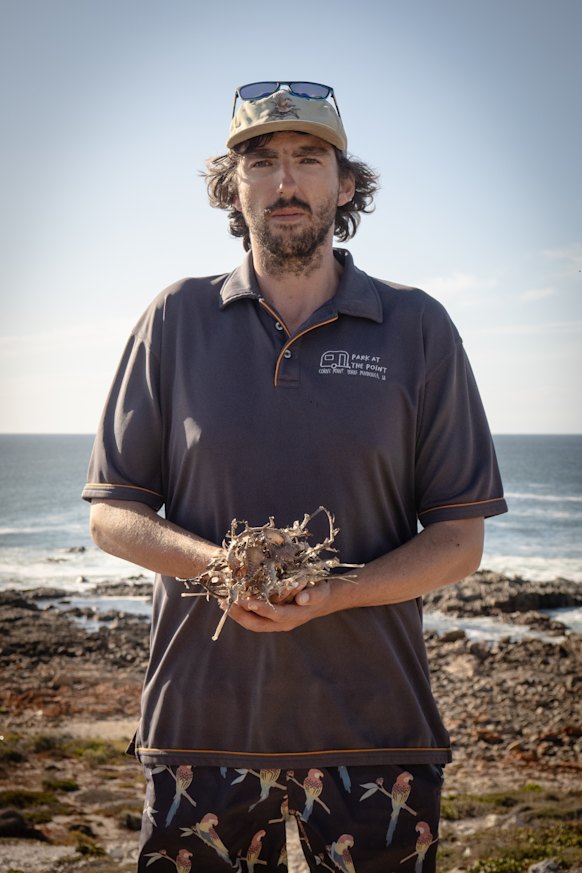
After a few minutes on the beach at Corny Point, our eyes sting and throats tighten. Everyone coughs. The air is acrid and metallic, like chillies scorching in a copper pan.
Cameron says that even after 12 months of toxic blooms hitting South Australian shores, the sight of such widespread loss is hard for most people to see. Many locals have stayed away from the beach for weeks or months.
“My soul got shattered in May [last year, when it first hit the Yorke Peninsula],” he says. “And now it’s just like: ‘Well, I’ve seen the worst I can see’. It doesn’t get worse than like, three-metre stingrays dying in front of you.”
The bloom, caused by multiple species of the tiny dinoflagellate Karenia – a genus of planktonic organisms that drift in water columns – turns seawater a sickly colour, and produces a mucky foam that causes skin irritations in humans. In marine species, Karenia is deadly.
Cameron takes water samples several times a day, testing for Karenia and sharing the results from this remote corner of the state with authorities.
Karenia levels are considered elevated when they reach above 10,000 cells per litre. For the past few weeks, Cameron has not recorded a sample showing levels below 1 million cells per litre.
Imagine a bushfire tearing through remote terrain, indiscriminately incinerating everything in its path. Ahead of the fire front, animals flee. The smallest and slowest stand no chance, while bigger animals gulp in large amounts of smoke fumes and succumb to the toxic fumes.
“The bushfire analogy is true,” Cameron says.
“Once it moves through an area, it’s devastated. It’s decimated. It’s just out of sight. [And] when it’s out of sight, people don’t really have to care – they don’t have to see [it].”
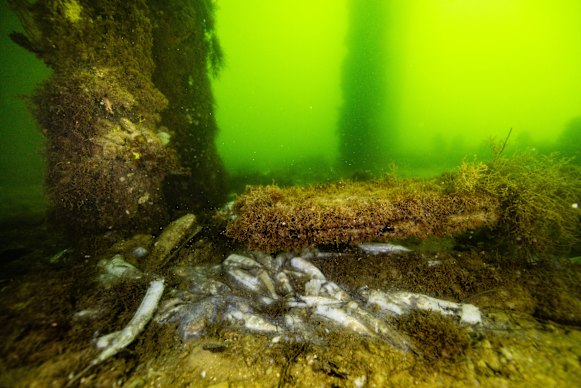
Back in March 2025, ecologist and microbial and estuarine expert Faith Coleman took a call from a journalist, who had heard from a fisherman in Boatswain Point. The fisherman, Coleman recalled, said he had developed boils on his arms from contact with seawater of worsening quality. His daily catches of seafood were dwindling.
“At Boatswain Point, I took water samples and the water was completely dead,” Coleman bluntly told a Senate inquiry last year. “I’ve never seen water completely dead. It was completely dead. There was nothing at all in it.”
Nursing a mug of tea on her verandah, Faith recalls those uncertain early days.
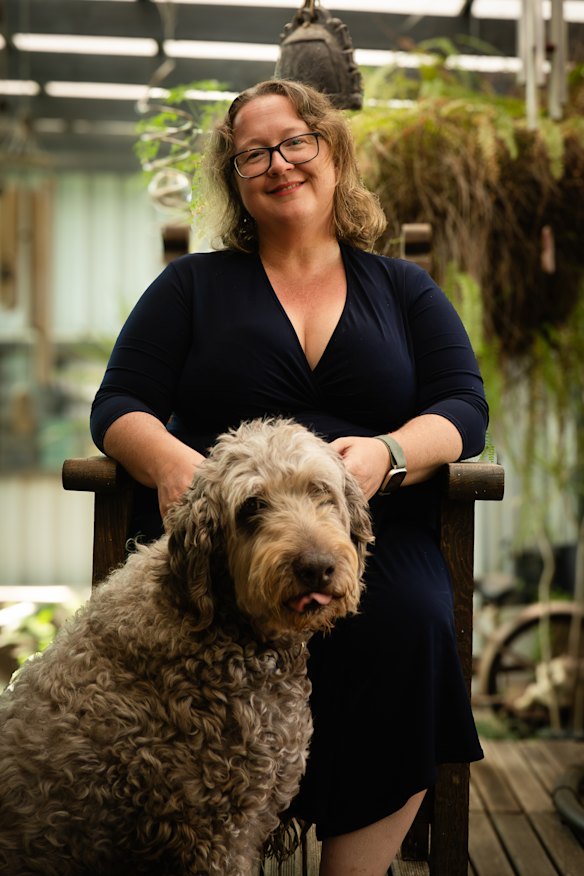
“All of the fishermen there through January and February noted lots of dead matter,” she says. “The water was four and a half degrees hotter than normal.”
Game of cat and mouse
Climate change is driving an increase in intensity and frequency of harmful algal blooms, as oceans absorb about 90 per cent of the excess heat from climate change.
In 2024, the World Meteorological Organisation began monitoring a marine heatwave that swept the globe and enveloped Australia – eventually stretching for 40 million kilometres around the south-west Pacific – in the hottest year on record for the region.
In March 2025, local ABC outlets started to report surfers falling sick and fish and octopuses appearing unwell. Seals began washing up dead on Boatswain Point.
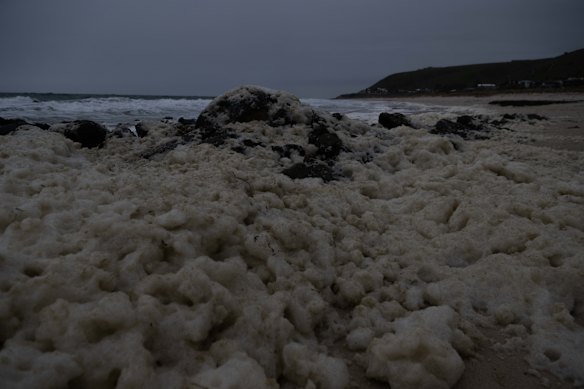
Nonetheless, it took weeks for testing to confirm the presence of Karenia. By the time it was confirmed, the algal bloom had spread for kilometres along the coast south of Hindmarsh Valley.
For 12 months now, scientists have been engaged in a grim game of cat and mouse with a microscopic enemy that defies definition.
In November, scientists from Australia, New Zealand and the United Kingdom published a research paper that showed not just one Karenia – Karenia mikimotoi, as previously believed – was contributing to the blooms, but five.
These five, Karenia cristata, Karenia mikimotoi, Karenia brevisulcata, Karenia longicanalis and Karenia papilionacea, had changed in their dominance. While Karenia mikimotoi was previously identified as the dominant strand, Karenia cristata – which contains brevetoxins – was now the dominant strain.
This was significant for two reasons: because cristata had not previously been identified in Australian waters, and because it is a neurotoxic shellfish poison that affects humans as well as marine life.
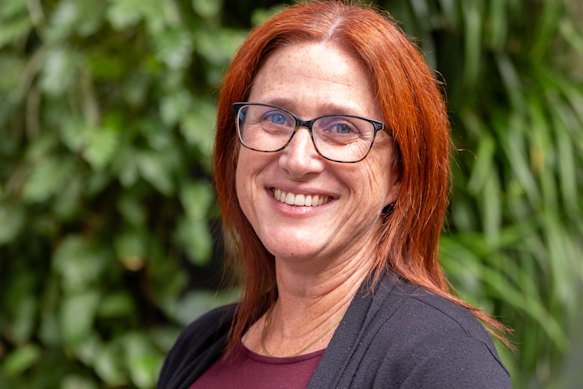
Coleman describes Karenia with a type of grim reverence.
“They have these huge genomes. I mean, their genomes are 20 to 40 times that of humans, and much of that genome is dark at any one point in time,” she says.
“So we have no idea what that genome does. They’re highly adaptable creatures, and they can turn on and off parts of their genetics at any one point in time. And so the creature that you think it is – at this point – in two or three generations, might be something completely different. The concept of species no longer holds the way that it does.
“I think it’s incredibly important that we understand at a public and general consumption level that [this] is a really, really young science that is going to take us a long time to get right.”
The South Australian government blamed three factors for the bloom: floods in 2022-23 that swept nutrients through the Murray River mouth and into South Australian coastal waters, an upwelling in 2023-24 that brought cold and nutrient-rich water to the surface, and the marine heatwave.
An increasing number of scientists now cast doubt on the Murray River theory, saying the time-lapse between the floods and algal bloom outbreak render it unlikely as a factor.
Either way, no one denies that climate change has created wickedly ideal conditions for Karenia blooms.
Conservation Council of South Australia chief executive Kirsty Bevan represents 50 of South Australia’s environment and conservation organisations and their 90,000-odd members.
As a former manager of science within the South Australian department for environment and water, and program manager with the Great Barrier Reef Foundation, Bevan has scientific skin in the game. But it’s as a parent, as much as a science leader, she finds the bloom “really frightening”.
“By agreeing that climate change is a part of this, if we’re not addressing climate change then these events – whilst we might pass this one – are likely to occur again, and possibly be more severe,” Bevan says.
“The planet is showing those signs of climate collapse, and it is screaming at us to pay attention. And I think if we don’t pay attention to that, then we are really creating an unlivable planet down the track … we’re talking within lifetimes. We’re talking two generations away.”
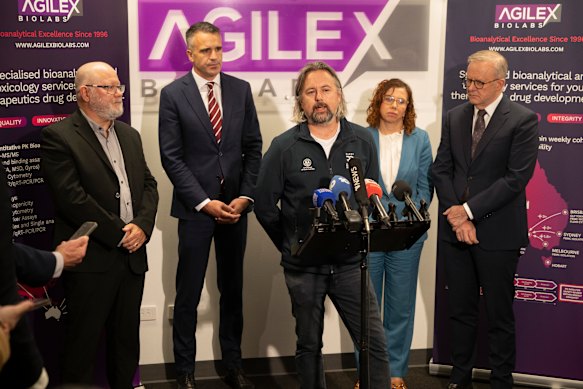
Professor Mike Steer, executive director of the SA Research and Development Institute (SARDI), said more than 30 per cent of the state’s coastline had been affected by blooms. Currently, the west coast of the Yorke Peninsular was the hardest hit.
“It is quite, quite distressing and disturbing to see large quantities of these animals wash up ashore,” he said.
“It actually has been a feature of this bloom and really contributing to people’s sort of ecological anxiety.”
In Ardrossan, on the Yorke Peninsula’s east coast, Great Southern Reef co-founder and marine biologist Stefan Andrews looks over the ocean with dismay.
His young daughter has just had a swimming lesson in the same waters he has spent years diving in.
“She just started with the goggles in the water, and she saw her first fish alive in the water,” Andrews says.
“And that’s how it should be; not seeing that same fish washed up [dead] and learning about it, which is how a lot of kids are seeing some of these creatures for the first time.”
Andrews has just finished a dive off the east coast of Kangaroo Island, an ecotourism hotspot known for its remote, relatively pristine reefs. Large sections of the golden kelp forests were severely degraded and vast areas of the kelp understory that were once covered in sponges, ascidians and other invertebrate life were gone.
The Great Southern Reef Foundation argues the lack of baseline data about the marine species living in South Australia means that we cannot accurately assess what has been lost.
“We’re losing local populations of species that may have very limited ranges and could become locally extinct before we even knew they were there,” Andrews says.
“And the analogy that we’ve used when speaking to politicians is, [say] you bring your patient into the emergency room, and you don’t have any medical records … the response becomes guesswork.”
Underscoring this point, Cameron – a young father, caravan park manager and citizen scientist – has spent the past 11 months picking through the shoreline to record the bloom’s victims, and testing water daily to gauge Karenia levels.
In the process, Cameron says he has discovered several marine species previously unknown in South Australian waters, including a species of pistol shrimp.
Complicating matters is the development of what Coleman describes as a “feedback loop”, created by the increased dominance of dissolved organic material (the decay of marine creatures killed by Karenia), in turn creating an enormous food source for Karenia.
Steer says that, so far, at least 30 per cent of the South Australian coastline has been affected by blooms.
Bevan says there is a “100 per cent” chance of further blooms hitting Australian coastlines, including on the east coast, as fossil fuel consumption rises and marine heatwaves become more frequent and intense.
“We know that gas, when you pull it out of the ground, emits methane and carbon dioxide, two of the biggest greenhouse gasses accelerating global warming.
“We know that there is a link between those fossil fuel companies accelerating climate change and then the consequences of that are things like the algal bloom.”
Coleman says that in time South Australia’s bloom will pass. The best chance we have to mitigate or reduce the scale of future blooms, she argues, is large-scale investment in seagrasses, increased areas of oysters and other shellfish, sponges and other filter feeders.
“Unfortunately, filter feeders have historically been badly affected by human activities, and many of the filter feeders we had remaining in our continental waters before the bloom have died quickly as a result,” she says.
“While restoring these habitats will help in the short to medium term, with the recovery of this bloom and suppression of the next one, none of this will help if we don’t address climate change, as a matter of priority.”
The author travelled to South Australia with the assistance of Solutions for Climate Australia.
Get to the heart of what’s happening with climate change and the environment. Sign up for our fortnightly Environment newsletter.