2 months ago
17
2 months ago
17
Opinion
December 12, 2025 — 5.00am
December 12, 2025 — 5.00am
Inconveniently for someone like me, just about everything said about the teen social media ban this week will probably prove irrelevant. The obsessions of the moment – whether it blocks the right platforms, and whether teens have managed to find their way around it – are only short-term technical concerns and subject to rapid change. The policy’s true consequences are probably unknowable from where we are, and could fall anywhere on a spectrum that spans triumph and catastrophe.
Curiously for a policy ostensibly aimed squarely at the problem of youth mental health, just about every major youth mental health organisation seems opposed. In October last year, some 140 academics and civil society organisations, while acknowledging the harms of social media, wrote the prime minister an open letter dismissing the policy as “too blunt an instrument” to address them. Curiously, also, that had no discernible effect.
The policy remains hugely popular. It has the broad support of parents, especially those with harrowing stories of social media’s toll on their children. Then there are those who lean heavily on the work of social psychologists such as Jonathan Haidt, or US Surgeon General Vivek Murthy, which relies on some degree of developmental science – science which the mental health experts say is being stretched.
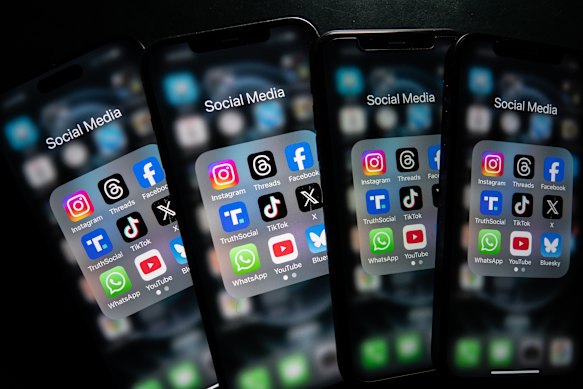
Scroll no more: December 10 was the first day of Australia’s teen social media ban.Credit: Getty Images
There aren’t many cases like this, where the divide between experts and the people is so stark. Even among experts, the closer you are to the specific specialities of youth mental health and social media, the less likely you are to support the policy. This reflects the highly emotive nature of the issue, which stirs a desperate need for something, anything to be done, and is probably why a similar divide shows up on youth crime and bail laws.
But I think there’s something deeper happening here, too: that this policy expresses a far more profound concern with social media as such, that goes well beyond the narrow issue of youth mental health.
Perhaps the most instructive evidence for this comes from the United States, which has unleashed so much of this force on the world, and whose own citizens are drowning in it. In a country that agrees on so little, nearly 80 per cent of Americans say social media companies have too much power and influence in politics. Only 10 per cent say these platforms have a positive effect on the country. Nearly two-thirds deem the effect mostly negative. Democrats and Republicans differ only slightly on these questions, and the overall results are durable: they very nearly replicate what surveys found in 2020. And a slight majority (51 per cent) support more regulation of social media, while only 16 per cent want less.
Loading
Beneath this lurks a key idea: that we can no longer simply assume technological innovation is a self-justifying good. That’s a quietly radical idea in our time, as conventional wisdom tends to be that technology ultimately makes things better, delivering us more convenience, more choice, more mastery over our world. It is rare that we stop to consider whether that technology either enhances or degrades the human condition. That sort of question is left to the musing of philosophers, while real people plough on full steam ahead.
True, there has always been a cohort with such anxieties, who warned of the depredations of everything from television to the printing press. But our concerns over social media follow a different path: rapid, enthusiastic adoption followed by widespread buyer’s remorse. Less premature doomsaying than its opposite: naive utopianism run aground.
The policy doesn’t target social media content as such. Instead it targets social media accounts. That is, it aims to isolate social media’s most rapacious feature: the mass collection of data from those accounts, which is then fed into an algorithm designed to ensnare the user. We understand what that means as adults because we experience it ourselves. We recognise the strange hollow feeling after being sucked into a scrolling vortex. We sense this pulling us away from a better version of ourselves in the way most addiction does.
That’s a profound anxiety, which recognises something amiss in the whole tech ecosystem. It sees a technology that is no longer about enhancing our choices or mastery of the world, but which might be mastering us, and with deeply social consequences. That its algorithms are funnelling us into brutish and belligerent interactions, to our mutual detriment, and with no common good in mind – or indeed any good other than the enrichment of a handful of tech billionaires. Put that way, it’s predatory.
Loading
To ask politics to respond to that is hugely significant because until now, it has mostly refused to do so. The onslaught of poker machines, which work in a similar way, continues apace. Gambling advertising remains ubiquitous, even around children. We enact these social media reforms at precisely the same time as AI is beginning to work its way into our intimate lives: substituting for friends, psychologists, even lovers.
AI developers are now considering incorporating advertising into their product, which would inevitably trade on all the data being thrown into it. Teenagers are already flocking to such platforms, whose potential is no less predatory. But politics’ approach so far has been to resist regulation. There’s a real prospect here of government policy responding to the problem of the last generation while waving through the problems of the next.
But if this moment heralds something else – specifically, a more sceptical relationship with technology – it’s a hugely significant one. However history comes to judge this specific policy, it will have stirred in us a sense the language of choice is no longer enough in the face of these machines. That implies a total reimagining of the relationship between politics and technology, where publics expect the former to scrutinise and assert sovereignty over the latter in the service of some common good. Only future historians will be able to judge if that’s what we’re seeing. But if it is, it’s a far more seismic shift than any news copy of the day could possibly capture.
Waleed Aly is a broadcaster, author, academic and regular columnist.
The Opinion newsletter is a weekly wrap of views that will challenge, champion and inform your own. Sign up here.
Most Viewed in National
Loading