3 months ago
23
3 months ago
23
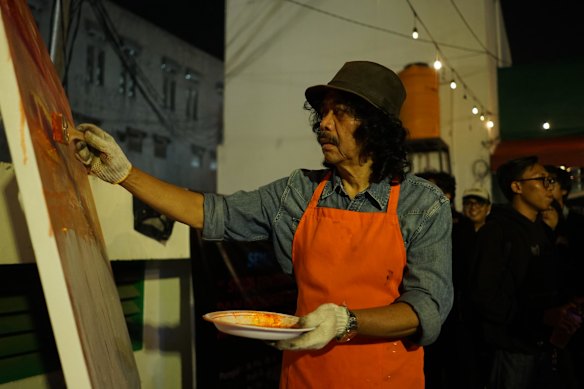
The artist’s studio is crammed with work – charcoal drawings, acrylic paintings, large and small, works hanging above each other, leaning one on top of another. We are 150 kilometres from Jakarta, in Bandung. The place is heaving: teenagers working on a water-recycling project in the yard, university students gesticulating in front of bold anti-corruption drawings and etchings, local folks just dropping in for a visit, other artists. Folks like me, knees creaking, recruited into planting small seedlings in dark brown earth during what was supposed to be a regular artist’s talk. Kids everywhere. Happy noisy bedlam.
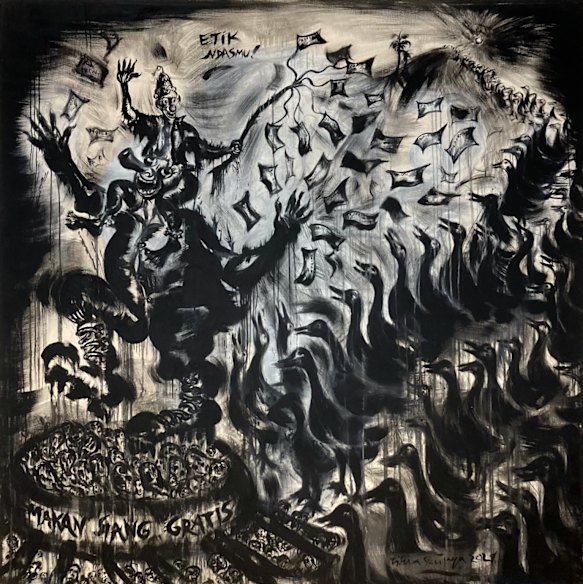
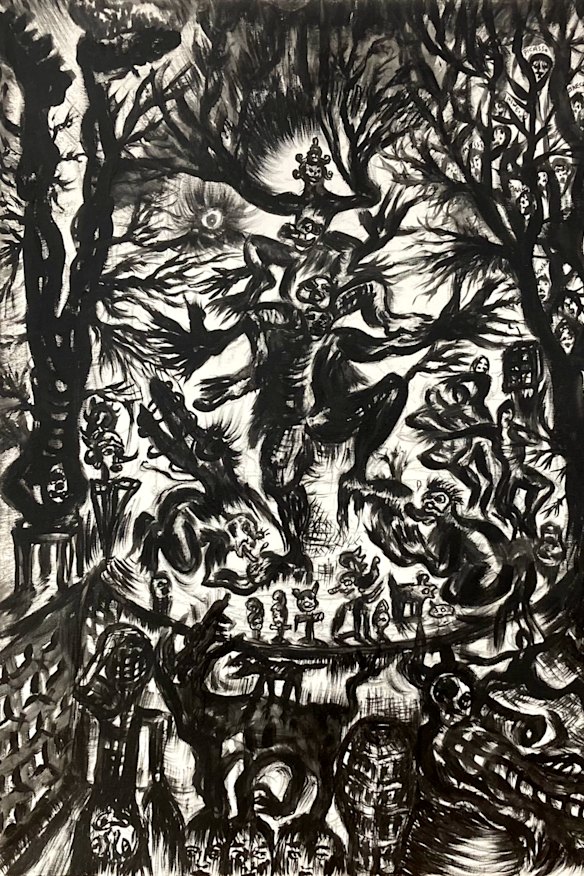
This is the life’s work of Tisna Sanjaya, venerated Indonesian artist and activist over decades. Now he’s bringing his bravely political paintings and performances to Australia for his first-ever solo show, Cultural Amnesia, at Jo Holder’s The Cross Art Projects in Sydney. He’s not the only Indonesian artist on show. This week, his son Zico Albaiquni, is onto his fourth solo exhibition, The Land that Refuses to be Beautiful, with Ames Yavuz.
There’s an enthusiastic army of people raising the profile of Indonesian art and artists in Australia. Academics, historians, the artists themselves and even a reformed lawyer who buys and sells service stations. Our consciousness of Indonesian artists is growing – just as our politicians say today that the two countries are so important to each other.
Other Indonesian artists are also joining the rosters of galleries across the country: Faisal Habibi at Redbase Gallery in Sydney, Dadang Christanto at Gallerysmith in Melbourne, Arwin Hidayat at Mitchell Fine Art in Brisbane, Jumaadi, after a string of institutional shows, at King On William in Sydney.
But Tisna, as he is always known, was the first, back in 1999 when legendary curator and author Julie Ewington worked with him in the Third Asia Pacific Triennial of Contemporary Art. She loved his work.
“He’s always been committed to political questioning, coupled with spiritual renewal. He’s a devout Muslim in pursuit of social justice. It’s a robust and courageous practice,” she says. Plus he took, head-on the corruption of politicians in Indonesia back then.
He still does. He wants to change the political landscape through his work, to get people engaged with what’s happening to the climate and the land in his much-loved Indonesia. That’s where the water purification plant and the seedings contribute. The purification plant works. The plants grow and provide fruit and vegetables, although recruiting random people as horticulturalists could be risky.
“Mother Earth is part of your humanity, your homeland. This land, this water, that is what makes you Indonesian,” says Chaitanya Sambrani, associate professor in art history at the Australian National University ANU. In Indonesian culture, the earth is sentient. You better look after it.
But what I saw that day was no one-off performance for tourists. Elly Kent, academic at the ANU specialising in Indonesian studies, deputy director of languages and author of Artists and the People: Ideologies of Art in Indonesia, says there is an intense connection between artists in Indonesia and their social contexts.
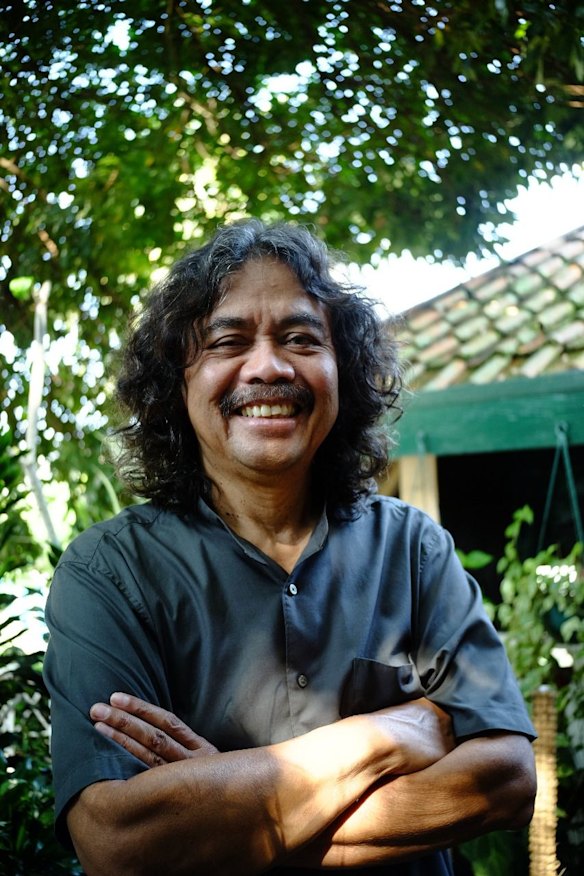
Tisna set up his studio and gallery in Cigondewah, part of Bandung which was agrarian when he was a child. Since then, it’s been industrialised and polluted, textile factories dumping waste (thanks for nothing, Australia). Plastic factories doing the same. That dumped waste turned the river black, poisoned the well.
And those water purification plants with spinning wheels, they were a way of engaging the community in work for everyone. Plus it’s not just earnest work: pigeon-racing, martial arts, children playing instruments in the yard. In the background, Tisna engages with academics, politicians, business, the local community.
“He sets his sights on a political issue he wants to address and sets up a campaign in which all of these different people contribute. It’s visible and obvious – and he engages really closely with these different parts of society,” Kent says.
Tisna, she says, is an excellent example of a very striking tendency in Indonesian art – that relationship between artists and their communities.
Plus, artists move back and forth, crossing borders, bringing intellectual and cultural goodies with them. She reminds us of the Macassan traders, who visited northern Australia, trading trepang (sea cucumbers) with the Yolŋu people since at least 1700. There was more than a food connection. There are images of the trading boats from either side of the voyage, from Sulawesi to Arnhem Land. And there is still a modern day artistic connection and collaboration. Australian Aboriginal art collective proppaNOW has worked with Taring Padi, a collective of Indonesian artists, over decades. It led to the award-winning exhibition Tanah Tumpah Darah (meaning, the land where my blood was spilled) at Griffith University in 2024.
The drive to broaden the reach of Indonesian art into the Australian community is credited to two men. Meet Konfir Kabo. He bought his first artwork by an Indonesian artist, Maria Indria Sari, a stitched canvas, about15 years ago, from independent curator Mikala Tai, who resigned from Creative Australia over its bungled Venice deselection last year. Tai was at Melbourne International Fine Art gallery back then, honing her craft as someone who really gets what art beyond Europe has to offer. She has observed a deepening appreciation of Indonesian art in this country, fed by the people who lead the Asia Pacific Triennial. “APT is always ahead of the game and was looking at Indonesian art even before it became a hit globally,” she says.
Kabo, who moved to Australia from Indonesia as a teenager, laughs when I remind him about that first purchase. Now most of his 2000 works are stored in warehouses at Ballarat, not far from the Art Gallery of Ballarat, which held the first institutional show curated from his collection. AGB’s Louise Tegart was on one of Kabo’s rattling-fast tours of art galleries through Indonesia and came back a convert, knew of his collection and seized the opportunity.
“I was so excited and inspired by what I had seen on the trip that I felt it was really important for the AGB to showcase the incredible contemporary art coming from Indonesia … we didn’t really have a record of showcasing Asian art so also felt it was important for us to commence showing Asian art to our audiences.”
That was in 2024. He’s also lent to biennales all over the world, to institutions, even to friends and family. Kabo is a retired lawyer, now an investor in service stations. He’s planning his own museum with a permanent collection in Ballarat, not far from the art gallery. Is he doing a Judith Neilson, owner of White Rabbit Gallery and the woman who dragged Chinese art into the Australian consciousness? He’d very much like to – but claims he doesn’t quite have a spare billion dollars. Yet.
“Unfortunately, I’m but a fraction but every time I walk into her gallery, she is an inspiration,” he says.
And meet John Cruthers, former chair of The Sheila Foundation, former filmmaker, now art consultant and director of 16albemarle Project Space. He grew up with a mother, Sheila Cruthers, who adored Australian art and built Australia’s biggest collection of women artists. Now her son is helping Australians really come to grips with South-East Asian art.
Together, the two of them have shepherded Australians along the busiest art tour imaginable to showcase Indonesian art to Australians: curators including Tegart from Ballarat, academics, collectors, enthusiasts, hordes of students. And that’s how I met Tisna Sanjaya for the first time. Quietly spoken but not soft. Intense. And this weekend, he’s performing for Molly, his beloved wife who died last year. It’s about the everyday, the washing and cleaning, the work she did maintaining their lives, their home, her practice of care and love and prayer. But washing also has another meaning for Tisna, reflecting on the political situation in his homeland, a kind of image laundering.
“I have witnessed how many politicians, activists, and intellectuals seem fond of ‘washing clothes’: changing outfits, cleansing traces of their anti-reform past, and then appearing with a new political image, while their roots often remain the same.”
*I’ve been hanging around Australian galleries since 1983 so I inevitably end up writing about friends and family. Despite my connections, I still refuse to write about anything terrible. I’ve also been on one of the Indonesian art tours described above, one of the most exhausting experiences of my life; and I’m a mother of three. That tells you what it was like.
Tisna Sanjaya’s exhibition Cultural Amnesia is on at The Cross Arts Project, Sydney, from February 21 (opening performance) to March 28. Zico Albaiquni’s exhibition, The Land that Refuses to be Beautiful, is on at Ames Yavuz gallery, Surry Hills, until February 21.
To read more from Spectrum, visit our page here.