3 months ago
25
3 months ago
25
But that was back when Crown was in his early 20s, before he changed his name.
Meet Peter Kontista
To his classmates at St Gregory’s College Campbelltown, Crown was always known as Peter Kontista, a likeable guy and a member of the well-respected Camden family behind the C Kontista Real Estate agency.
Of a handful of old boys who spoke to this masthead, there’s no recall of his share trading at school, although he was said to be good at maths. They all wondered what he’d been up to since then.

Peter Kontista in his St Gregory’s College Campbelltown school photo.Credit:
The only mentions of Kontista online are a few unclaimed shares from a Queensland natural gas company and a top-band score in Business Studies in the Higher School Certificate honour roll of 2002.
Crown has not responded to calls, texts, emails and registered mail for this story, and he is no longer represented by his two most recent lawyers, so a detailed list of questions remain unanswered.
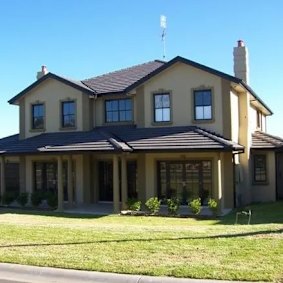
Peter Kontista’s first home was a land-only purchase in Camden Park for $320,000 in 2005.Credit: Domain
But a forensic look at the public records behind his business forays reveals an increasingly onerous reliance on non-bank lending that is not only faltering under the weight of its debts, but coincides with broader warnings from the corporate regulator about Australia’s booming and largely opaque private credit market.
The Australian Securities and Investments Commission has become increasingly vocal in recent months over concerns that private credit funds are masking defaults and bad loans even as the sector booms in Australia to more than $200 billion.
The tall young man with grand plans
When Peter Kontista was starting out it was with help from ANZ, not private credit. Having registered for his building licence a year out of school, he bought his first property, aged 20, in Camden Park for $320,000. That same month he established a home building and renovation company Permak Developments.
Among the company’s first big jobs was a house in need of work in the heart of Camden. It was bought in Kontista’s name in 2006 for $270,000, complete with white-ant damage and heritage restrictions.

Retired concreter Kevin Scattergood recalls the young Peter Kontista well.Credit: Natalie Grono
Retired concreter Kevin Scattergood remembers the property, and Kontista, well. He only had one dealing with the tall young man with big ideas and grand plans, but it left him with an unpaid bill of almost $45,000.
Scattergood had thought payment for the concreting job was secure, given the invoice was linked to security-of-payment laws. “But the day we sent him a letter about the debt was the day he went into voluntary liquidation,” he said. “So while we thought we had some security of payment, he just went into voluntary liquidation and got rid of all his debt.”
Carmen Galea, the manager of Panthers Concrete Tanks, also recalls meeting the young Kontista. She was struck by how intelligent he seemed, and the fact that her company was never paid its $10,230 bill.
Galea and Scattergood were among 47 creditors listed in a 2007 liquidators report owed more than $545,000 when Permak Developments collapsed.
The following year, as housing values across Sydney took a downward turn in the wake of the global financial crisis, the Camden property on which Scattergood did so much unpaid work was sold mortgagee-in-possession for $380,000.
Meanwhile, Crown’s home in nearby Camden Park was also carrying signs of Permak Development’s liquidation before the bank sold it in 2008 for $630,000.
Then there was Crown and his now-wife Vanessa’s jointly owned property in nearby Ellis Lane: bought for $510,000 in 2007, the bank sold it the following year for $420,000.
Within days of turning 24, Crown had not only placed his first company into voluntary liquidation, but the bank had foreclosed on three of his properties.
Worse was to come the following year when a family dispute became public by way of a local court claim against Crown by his father, Frank Kontista.
Crown successfully defended the claim and obtained an order for Kontista snr to reimburse Crown’s legal bills.
But it turned out that Crown had not paid his own lawyers’ bills.
It effectively left the firm, Byles Canceri Lawyers, with no recourse but to pursue payment through the Supreme Court from the father directly for their unpaid bills worth $77,472.36, which they did six months later.
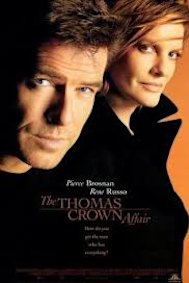
The promotional poster for The Thomas Crown Affair movie starring Pierce Brosnan and Rene Russo.Credit: IMDB
Crown’s former name was last seen on corporate records in early 2008 when he resigned as a director from Resilient Enterprises Pty Ltd.
He rejoined the company in 2011 as Thomas Crown.
Corporate records, mortgages and signatures from that time were in the name of Thomas Crown, prompting some who knew him to wonder if his name was inspired by the 1999 hit movie The Thomas Crown Affair starring Pierce Brosnan.
In the film, Crown is a handsome, cultured adrenaline junkie and self-made millionaire businessman. He is also an art thief who entertains himself by stealing a Monet.
Either way, by late 2013 Crown’s corporate records were in the name of Thomas Peter Crown. He goes by his middle name.
Commercial gains
Name change aside, Crown’s bullish property pursuits, penchant for debt and propensity for legal action remain distinctive features to this day.
So much so that of the more than 20 business associates who spoke to this masthead about their dealings with Crown, not one would do so on the record for fear of legal action.
To Crown’s credit, his reputation as a shrewd property investor is backed by title records. In a series of commercial property flips in the Camden area from 2013 he made a total capital gain of more than $3 million from three properties alone.
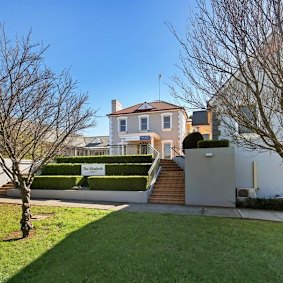
The Elizabeth was converted into eight separate office suites by Crown before it was sold for a total of $5.76 million.Credit: Domain
Other Camden investments were even more lucrative, but also highly leveraged, judging by the slew of mortgages and caveats registered on title during Crown’s ownership.
Two of those properties were owned in separate company names, both of which were placed into voluntary liquidation last year owing the Tax Office $970,000 and $294,000, respectively. The liquidator’s report states that the tax debts are disputed by Crown.
In 2018 Crown’s focus shifted to the start-up and tech sector. He was an early investor in the White family-backed Ailo property management software start-up, ploughed a few million dollars into wealth management technology provider Spitfire, bought into Boost Media until a company buyout last year, and was an investor in business incubator Innovyz.
It was enough to earn him the “tech bro” moniker, although they were not all financially rewarding.
Among his most significant investments were 10 million shares in Ailo. Acquired for about $8 million, they are now in the hands of receivers.
Spitfire entered administration in 2020 with $5 million owing to creditors, and Crown’s Resilient Investment Group among them.
Then there’s his investment in oil and gas production company AXP Energy (previously called Fremont Petroleum).
As the company’s largest shareholder of 100 million shares, Crown was appointed to the board in early 2019, and soon after credited with sourcing a $6 million loan facility to fund the ongoing development of a gas drilling field in Colorado from three family offices in Australia. Chief among them was the late Lynette Harvey, former wife of billionaire Gerry Harvey.
It was a triumph for Crown. He was paid a one-off fee of $200,000 for his efforts and elevated to chairman of the board. In announcing his appointment Crown was credited with bringing “considerable experience and skills to the company through over 20 years in investment markets”. He was 35.
Loading
A slew of good news disclosures followed, but when each announcement was followed by significant share sales it raised questions as to whether anyone was selling their stock during the blackout period.
Despite denials, an investigation the following year revealed all of Crown’s shares had been sold, most of them during a closed share trading period. It was a clear breach of the company share trading policy and ASX rules.
In explanation, Crown said he was not aware of the share trades during the blackout period, and that it was initiated by his private wealth management team without his approval. A subsequent probe by the corporate regulator deemed the trades as not suspicious. It was not a lucrative sell-off by Crown.
The Highlands life
Just as Crown was being cleared for his AXP share trades in 2021, Hume Coal lost its decade-long bid to build an underground mine under vast swaths of pastureland in the Southern Highlands. In response, the South Korean parent company, Posco, put the entire aggregation of farms up for sale in one job lot.
What followed was a bold property play in which Crown emerged as the bullish $101 million buyer, secured behind the scenes by loans from three non-bank lenders after National Australia Bank pulled its in-principal approval a few weeks before settlement.
Within days of taking possession Crown flipped the largest farm, Mereworth, to the Medich family for more than $49 million.
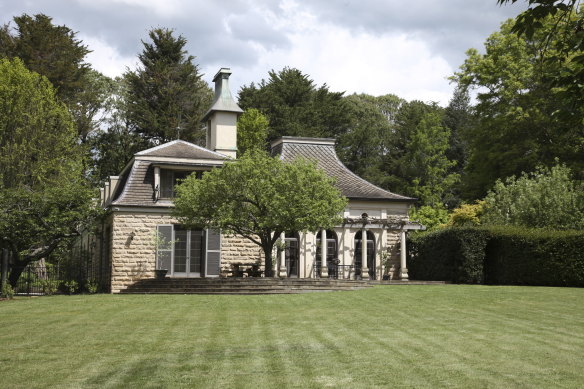
The historic Mereworth property at Berrima, with its distinctive mansard roof, was designed by architect John Amory.
But in the years since then, Merricks Capital’s outstanding debt on the deal has grown to more than $122 million, with more than $15 million owed to the second lenders, Bridge Street Capital and Saddleback Mountain Estates, according to separate Supreme Court judgments.

The Bronte house sold last year for $17.7 million has returned to the market for $20 million.Credit: Domain
If Crown was sweating on the financing, he didn’t act like it.
Instead, Crown splashed on one of the district’s oldest farms, Newbury Farm, for $38.5 million, and a trophy home in Bronte for $22.65 million.
As the deadline on the Merricks Capital debt lapsed in 2023, and various corporate entities were handed to receiver Costa Nicodemou, of Newpoint Advisory, Crown hatched his grandest plans yet.
Cattle-grazing paddocks that made up his Leets Vale farm were on the drawing board to become Celer Club, a luxury auto lifestyle club with a world-class racetrack, and 220 premium trackside villas, a luxury clubhouse, conference centre, hotel and health spa designed by South Australian architecture firm Studio Nine Architects.
It was deemed a once-in-a-lifetime project by some of those involved, but others were less impressed when their bills went unpaid. More than $60,000 remains owed to the architect firm alone.

An artist’s impression of the Celer Club automotive racetrack at Berrima was designed by Studio Nine Architects.Credit: Studio Nine Architects
The farm next door was proposed as an auto-industrial park, with 43 commercial lots and early interest from major brands Bunnings and Ampol.
But even before receivers took control of it Bunnings had decided not to proceed, and a spokesman for Ampol said there was no contact with them over the site.
Then there was a proposal for an agritourism operation in Sutton Forest called Farm Gate, with crop-to-shop market stalls, a paddock-to-plate restaurant, and eco-lodges.
But 18 months after Crown purchased the 40 hectares for $4.25 million his lender, billionaire Robert Whyte, locked him out of the property. It was recently sold mortgagee-in-possession for an undisclosed price.
Crown’s most ambitious plans were reserved for Evandale farm to be redeveloped it into a town with up to 5000 new homes, of which 10 per cent would be designated for affordable housing and five per cent as build-to-rent housing.
This time last year Wingecarribee Shire Council and the state government’s planning and transport departments were already being briefed on the Evandale Town precinct proposal, but by the time an up-dated proposal was rolling off the printers in March receivers had foreclosed on it.
The almost 600-hectare farm was recently being shopped around mortgagee-in-possession amid talk of a $50 million sale before a buyer entered negotiations. It is understood potential buyers have raised the prospect of pursuing the Evandale Town plans.
Crown’s other legacy project, Silicon Highlands, was more progressed by the time Newpoint Advisory took over. But on the day Crown was expected to formally present the technology and education park to Wingecarribee Shire Council, he pulled out.

An artists’ impression of the Silicon Highlands development that was proposed by Peter Crown.Credit:
Councillor Rachel Russell told Crown’s office she planned to confront him about a claim he owed $10,000 to a local earthmoving company.
“That’s a lot of money for a business like that,” she said. “It appeared they would need to take court action to get the money.”
When Crown didn’t show, Russell confronted a member of his team instead. “I wanted to send a very clear message that we are a community here in the Southern Highlands and we look after each other,” Russell said.
That business has since been able to recoup some, but not all, of the debt.

Councillor Rachel Russell of Wingecarribee Shire Council had planned to confront Peter Crown.Credit: Wingecarribbee Shire Council
Dave Hough, of Excel Earthworks, said he hasn’t been so lucky, and is still owed about $80,000 for a month-long job in which he and his crew built a driveway across the Sutton Forest farms.
Hough said Crown later agreed to pay about $39,000 to cover half of the bill, but he didn’t accept it because he was owed more than that in materials.
“What am I going to do, spend $50,000 in court to get $30,000 of it?”
Private jet company Navair is doing just that, launching legal proceedings in the Supreme Court recently in pursuit of unpaid bills in the tens of thousands for one flight. Crown is counter-suing in a bid to be repaid a deposit for flight he never ended up taking.

The almost 600-hectare Evandale in Sutton Forest was the largest of Peter Crown’s farms before its ownership was taken over by receivers.Credit: Tim Bauer
As Crown’s financial worries have grown, his ranks of supporters have shrunk. Nine months after Crown assembled a team of highly regarded C-suite executives to run his family office, all of them have left amid suggestions they are owed hundreds of thousands of dollars in unpaid pay, superannuation and leave entitlements.
Listed among the creditors of the companies in receivership is Revenue NSW, second lenders Bridge Street Capital and Saddleback Mountain Estates for their $14 million, and Wingecarribee Shire Council’s more than $10,000.
As receivers have moved in on more of Crown’s interests, other parts of the property empire have been sold. The Bronte house that was laden with debts on title was sold earlier this year, proving a loss on two years’ ownership.
The last of Crown’s Camden interests, the Camden Stockyards, sold earlier this year for $4.55 million after receivers took control.
Newbury Farm, arguably Crown’s best farm, is the latest loss to his portfolio.
Having purchased it for $38.5 million in 2023, Crown had appointed McGrath Estate Agents to sell it earlier this year for $48 million.
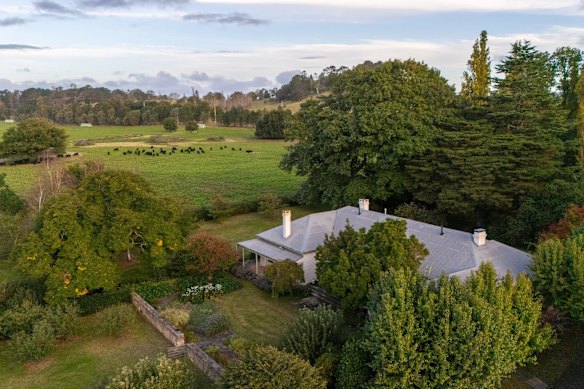
Newbury Farm was purchased for $38.5 million in 2023 and when it didn’t sell was handed over to receivers in December.Credit: Domain
When it didn’t sell, and just days before receivers were appointed, Crown sold off the farm’s 575 Angus cattle.
A mortgagee-in-possession sale campaign is expected in the new year.
That leaves Crown with the family home, a $5.3 million residence known as Hampton Lodge. Owned since 2011, it was his first significant purchase after he changed his name. Set behind an electric gate and tree-lined driveway, the property boasts a pool, landscaped gardens, four mortgages and two caveats from his other lenders.
It is held in the name of Angelwood Investments Pty Ltd, which is now also in administration.
While Merricks Capital are understood to be confident of reclaiming at least the principal of their loans, Crown has continued to try to claim any income from the properties.
As Crown’s debts have mounted on the back of penalty interest rates, he has tried to wrest control of the properties away from the Merricks Capital-appointed receiver to claim any income from the properties.
In the latest round of legal action over the Southern Highlands land aggregation, Supreme Court documents detail how Crown emailed local farmer Matthew Kowalski to falsely claim that the receivers “no longer have any authority”, and directing him to pay his agistment fees to Crown, rather than the receivers.
The next day Crown made a similar claim to the real estate agent enlisted to sell the Evandale farm, Ben Wicks, and to the Ray White property manager, Kate Welsh, who was managing one of the rental properties.
Justice Michael Ball took a dim view of it, issuing a damning declaration that Crown had engaged in misleading or deceptive conduct.
For all the detractors and creditors that surround Crown, he still has a modicum of support, albeit from someone who is not owed money.
A former contractor, speaking anonymously given a request from Crown not to speak to the media, said the issue is not Crown, but the lenders behind him.
“How is it legally allowable that one person is able to borrow that much money? Smart people will exploit the system, but these loans were also exploitative.”
Get the day’s breaking news, entertainment ideas and a long read to enjoy. Sign up to receive our Evening Edition newsletter.