3 months ago
25
3 months ago
25
″I was so nervous this morning, I made the mistake of looking at a bunch of other Lunch Withs and just went, ‘Oh my god, what the f--- are we going to talk about?’”
I’ve just finished a near two-hour lunch with Mike Callander, a resident DJ of 15 years at Revolver Upstairs, and this comment throws me.
Whether you’ve been a “Revs” club rat or have never hiked up its foreboding staircase, Melburnians have an enduring fascination with the institution that has come to define the city’s nightlife and one which, fortunately for me, Callander thinks of as a second home. In other words, there is plenty to talk about.
Callander, 45, has held a residency at Revolver since 2010 – more than half of the club’s 28-year history in Chapel Street, Prahran. Today he plays for partygoers in the early hours of Saturday mornings, often from 2am to 5am.
We’re sitting at Cookie, a Thai restaurant and bar established by Revolver founder Camillo Ippoliti in the Melbourne CBD’s Curtin House.

The lotus root salad with sweet potato, watercress, cashew and cherry tomato.Credit: Joe Armao
The lotus root salad is a must, Callander says. The dish is beloved among his clubbing friends and is also served at Revolver’s Colonel Tan’s restaurant, which runs five nights a week on the venue’s rotating roster of vintage couches.
Revolver evokes different meanings. On the one hand, it is a respected stalwart of Melbourne’s electronic music scene, attracting international headliners such as Fatboy Slim, Fred Again and Bicep. It’s also seen as a rite of passage and safe space for Melburnians who want to let loose among like-minded techno lovers. On the other, it holds a rare 24-hour liquor licence, which has fuelled stories of the Revs vortex that absorbs dedicated pill-poppers for three-day benders.
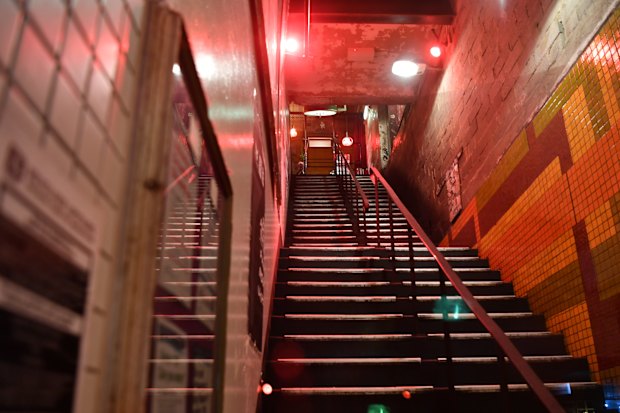
The Revolver staircase.Credit: Joe Armao
Callander has seen it all, and he’s quick to squash urban myths that people have been found dead beneath the pool table or behind a couch.
“It’s absolute rubbish,” he says.
“There’s a lot going on there and you can choose what to focus on: people taking drugs one night, the amazing restaurant, the art on the walls. I’ve seen a chamber orchestra playing there, a BMX competition, I’ve done DJ lessons.”
Callander first experienced Revolver as a fledgling club kid in 1998, a year after it opened.
“The funny thing is, it’s almost exactly the same,” he says.
“I just could not believe how random it was, the whole club full of people sitting down, or dancing on the tables, and the tables were covered in ash.
“It was just awesome … the place felt a bit lawless … It just felt like you could have been in Berlin and you were doing something cool.”
Callander’s love of dance music came from his older brother. He recalls being 13 and hearing a DJ-mixed CD for the first time. “It became an important little totem for me, going, ‘How is the music never stopping?’”
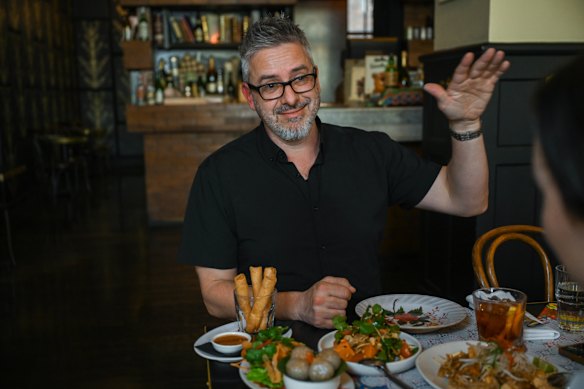
Mike Callander at lunch at Cookie in the CBD.Credit: Joe Armao
Callander started making music as a teenager on his keyboard and, in the late ’90s, dove into Melbourne’s rave scene.
“It was just like another world,” he says. “Pretty quickly, I was like, ‘I’ve got to be part of this somehow’.”
At 18, he bought a set of turntables using money from his parents intended for a car. “They were totally pissed [off],” he says.
His dad eventually embraced Callander’s career choice after he started getting paid gigs in 2001. For his mum, he says, it remained “a symbol of unrealised potential” until he got a PhD in music three years ago.
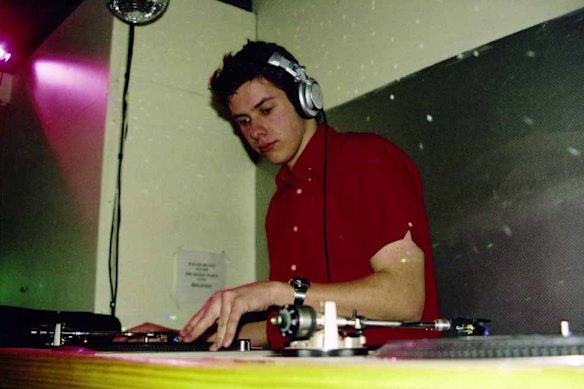
A 2001 photo of Mike Callander, believed to have been taken at the former Sub Club on Commercial Road, South Yarra, where the nightclub Circus now is.
Callander says his first big break was getting a job DJing in 2005 at Honkytonks, a CBD nightclub that contributed heavily to Melbourne’s laneway culture before it shut in 2007.
“That was like receiving a trophy,” he says. “For people of my vintage, Honkytonks was legendary. You would walk down a laneway, no idea where you’re going, and walk into a tiny club, 300 people max, with the best music.”
Callander went on to play 10 summers in a row in Berlin (“the first time, I felt like I was going to the Olympics”) and has worked with Australian artists The Presets and The Avalanches.
But it’s Revolver that has been his biggest career constant. It’s even where he forged a romance with his now-wife in 2012 after meeting her in a German club a year earlier.
Callander plays in the back room, the best-known of the club’s two rooms with its quirky smattering of old couches and a floor-to-ceiling cage protecting the DJ booth.
“It’s actually a really hard room to DJ at. The crowd is transient; it’s not a focused DJ-dance floor topography, it’s just people floating around everywhere. The chaos of that is what makes it awesome as well.”

Vegetarian red curry with tofu, snow peas, tomato and pineapple.Credit: Joe Armao
When things aren’t quite clicking, his manoeuvre is to deliver a surprise – like mixing The Nutbush or a Billie Eilish song with heavy, minimalist techno.
“You may as well get more risky rather than safe,” he says.
You’d be hard-pressed to find Callander’s music online. His Spotify feed is limited and, unlike most DJs, he doesn’t upload his sets to SoundCloud.
“Music’s so disposable now. I’m not diluting the value of this by going, everyone can have it,” he says. “I’m so fortunate that I established myself before the influencer phenomenon ... I want to just do it and I want the room to be full.”
Callander believes the secret to Revolver’s long-standing success is that between Friday night and Monday morning, party-seekers can count on the club being open.
“It never shuts early … If you’re looking for a party, you’ll find one. Some of my favourite moments are when I’ve DJed an early set, there are five people on the dance floor, and they’re having the best night of their lives.”
Revolver doesn’t shy from the fact that people take drugs within its walls.
“Every night there’s a level of debauchery. I’ve seen people completely naked on the dance floor,” Callander says.
He points out that people consume drugs anywhere; the football, the races.
“If they take drugs at Revolver, and they’re not well, they’ll look after them. They move mountains to make sure people are safe.”
He says the club occasionally has signs warning patrons of a life ban if they’re seen taking the drug GHB or urging caution over dangerous pill batches doing the rounds.
“For a business to have survived this long, it’s such a tight ship,” he says. “Revs would have the cops on speed dial.”
But, by and large, punters keep returning to Revolver because its pounding bass and dark, grungy rooms are giving them something, be it a spiritual experience, an escape or a much-needed dance session. Some clubbers refer to Sundays at Revolver as “going to church”. For Callander, it’s more of a meditation.
“There is something about dance music and clubbing: time can stand still, you can feel elated or you can disconnect from whatever is happening, and that’s important to people, it’s therapeutic,” he says.
“There’s a material aspect too. If something’s so loud, it’s physically moving. It gives people what they want when they need it. It gives them too much sometimes as well.”
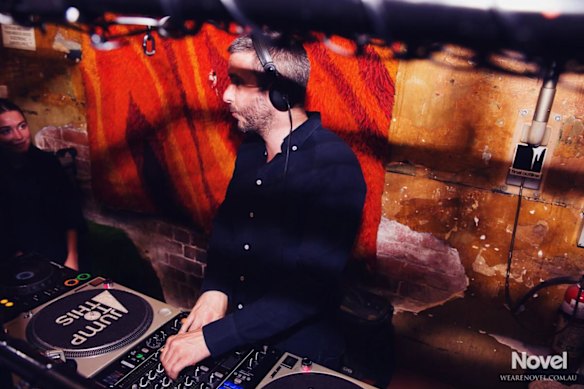
Mike Callander in the cage at Revolver Upstairs in 2013, with now-wife Annie looking on.Credit: Courtney Guthrie
Callander says he frequently has moments from behind the decks that make his heart flutter.
“When I’ve put two tunes together and gone, ‘Oh my god, I can’t believe how good that sounds’ and other people feel that … it’s magic,” he says.
The unforgiving hours of DJing can take a toll. Callander admits that in his 20s, his lifestyle wasn’t healthy. He’d go out Friday, Saturday and Sunday nights, roll straight from clubs into family gatherings and spend all week putting his head back together.
Today, he religiously has a four or five hour “disco nap” on Friday evenings before heading to Revolver, and he rarely stays out after his set. “When you get to 45 it really hurts. At some point you have to choose what’s most important … Life’s just way better when you’ve had [sleep].”

Tapioca dumplings with lotus root, pickled turnip and peanuts.Credit: Joe Armao
Revolver, partly because of its long history, has a wide-ranging demographic. Young and old clubbers are perfectly comfortable there, Callander says. It’s only recently that he started to feel some ageism while inside the DJ cage, with young people probing his age.
“Post-COVID there’s a generation of people who didn’t learn about clubbing from going out,” he says. “They learnt about clubbing on Boiler Room, a YouTube channel with DJs surrounded by people posing. And so they go out and they’re right up in your face and they’re like, ‘Why are you here? You seem to be not the hot new thing.’”
As for today’s clubbing culture, Callander notes that young people are unquestionably drinking less, posing a problem for club owners around the city due to the drop in spending. Whether it means young people are taking more drugs, Callander isn’t so sure: they go home earlier and don’t appear out of control, he says. It could be that “wellness” is a growing priority or it could be that more partying is occurring at home, before and after the club, to save money.
“Everyone is reckoning with how to make a living from this,” he says.
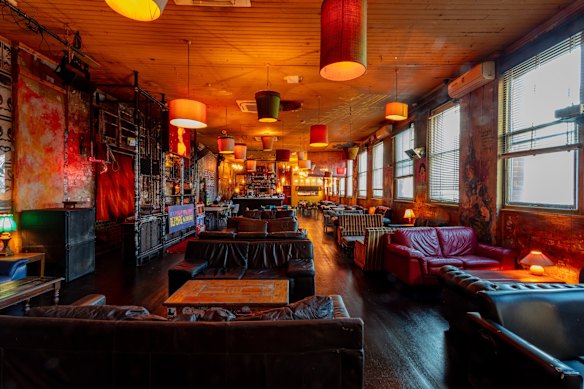
The Revolver back room, when it is laid out for the Colonel Tan’s restaurant.
Revolver is also not completely immune to the problems on Chapel Street, he says. The once-renowned party strip is dealing with a rise in store closures, homelessness and violence. But he says the club’s strong foundation helps it withstand the troubles.
Callander now balances his Revolver residency with his full-time “day job” – his first in more than 20 years. He is a lecturer and researcher of electronic music and DJ culture at RMIT University, and loving it.
I ask what keeps him motivated to continue climbing the Revolver staircase every Friday night.
“As I’ve gotten older, and my inclination to be out in the middle of the night has subsided, it’s the craft,” he says. “I feel like I can add some value to the experience that people are having. And on a selfish level, I love the music, and I want to choose the music.”

The bill.Credit:
The two jobs, of course, also complement each other. His practice supports his teaching, and he gets to see Melbourne’s nightlife through the eyes of his Gen Z students.
“My night job is part of the reason why they want me working at RMIT. Revolver is an institution. Artsy people see the art in it.”
Callander has lately been pushing deeper into his craft. He bought a lathe to cut his own records, and he’s eager to explore new settings for DJing, such as through art gallery or dinner events – an idea that some older electronic fans, who don’t want to be out past 1am, would appreciate.
“I’m not going to be clubbing forever, but I’ll be DJing forever.”