3 months ago
21
3 months ago
21
In a colourful modular building monitored by CCTV cameras, Ciara Moore sat in front of seven squirmy four-year-olds and did something that some people here in Belfast – maybe the ones who occasionally throw raw eggs over the two locked security fences – consider an act of insurgency. She put a tiny bunny puppet on her index finger and said the word “coinín”.
That’s Irish for rabbit, which her mixed group of Protestant and Catholic preschoolers dutifully repeated back to her. They did the same for the Gaeilge (Irish) words for “dog”, “blue”, “yellow” and “gingerbread man” (“fear sinséir”).
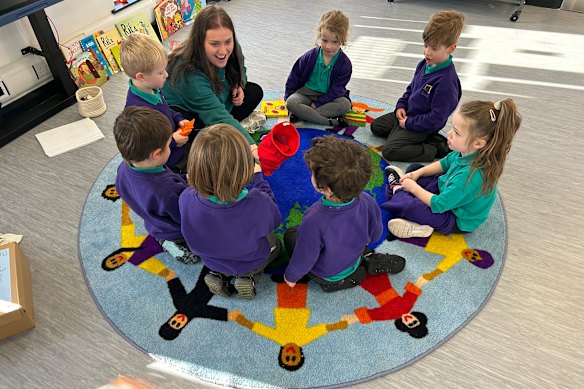
Ciara Moore, the principal of Scoil na Seolta, teaches a lesson in shape and colours to a class of four-year-olds.Credit: Steve Hendrix/The Washington Post
The lessons are rudimentary, but that they are happening in Belfast – especially in this heavily Unionist neighbourhood, where Union Jacks are more often seen than Irish tricolours, is remarkable and profound.
Moore is a teacher and the principal of Scoil na Seolta (School of Sails), which opened last year as the first all-Irish-language preschool and primary school in East Belfast, where many painted walls still pay homage to the armed, Unionist paramilitaries of the country’s decades-long sectarian conflict.
Built on the site of a closed industrial drill-bit factory, the school is part of a resurgence of the Irish language across Northern Ireland, where for centuries the ancient Celtic tongue had been driven out of public use by law, custom and hostility.
Gaeilge’s growing popularity – even among Protestant parents who have signed up enough children to double the size of Moore’s class next year – marks a stark shift in attitudes about culture, identity and heritage that are gaining pace throughout Belfast, at least when it comes to linguistic tradition.
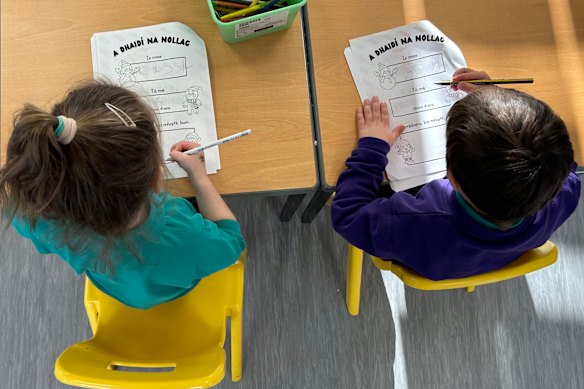
Pupils work on an Irish-language lesson at the Scoil na Seolta.Credit: Steve Hendrix/The Washington Post
New initiatives are installing bilingual signage for roads and buildings, and Irish-language schools and classes are emerging in areas that were once exclusively English-speaking and fervently loyal to Britain.
A few years ago, the Irish speakers who came into Oisin McEvoy’s stylish cafe, Neighbourhood, in central Belfast would whisper a surreptitious “maidin mhaith” (good morning), a secret-society test before speaking openly.
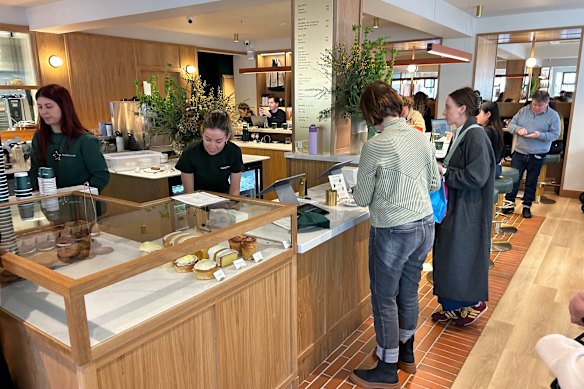
At Neighbourhood, a cafe in central Belfast, it has become common to hear Irish spoken by customers and staff alike. Credit: Steve Hendrix/The Washington Post
Now the place is full of bilingual babble, the Happy Christmas cups say “Nollaig Shona” and many of McEvoy’s young baristas are fluent, reflecting the first generations who began learning the language early and openly.
“We want Irish to be part of the fabric of Belfast,” said McEvoy, a Catholic whose partner in the business is a like-minded Protestant. “And now it is really beginning to feel like it is.”
The government, which suppressed Irish for decades, is now openly boosting it. Irish was granted protected minority language status in 2022. In October, the Belfast City Council, over objections from Unionist parties, approved £1.9 million (about $3.8 million) to install bilingual signage in official buildings and apply new bilingual logos to city uniforms and vehicles.
And the region’s first-ever Irish language commissioner took office in November with a mandate to promote and protect the language in more than 100 public bodies in Northern Ireland.
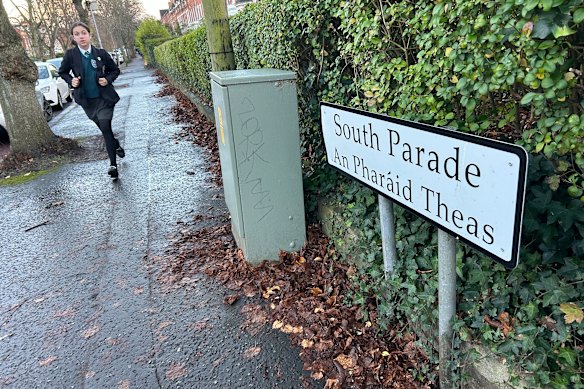
Individual streets in Belfast can now opt for bilingual signage, as long as at least 15 per cent of residents agree.Credit: Steve Hendrix/The Washington Post
To Irish supporters and opponents alike, it all feels like a tipping point in the long fight to bring the language out of the shadows, efforts that started with wildcat schools in church basements in the 1970s and gained momentum after the 1998 Good Friday Agreement, which ended sectarian violence and established a power-sharing arrangement.
In recent years, Irish appears to have overcome the lingering resistance that remained even after the law caught up. With a boost from the super-popular all-Irish rap band Kneecap, the language is spreading across Northern Ireland – with its 35 Irish primary schools – becoming commonplace throughout the nationalist strongholds of West Belfast and getting footholds in Loyalist strongholds.
“It feels like something irreversible is happening in the last few years in the nature of Irish as language, as something to be proud of,” said Mark Harte, an expert in Irish at Queen’s University Belfast’s Language Centre. “Irish is both visible and heard on the streets now.”
Loyalist leaders have opposed most initiatives and voted against elevating Irish to official minority language status. They have raised concerns about the cost of bilingual signage and levelled accusations that the changes were rammed through council.
Clive McFarland, a spokesman for the Democratic Unionist Party, said many of its Loyalist constituents feel that Irish is being forced on them for political purposes with an eventual goal of reunification with the Republic of Ireland to the south and west. Some call the spreading of the Irish language the “greening of Ulster”.
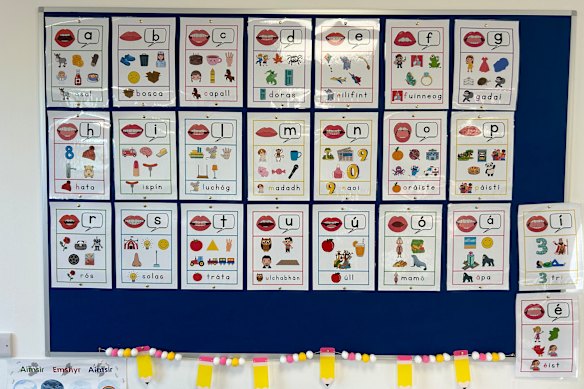
An Irish alphabet chart in Ciara Moore’s classroom.Credit: Steve Hendrix/The Washington Post
“There are some who wish to see Irish imposed on the whole society,” McFarland said, “because they are trying to make Northern Ireland less like the United Kingdom and more like the Republic of Ireland.”
Irish isn’t new to Northern Ireland, but it had almost disappeared. The language dominated the island for centuries, its written lineage running from inscribed Ogham stones to early Christian manuscripts.
But Irish began to be supplanted with English colonisation. Over time, laws banned Irish in courtrooms and government bodies. Schools punished children for using it. The Great Famine wiped out entire rural populations of Irish speakers through death and emigration.
After the island was partitioned in 1921, Northern Ireland’s British government treated Irish as a republican threat. The language moved behind closed doors, kept alive by families and fighters. “Every word of Irish spoken is a bullet fired for Irish freedom,” was a slogan cited by partisans on both sides.
“There was a lot of hostility around the language, controversy that was created around it,” Séamus Mac Dhaibhéid, 69, said. As a teenager, he had his school bag dumped out by British soldiers on a regular basis when they heard him speak Irish.
Mac Dhaibhéid grew up as part of an early underground campaign to resurrect and protect Irish. He and others would affix Irish street signs below the English versions in his hometown of Newry, find them torn down the next day and put them back up.
“Now almost every street sign in Newry is bilingual,” said Mac Dhaibhéid, who teaches Irish classes five nights a week.
He was among a growing cadre of advocates taking the fight public. Ciarán Mac Giolla Bhéin was another. In the early 1980s, his parents put him in an unauthorised Irish school in the basement of a desanctified Presbyterian church on Belfast’s Falls Road. There was no public funding; parents did the painting, cleaning and some teaching.
“Our lab equipment was a picture of a Bunsen burner,” Mac Giolla Bhéin recalled.
But the school stuck. The church is now the Cultúrlann, a busy Irish community centre where Mac Giolla Bhéin was having coffee in the bilingual cafe. He is the first Belfastian to become president of the Conradh na Gaeilge (the Gaelic League), a Dublin-based Irish-language institute.
Outside, the bilingual street signs and storefronts lining Falls Road, once one of the most contested fault lines of the conflict, provided evidence of his group’s success.
“For us, the very physical manifestation of equality is having Irish and English side-by-side on a sign,” he said. (A sleek new crosstown bus connecting West and East Belfast passed as he spoke; it displays destinations in Irish until it reaches the city centre and then switches to English only.)
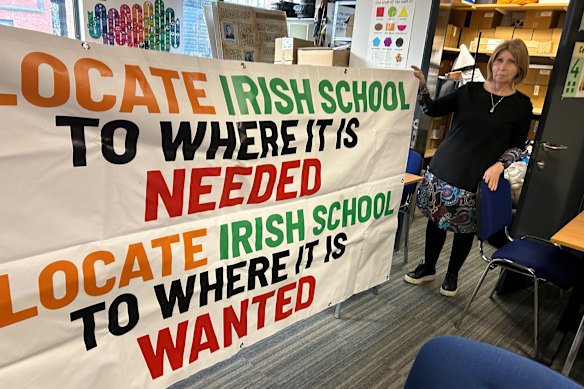
Linda Ervine, an Irish-language advocate in East Belfast, displays one of the protest signs hung outside the Irish school she started in that Loyalist part of the city. Credit: Steve Hendrix/The Washington Post
Maybe the least likely champion of Belfast’s Irish revival is Linda Ervine, an East Belfast Protestant with impeccable Unionist credentials. Her husband is a former leader of the Progressive Unionist Party and her brother-in-law, David Ervine, was a onetime paramilitary fighter imprisoned for transporting a bomb who became a supporter of the peace process.
Ervine, on a whim, sat in on an Irish lesson and fell in love with the language. She founded some of the city’s most important Irish organisations, all on her Unionist side of town. She was a driving force behind the School of Sails, a few blocks away. And Turas, the Irish-language institute she started in 2012, runs 22 classes a week and has taught Gaeilge to thousands of East Belfastians.
Many of those living on surrounding blocks, including ex-paramilitary fighters and teens who watch Kneecap on TikTok, hadn’t realised that so much Irish was around them, buried in the Anglicised names of streets and parks. Ervine grew up just as unaware.
“I never even knew that I had been born in Béal Feirste,” she said, using the original Irish that means “mouth of the sandy ford” and eventually became Belfast. “That part of our identity was denied to so many of us.”
Not all neighbours are interested in that part of their identity. Some old friends won’t talk to Ervine any more, and she routinely gets an earful from locals who tell her “the Irish” isn’t welcome in their part of the city. One night, someone strung a banner reading: “Locate Irish School To Where It Is Wanted.”
Loading
“It’s all political isn’t it, forcing this on us?” David Floyd said, as he was nursing a lager at the Great Eastern pub, two blocks from Ervine’s centre and across the road from a mural honouring Loyalist fighters wearing balaclavas. “They put those signs up on streets around here, and they’ll be on the ground within days,” Floyd said.
But for Ervine, who identifies as “both British and Irish”, the growing interest in the island’s indigenous language is beginning to connect more Belfast communities than it divides. “When they first started coming, they didn’t want their friends and neighbours to know,” she said. “Now they are bringing their friends and neighbours with them.”
The Irish phrases included in this article were recorded by Sean McLoughlin, the president of Scoil na Gaeilge Sydney (Irish Language School Sydney). Northern pronunciation of the word “Gaeilge” (Irish language) sounds like “Gaylig”, while in other dialects, it is pronounced “Gwayle-guh”.
The Washington Post
Get a note directly from our foreign correspondents on what’s making headlines around the world. Sign up for our weekly What in the World newsletter.