3 months ago
25
3 months ago
25
Brett Lee’s first ball to a Test cricketer swung wide – at a fair clip, of course – and would’ve finished at gully if not for the SCG netting.
Some six years before the most storied of Boxing Day Test debuts, when he razed India with 5-47 and a wicket in his first over in 1999, Lee first rose to prominence in Australian cricket circles – once he landed a ball on the pitch.

Brett Lee celebrates his debut Test wicket - Indian opener Sadagoppan Ramesh - at the MCG.Credit: Will Burgess
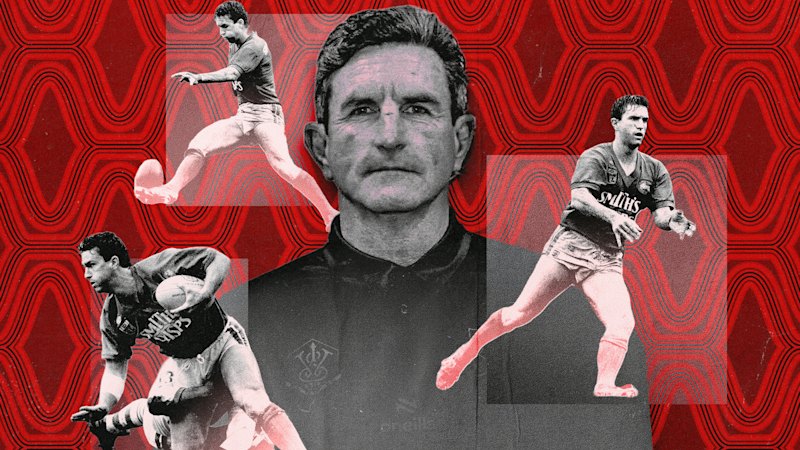
Lee is the latest inductee to the Australian Cricket Hall of Fame, some 32 years after accepting an invitation to bowl at modern-day greats Allan Border, Steve Waugh and David Boon as they prepared for the travelling World Series carnival of 50-over cricket.
At 16, short and still whippet thin, Lee may have borne a passing resemblance to the champion greyhound that would one day be named after him. He still “had to run around under the shower to get wet”, after all.
His mother, Helen, dropped him out the front of the SCG after driving up Mt Ousley in the Mitsubishi Sigma that ferried brothers Shane, Brett and Grant from Oak Flats to any number of suburban grounds.
He raised eyebrows marking out his run-up, given he marched 15 metres past the mark set by Craig McDermott, then Australia’s foremost fast bowler. His first ball drew guffaws as it cannoned straight into the off-side net, but little more than a grunt from Boon facing up at the other end.
“Second ball, brand new white ball, it swings to leg, straight into the other side of the net, on the full as well,” Lee laughs.
“Blokes are starting to laugh. Boony didn’t say much – just picked the ball up and tossed it back.
“I’m at the top of my mark again, full of nerves, I’m all over the shop. And I just think ‘Stuff this. Run in, bowl quick. Back yourself.’
“Third ball, it’s a perfect yorker, rips Boony’s pegs out. I’ve got this big smirk on my face and poor old Boony’s been stitched up with the worst practice you could imagine.”
Lee joins a cohort of Australian greats in the Hall of Fame courtesy of more than 700 international wickets, Test and World Cup triumphs and a career spanning more than a decade. His status as one of the game’s unfailingly, infallibly nice guys is a genuine badge of honour.
“I loved winning, I loved taking wickets and the teams I played in,” Lee says.
“But my biggest personal achievement in cricket was bowling fast. Going past the 160km/h barrier – that’s what I’m proudest of.”

Brett Lee jumping for joy: a familiar sight throughout the 2000s.Credit: AP
‘An injection of straight adrenaline’: what it takes to bowl truly fast
Lee is one of five bowlers to have cracked the fabled 160km/h mark (in front of a speed gun, at least).
He swears he told his parents he’d do so, wearing the baggy green, at age nine.
Lee will turn 50 next year, and his body has been put through a wringer of 20-odd years of bowling at express pace.
Despite two broken backs, six ankle operations, busted shoulders and elbows, his frame has survived remarkably well for all the work Lee put into his craft.
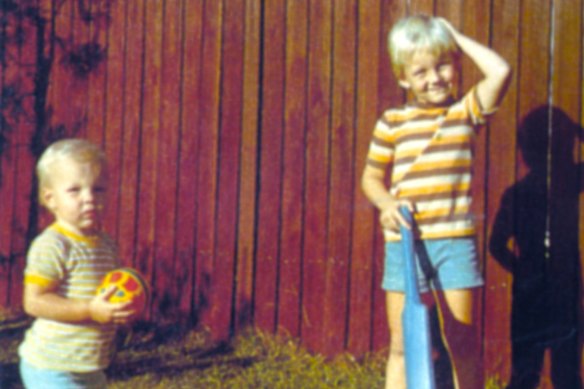
Brett and Shane Lee as youngsters at their childhood home at Mt Warrigal on the NSW South Coast.
“I saw all the videos of Jeff Thomson bowling absolute rockets in the ’70s and ’80s, and I knew straight away that bowling fast was what I wanted to do,” Lee says.
“I knew it was going to be the hardest job in the world and I knew there were going to be sacrifices… I played my last Big Bash game when I was 39, and I was working on my bowling action right up until that last game. In my eyes, I never got it absolutely perfect, but I’m a bit of a perfectionist.”
Fast-twitch fibres from mum Helen’s sprinting background, his dad Bob’s doggedness and determination, and a childhood sparring in the family’s NSW South Coast backyard make for a fair fast-bowling base.
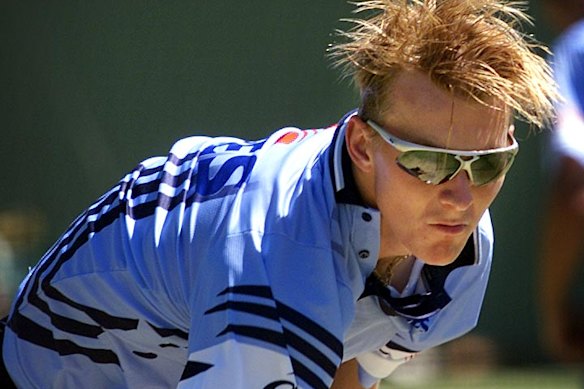
Speed demon: Lee training with NSW in 1999.Credit: Iain Gillespie
A ball randomly chased down a hill in Kiama as a teenager had “my legs in overdrive, moving faster than I’d ever moved. And I thought, there’s something here. How do I move as fast as possible, and transfer that into bowling faster?”
Soft-sand running. Lean muscle and body weight exercises over mass. Grass sprints and all manner of exercises and training programs cooked up by former Australian strength and conditioning coach Jock Campbell, who most memorably incorporated a parachute into Lee’s resistance training at the 2003 World Cup.
It all amounted to more than a decade of Lee sprinting 20-odd metres up to 120 times in a day. Launching his body into the air, snapping roughly 16 times his body weight through his front foot and slinging the ball at blistering pace.
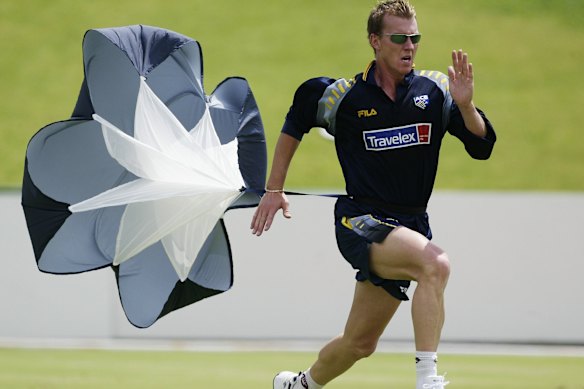
Brett Lee puts Jock Campbell’s parachute to work in South Africa.Credit: Getty Images
“You think about F1 and how they tune their cars – it’s so many minute things that have to be in sync,” Lee says.
“It’s all the training and preparation. It’s the wind, it’s your footmarks, snapping down your front arm and your wrist – it’s all timing and coordination.
“But when it all works, and the ball flies through to Gilly [long-time Test wicketkeeper Adam Gilchrist], there’s nothing quite like it. It’s the best feeling in the world. It’s like an injection of straight adrenaline when you can bowl truly fast.”

Lee left no stone unturned ensuring his body was fit for fast bowling.Credit: Getty Images
‘Binga, I’m going to kill you’: The great pace race
For young and old in the early 2000s, the closest we got to those Pulp Fiction-esque adrenaline injections was watching Lee and Pakistani contemporary Shoaib Akhtar push the boundaries of leather-flinging.
Where Shane Warne led spin bowling’s renaissance of the 1990s, Lee and Akhtar presented once more as the game’s rock stars, enigmatic with form that waxed and waned. But always at a rapid pace.
Dennis Lillee forecast the arrival of an unnamed speedster in October 1999 in an article for the West Australian, and by December that year, the world knew it was Lee.
A stunning spell at the WACA left veteran paceman Jo Angel with a broken arm and vaulted Lee into his Boxing Day debut. With Akhtar already pushing 155km/h-plus, the pair weathered questions over their bowling actions to steadily push each other toward the fabled 160km/h mark (100 miles an hour).
Setting aside the veracity of speed guns (Mitchell Starc’s own 160km/h measurement in 2015 was widely questioned), the 2003 World Cup in South Africa is considered a high-water mark for the pair.
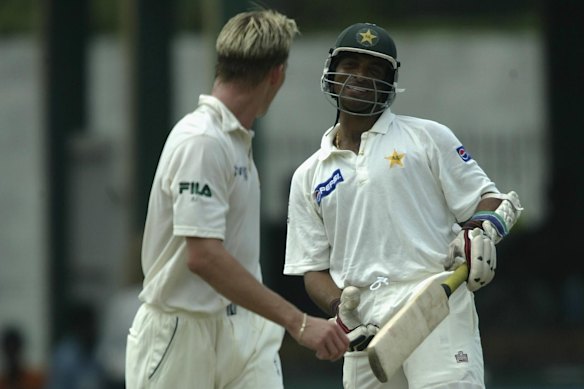
Shoaib Akhtar faces up to Brett Lee in 2002.Credit: Getty Images
Akhtar was clocked at 161.4km/h against England in Cape Town, while Lee terrorised both New Zealand and Sri Lanka with brutal displays of fast bowling as he claimed 22 wickets for the tournament and regularly pushed toward 100 miles an hour.
“I first saw Shoaib after playing for Mosman. We were sitting in the pub, and I’m watching on TV thinking, ‘this guy is something else’,” Lee says.
“Racing him to that 160 barrier, I loved every bit of it. It was exciting, I loved that he was an entertainer as well, and we’re great mates off the field. Even if he did try to kill me a couple of times.”
Right in the midst of their duels with the speed gun, it turns out.
“I’ve walked out to bat in a one-dayer against Pakistan at Docklands (in 2002), and from 70 metres away I can see Shoaib with the ball in his hand yelling out,” Lee recalls.
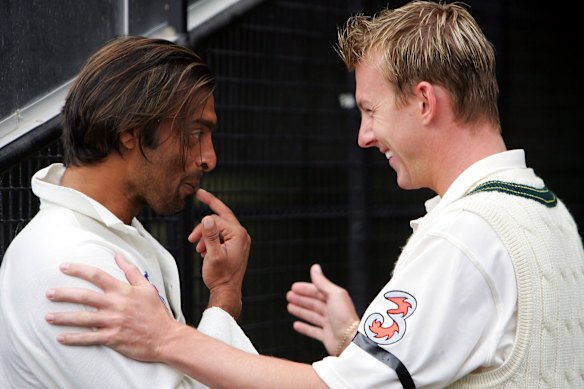
Akhtar and Lee: Great rivals, great mates.Credit: Getty Images
“‘Binga. Binga. I’m going to kill you’.
“First ball he’s come flying in with a yorker and it’s hit me on the toe before I could even move. I was happy to walk, I’ve given myself out LBW, ‘that’s plumb, thanks’ and marched off.
“But the umpire’s given me not out and called me back! We had some great battles and a lot of media hype, but I’ve always loved Shoaib’s approach to the game.”
And when Lee’s fastest ball ever recorded came, it wasn’t on a high-voltage WACA deck, the Highveld of South Africa or before a heaving MCG.
It was in Napier, New Zealand, in 2005, at the fag end of an ODI series Australia won 5-0. Unsurprisingly, a minor media storm had already kicked off as figures on either side of the Tasman debated whether Kiwi batsmen were scared of Lee’s devastating pace.
In his first over with the white ball, Lee ripped through the gears to New Zealand opener Craig Cumming. His fifth ball hit 160km/h down the leg side. The next was clocked at 161.1km/h, and wouldn’t you believe it, beat the batsman for pace.
“I remember the conditions that day,” Lee says 20 years on.
“There was a slight breeze over my shoulder, the sun was shining, it wasn’t a hot day. And most of all, I remember the popping crease.
Loading
“If I slid my front foot, I could lose 15kms, so I wore these big long spikes to dig in when I landed – that’s where all the power comes through. Landing that day was just perfect.
“I know the speeds of that over because people have shown me the vision, and I used to cop jokes about always turning around to check the speeds. But that day, like every day, I’m telling myself to focus on my technique and it turns out I’ve done something pretty special.
“I look at it now and think of all the training and hours I put in. All the injuries, everything I put into my body, and I wouldn’t change it.
“I wouldn’t change any of it because I got to bowl as fast as I possibly could.”
News, results and expert analysis from the weekend of sport sent every Monday. Sign up for our Sport newsletter.