
 4 months ago
48
4 months ago
48
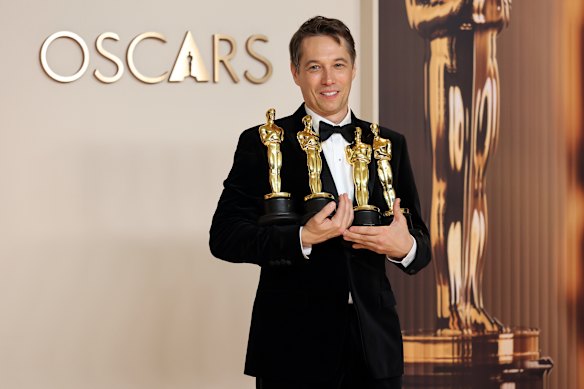
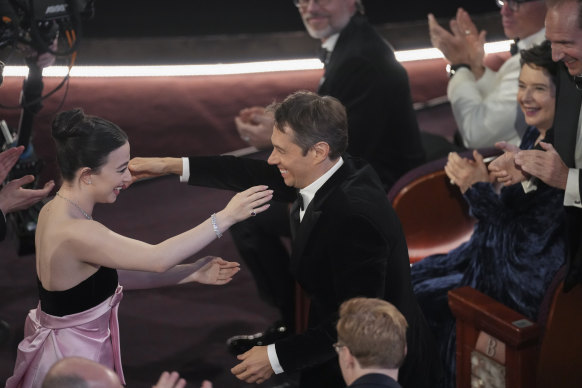
The 2025 Academy Awards could not have gone better. After winning the top prize at the Cannes Film Festival, the wild romance Anora cleaned up at the Oscars, with Sean Baker winning four times – for best picture, director, original screenplay and editing.
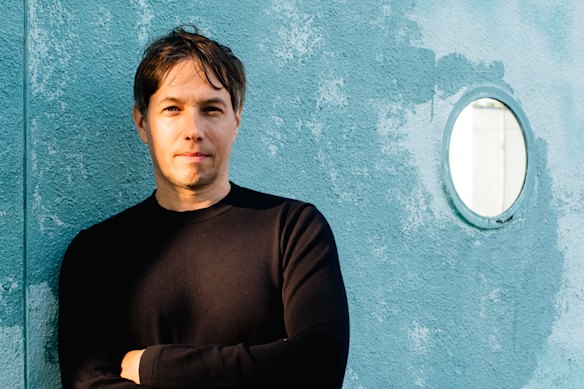
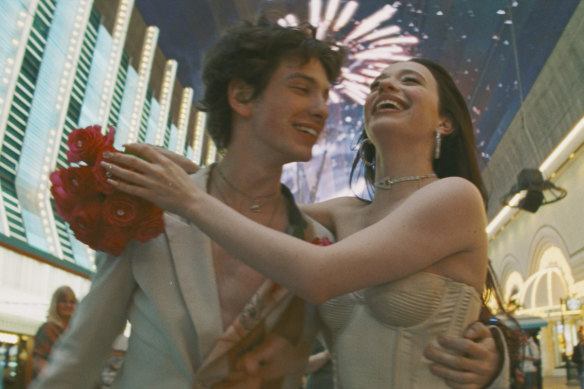
Only Walt Disney had done that before at a single Oscars, for producing four different films. Baker did it with one: a wild contemporary tale shot for just $US6 million, for which little-known Mikey Madison won best actress for playing a New York lap dancer swept into a freewheeling romance with a young Russian.
On stage at the Oscars he talked about three of his passions: the vital importance of films screening in cinemas, respect for the sex worker community, and why independent filmmaking – outside the commercial imperatives of Hollywood studios – matters.
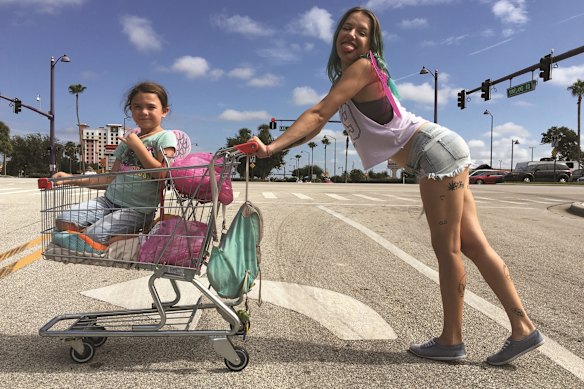
Baker, a youthful-looking 55-year-old, works with distributors who value film as art, led by A24 and Neon. The subjects of his heartfelt films have been marginalised Americans, including sex workers, strippers and porn stars struggling to make a living in Starlet (2012), Tangerine (2015), The Florida Project (2017) and Red Rocket (2021).
Since Anora, Baker has worked with long-time collaborator Shih-Ching Tsou on the Netflix film Left-Handed Girl (2025), set in a Taiwanese night market, and has directed a short for a fashion house, Sandiwara (2026), starring Michelle Yeoh and set in a Malaysian night market. He plans to shoot Ti Amo!, which is inspired by the Italian sex comedies of the 1960s and ’70s, this year.
Can we start, Sean, by talking about what that night at the Oscars was like for you?
Incredible. It took me almost a year to process it: just the intense gratitude I had for everybody involved. It was a passion project for everybody, from the actors to the PAs. It was just a great celebration.
It also meant I was able to get certain messages out during my speeches. The one that meant a lot to me was talking about the survival of movie theatres.
Has all that success changed you as a filmmaker?
I hope not. I try to check myself regularly. I’m going to stay in this independent space and perhaps get bigger budgets and get all of us paid a bit better. But I think what people like about my films is the DIY aspect of them. The indie/alt vibe that they bring. This success has allowed me to continue to do that.
Chloe Zhao made a Marvel movie, Eternals (2021), after her best picture-winning Nomadland (2020). Did you get offers to make a superhero film after Anora?
I didn’t, simply because I think I was so outspoken about the fact that I wasn’t interested. Chloe’s a good friend and I had a conversation with her about it. I’m like, “I haven’t gotten any calls”, and she goes, “I’ve heard directly from people at the studios that they would love to work with you if you want to but you’ve made it clear you don’t”.
I grew up on very mainstream popcorn cinema. Until my freshman year at NYU, before I was really immersed in global cinema, I was ready to make the next Die Hard, the next Robocop. I may, perhaps down the line, want to figure out how to do that. But right now I have a fan base that is looking for a particular type of thing from me and I’m all up for delivering that.
Why is the survival of cinemas so important to you?
We’re losing theatres almost by the day. It’s tragic. COVID really hurt things because people forgot how great it is to see a movie with an audience. The advent of streaming made people get used to watching movies at home. And the reduction of theatrical windows no longer makes the theatrical experience special.
If there’s a three-month-or-longer window I don’t see an issue with that. It will hopefully retrain the audience to say, “if I want to see a first-run movie I have to actually go to a theatre”. It’s how most filmmakers I know want their films to be seen – watching them with an audience where there are no distractions. There’s some hope because Gen Z [born between 1997 and 2012] is actually the biggest movie-going audience right now.
How do you feel seeing someone watching a film on their phone?
I’m like, ‘OK, you’re missing out’. It reduces the film to content and that’s pretty sad.
You once said that The Florida Project was the last film of your “sex worker trilogy”. Then you made two more with Red Rocket and Anora. What’s the appeal of characters who work in sex industry?
I’d done so much research in that world and become friends with sex workers, who were consultants on these films, so [I knew] there were more stories to be told. After Florida Project we were going in a different direction. We had a film that we were developing that COVID killed overnight.
That’s why we did a pivot to Red Rocket, which was an older idea on the back burner. It was exploring yet another world of sex work that just led naturally to Anora. I can tell you this, though: the next film does not contain sex work. Contains sex but not sex work.
How early did you want to become a filmmaker?
My mother brought me to the local library when I was five years old and they were showing clips from Universal monster films. It was the burning windmill sequence of James Whale’s 1931 Frankenstein that really did it for me.
I’ve talked to Guillermo [del Toro, whose latest film is Frankenstein] about this. That was the film that also made him fall in love with the movies. The night before I went to that library I wanted to be a construction worker. The next morning I was telling my mum I wanted to make movies.
Your mother was a teacher and your father was a patent attorney, and you’ve described them as “wonderful people, very ethical”. Is that where your empathy for marginalised people comes from?
I think so. The pursuit of empathy – to try to understand the plight of others – was something they helped forge. I went to a prep school in New Jersey, Gill St Bernard’s, that was very liberal. We were doing things in the ’80s that I don’t think public schools were doing – exploring the Iran-Contra affair and meeting with undocumented immigrants from El Salvador escaping persecution. So perhaps it also came from there.
Has it become harder to tell stories about an American underclass in the “end wokeness” Trump era?
I don’t think so. Our class divide is still as strong as ever. That’s what I’m exploring more – the class divide. If I look back at my films, that’s what I see. And also underground economies. I don’t think the Trump administration has changed that.
Do you see yourself as an activist as much as a filmmaker?
Interesting. With activism there has to be an overt stance. Not that I don’t have them but I don’t think it’s my job to preach to audiences. My job is to ask questions and to spark conversation and debate.
My movies up to now hopefully speak to both sides of the aisle. You can probably see my politics through it but I’m very careful about not preaching. Maybe a disguised activist or an undercover activist.
The New York Times has described your films as being about American dreams gone awry. What do you think of that way of framing your films?
I actually do perhaps agree with [that] a little more. I look back at my movies and I see all of my main protagonists are pursuing the American dream. But they have to pursue it through a different route. Sometimes they get there and sometimes they don’t. That’s life, that’s real.
There are people who cherish at least the idea of the American dream but don’t exactly have the same access to it because of their status in society. So they have to find another way to get there. It’s a pursuit.
How have you kept your social conscience and your optimism alive in dark times for the US?
It’s distressing that we’re so incredibly divided now that you can barely even talk about politics without perhaps losing a friend or getting cancelled. I can’t imagine being a young person navigating through this.
I’ve made the decision that my politics are infused into my work. That’s how I make my statements. That’s how I remain motivated, knowing that I’ll have that outlet. It’s dark times but I am hopeful.
How can independent filmmaking keep thriving, given the financial power of Hollywood studios and the major streamers?
It’s really about sticking to your guns. There are certain demands that I’m [requiring] moving forward and they’re contractual. I need a theatrical release. I need a long theatrical window, as long as I can get. I’m shooting on [celluloid] now. It’s important for filmmakers to support Kodak, the last company manufacturing this medium.
So there are certain things that filmmakers really have to fight for. A lot of my peers are literally buying theatres, [Quentin] Tarantino, Jason Reitman [among them]. They’re saying if that cinema has to be saved, I’m going to save it. We’re at a place where filmmakers have to do whatever they can do to save the art.
Are you OK with filmmakers being financed by, say, Netflix and making a Frankenstein?
Of course. That’s a business model that some people have to follow because of their budgets. Netflix is giving [del Toro] what he needs. Frankenstein did show around the world in theatres. Filmmakers who are working directly with streamers have to be, like, “give me some sort of theatrical release”.
But to each their own. We’re all struggling. We’re all just trying to get our films made. I don’t want to pooh-pooh anything.
Left-Handed Girl is a foreign-language movie – 100 per cent Mandarin – so it was a hard sell. Netflix offered so much more than the lower bidder that of course we had to go with them. But it wasn’t just a money thing. It was the perfect home for Shih-Ching’s film because she was a first-time director. It launched her career.
Millions of people have seen this film all over the world, probably more than all of my films combined. So we have to learn how to work with these different platforms that have different business models.
You shot the short film Sandiwara for fashion house Self-Portrait. What’s the appeal of this type of film?
I really enjoy making short films for fashion labels but it’s a side gig. It was a nice paying gig for me. Fashion films and perhaps commercial spots allow me to make money on the side. More importantly it’s my way of being able to be creative between features.
In the past I’ve worked with [fashion labels] Khaite and Kenzo. These three labels have given me 100 per cent artistic freedom. And I got to discover Penang, Malaysia, so it was a win-win. To work with somebody as iconic as Michelle Yeoh, it’s a no-brainer. She’s so fun, she’s so playful. There’s no diva attitude whatsoever.
What are you hoping to do when you’re in Sydney for Vivid?
I was at the Sydney Film Festival with Tangerine, so I’m looking forward to just taking in the city again. I’d love to visit independently owned movie theatres. I know you guys have a few movie palaces I’d love to see again. And I’m looking forward to your Australian coffee: the best in the world.
Sean Baker: In Conversation is at Vivid Sydney on June 7.
Find out the next TV, streaming series and movies to add to your must-sees. Get The Watchlist delivered every Thursday.

















































