3 months ago
26
3 months ago
26
Muslims have a tradition that the patriarch Abraham – father of Judaism, Christianity and Islam – never ate alone. He would go down to the highway and insist strangers came to share his meal.
It is a charming thought which has perhaps grown in the telling – it seems unlikely that a nomadic herdsman in Canaan (modern Israel) 3800 years ago would find traffic like the Hume Highway enabling such a practice – but it highlights the essential role of hospitality in the three monotheistic cultures and, indeed, most human cultures.
In modern Australia, other than for Christians for whom Christmas still has religious significance, hospitality is probably the real meaning of Christmas. It draws family, friends and others in a unique celebration of connection that is all the more important in an increasingly fragmented and alienated society.
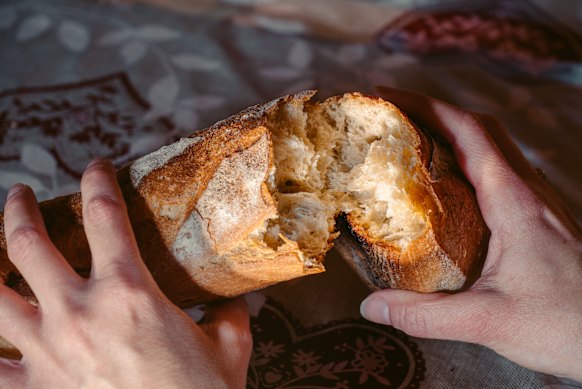
Hospitality - or breaking bread - is an obligation in Judaism, Christianity and Islam. The phrase came from the practice of tearing apart bread and sharing it; it gained meaning when Christ broke bread with his disciples, and was ritualised into Holy Communion in Mass.Credit: Getty Images/iStockphoto
To the voices that follow in this article, hospitality is many things. To the charity director it is the sacred space where strangers enter and leave as friends; to the top restaurateur it is the little details of things that go unsaid; to the professor of psychiatry it is inclusivity for the dispossessed and alienated; to the Anglican archbishop it is the shape of the Christian message of salvation but also its imperative; and to the Muslim hospice worker and volunteer it is about honouring the guest with love and humility.
These views share characteristics: hospitality is welcoming, it is sharing, it is generous, it helps provide joy and even hope and, above all, it connects people.
“The shortest distance between two people is a shared meal,” says Jon Owen, senior pastor at Sydney’s Wayside Chapel, which has been serving Christmas lunch for more than 50 years. “They dragged a few wheelie bins out to the top of the street and blocked it all off for a bit of a party, and it’s evolved from there. This year we expect anywhere up to 950 people.”
It is aimed at the homeless and lonely, but all are welcome. “Our mission is about creating community with no us and them,” Owen says. Many charities do great work, yet have a divide between those serving and being served. “But there’s something unique and precious when two people can sit down together, share a meal and just be two people who are celebrating Christmas,” he says.
“Christmas is a difficult day for many. To know a place has been set aside for you is very precious for many members of our community who know that somewhere there is a family celebrating Christmas that they are no longer welcome to be a part of. And that creates a real sense of sadness and sorrow and grief – for many people it is a festival of loss.
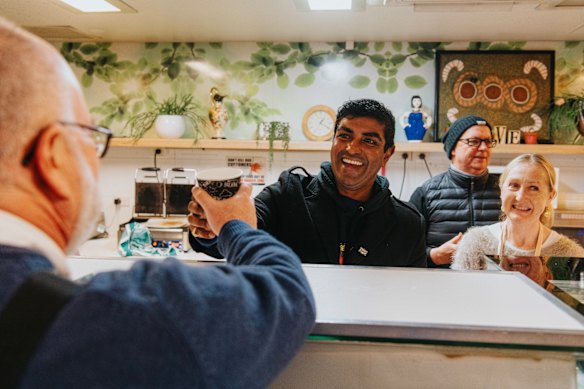
Jon Owen (centre), from the Wayside Chapel: “I say, don’t be miserable by yourself on Christmas Day. Come and be miserable with us. Come and enjoy life and light and community and joy.”Credit: James Brickwood
“I say, don’t be miserable by yourself on Christmas Day. Come and be miserable with us. Come and enjoy life and light and community and joy. We sing a lot about joy. In the original Hebrew it means something that is shared. Happiness is from individual achievement, but joy can only be shared.”
At the Wayside Chapel, the Christmas lunch is now a long way from rolling out some wheelie bins. It requires permits, exemptions, catering and massive planning – a few Wayside staff have been working on it for months. In the week before Christmas, up to 80 volunteers start work – for example, on slicing up a few hundred kilograms of ham – and the day itself will involve 200 volunteers. Many, many more offer to volunteer.
A high-quality restaurant might seem at the opposite end of the spectrum from Wayside, but the same values are involved. Christmas Day is the busiest of the year at Melbourne’s ultra-cool St Ali, according to CEO Lachlan Ward.
It is a haven not only for people passing through to begin holidays but for people in the highly transient hospitality industry who have nowhere else to go – one of the key reasons St Ali began its Christmas meal. “We find people are just grateful for us being open,” Ward says. “Christmas tends to bring out the same people every year – lots of friends from the industry, and friends in general.”
Famous as a specialist coffee roaster and café, St Ali serves its usual brunch fare up to lunchtime, then switches to a buffet of seafood, salads, charcuterie, roasts and an array of desserts over several sittings.
“We’ve experimented with different things over the years but we’ve found this gets tables mingling. It breaks the ice and is in keeping with the spirit of the day. It’s often a relief just getting to Christmas Day after such a sprint coming into it.”
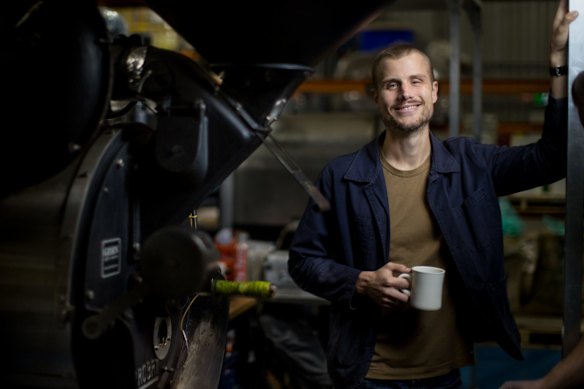
Lachlan Ward from St Ali: “We find people are just grateful for us being open (on Christmas Day).”Credit: Simon Schluter
For Ward, who has risen from barista to CEO of the St Ali group, hospitality is about the little details. There are many great food and beverage experiences in Melbourne and Sydney, but what sets it apart for him “is that human connection and that reading into the little details of the things that go unsaid – when to step in and step out, when to offer things”.
Psychiatrist Louise Newman believes the core of hospitality is inclusivity – particularly the welcoming and care of otherwise dispossessed or alienated people – which underlies the ideal of social cohesion, of what glues us together as people.
Newman, a Melbourne University professor, consultant at the Ramsay Clinic and to childcare services around the country, suspects that the West might be further on the path to disconnection and fragmentation than more traditional cultures.
“We see people living in cities literally surrounded by others but being profoundly alone. In the so- called developed West some of those core values of cohesion are really failing us,” she says. “We have a mass of people in fragmented groups and subgroups where there’s weariness at the very least, sometimes enmity and hostility between groups, yet people in those groups still have the fundamental human need to be with others.”
People need to have a sense of making meaning in a world that is otherwise experienced as meaningless and empty. If not, she says, they are more prone to drug or alcohol abuse as a way of not feeling.
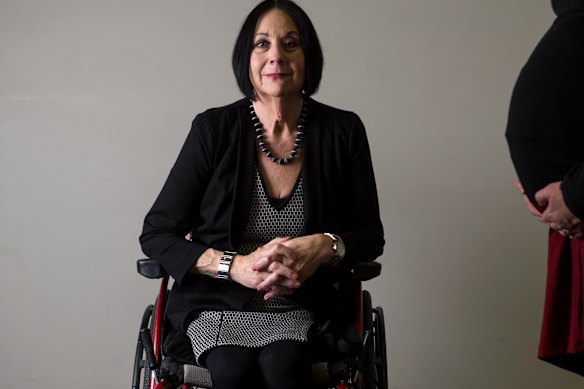
Professor Louise Newman believes the core of hospitality is inclusivity: “Even if it’s only for a day, they are part of a group, and it improves people’s self-worth.”Credit: Penny Stephens
People can be highly articulate about that, Newman says. “I saw a young man recently with difficult drug issues who could describe very well his early life difficulties. He was looking to understand his family, what had happened to him and why he didn’t know who he was.
“So it was a fundamental question of identity, and he drifted into really high-risk drug use, which didn’t help him understand the questions, of course. But he had no other belief, he had limited social interactions, and erratic behaviour.”
Newman says groups like the Wayside Chapel that cater for people who are isolated can provide a really positive experience. “Even if it’s only for a day, they are part of a group, and it improves people’s self-worth. They think, ‘I am actually a valuable human being if some people welcome me. I can be tolerated.’”
Newman, not herself a believer, thinks the church can offer meaning and hope to people who are disconnected and struggling. “I don’t think many humans can have quality of existence or a good sense of who they are and develop their own values when there is no meaning around them.”
Sydney Anglican Archbishop Kanishka Raffel naturally agrees. To him, God’s hospitality is the basis of the Christian message, the gospel. “Hospitality begins with the fact that God is hospitable. He is a welcoming God.”
It is one of the first things the Bible teaches, in Genesis. God creates spaces and then blesses his creation by welcoming them into it, Raffel says. He creates the sky and welcomes the birds, he creates the oceans and welcomes the fish, he creates the land and welcomes the animals. Then he creates humans and welcomes them into the Garden of Eden.
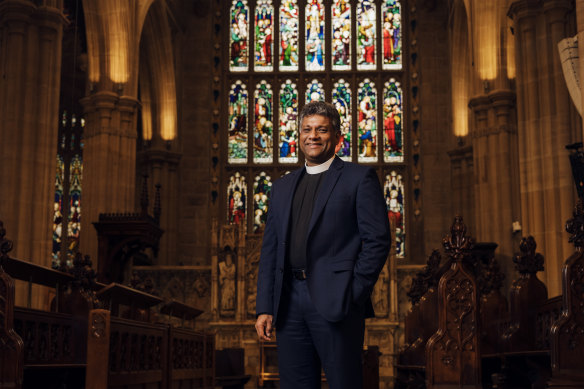
The Archbishop of Sydney, Kanishka Raffel: “Hospitality begins with the fact that God is hospitable. He is a welcoming God.”Credit: James Brickwood
He repeats his hospitality by feeding the ancient people of Israel in the wilderness, in the book of Exodus, and this welcome comes to a climax in the person of Jesus.
“We see hospitality embodied in Christ. He welcomes the undeserving, the outcast, the lowly, the sinner, and is generous to them for no other reason than his own grace and love. We are the beneficiaries. So hospitality is the shape of the gospel, but it’s also then the imperative of the gospel: as we received welcome from God, we are to welcome others. The Law itself says treat the stranger and alien well.”
Raffel says hospitality is the welcome that is extended graciously, not because someone has earned it or because you want to get something out of it. “It’s the opposite of ‘there’s no such thing as a free lunch’. It’s not transactional.”
Ayesha Quraishi’s life is dedicated to hospitality, as a chaplain at Melbourne’s Northern Hospital, as a volunteer for organisations helping people with illnesses such as motor neurone disease, as co- president of the parents and friends group at Al Siraat college offering multicultural dinners, as a volunteer at Al Quba mosque, and in giving hand and foot massages.
The massage is a form of hospitality, she says, in that “the hold of somebody’s foot in your hand is the hold of their emotions, it opens the door to people’s emotions which is a beautiful experience”.
Quraishi says the Prophet (Muhammad) instructs Muslims to cook meals not for two people but for three, so you can feed a visitor, a neighbour or someone in need. “Hospitality is a means of touching hearts – it strengthens connection and community. There is an encouragement to generosity and sharing food, which is the beginning and end of hospitality but, obviously, it encompasses a lot more as well. It’s not just food, it’s warmth and comfort and caring for physical needs,” she says.
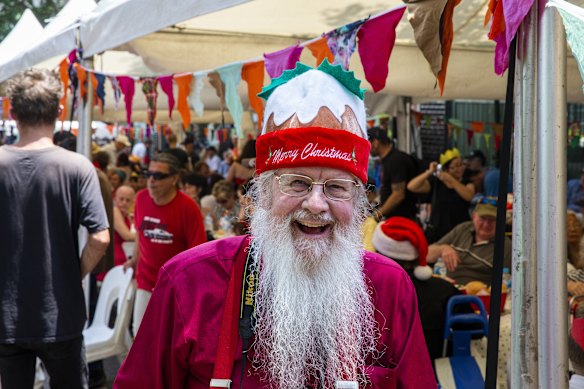
Hundreds of people will take Christmas lunch at Sydney’s Wayside Chapel - and Santa is likely to spread some cheer. Credit: Getty Images
At Al Quba, which gathers 1000 worshippers at Friday prayers, there is a hot, nutritious meal every week, usually a donation from a member of the community. Probably a few hundred people stay to eat, Quraishi says, “and it’s nice to witness”.
Wayside’s Jon Owen has an anecdote about the power of hospitality. Every Christmas morning he would get a phone call from a mum who said “when you see my boy, give him a hug and tell him his mum loves him”.
“And that used to break my heart and I really didn’t look forward to that call because her son was in the depths of heroin addiction. Our vision is love over hate, but we meet so many people driven by self-hatred. That’s what led to his heroin addiction – he was using it to forget about all the ways in which he hated himself.”
Two years ago, Owen says, the mum didn’t make the call because her son was celebrating at home with her, having turned his life around. “A couple of months later, a few of us joined him at his mum’s house for his 40th birthday. He said, ‘oh, you guys saved my life’. And we said, ‘no, you turned it around’. And he said, ‘no, no, you loved me when I hated myself, and that was enough. That was enough to keep me going.’”
Owen says: “That's the kind of love that chooses life over death, when you choose love over hate.”
Barney Zwartz, religion editor of The Age from 2002-2013, is a Senior Fellow of the Centre for Public Christianity.
Most Viewed in Lifestyle
Loading