
 3 months ago
94
3 months ago
94
We’re walking through an ancient alleyway so narrow and winding, that when someone looms towards us, we have to feel for a notch in the stone wall to flatten ourselves and squeeze past.
The ceiling above our heads frequently dips so low, we duck and wriggle through. At times, further along, all light is blocked, and it’s pitch black ahead and behind.
“I think our guide must be lost,” I whisper to one of my travelling companions. “This can’t possibly be the way.”
“Absolutely,” she says. “She’s obviously just too embarrassed to admit it.”
At that exact moment, I kid you not, there’s a blinding flash of light and an explosion of colour, noise, bodies and smells. We’ve arrived. Fes’ 8th-century maze of labyrinthine medieval passages has held no clue of what awaits and the shock enhances this most exciting of sights.
Sign up for the Traveller Deals newsletter
Get exclusive travel deals delivered straight to your inbox. Sign up now.
Morocco has so many of them. Beyond the incredible scene we’re staring at – one of the world’s biggest, and most ancient, markets – there are the sweeping sands of the Sahara Desert, the stunning mosques and kasbahs of the capital Rabat, the ethereal blue city of Chefchaouen, the romance of quixotic Casablanca and the exuberance of seaside Essaouira.
As a result, the country now seems to be capturing imaginations like no other, with tourist numbers up in 2024 to 17.4 million, a new peak that’s 20 per cent above the previous year.
There are plenty of practical reasons, too. Roads improve every year and more infrastructure is put in place, especially sports stadiums for the football-mad population. Morocco hosted the Africa Cup of Nations earlier this year and is co-host with Portugal and Spain of the FIFA World Cup in 2030. Hotels are numerous, food is spectacularly good and prices are pleasingly low.
As Egypt strains at the seams with the influx of tourists, the North African kingdom of Morocco presents itself as a shining beacon to visitors – it’s known after all as the “Kingdom of light”. Compare it with the more austere Tunisia – and the rather less tourist-friendly neighbouring Algeria, Libya, Mauritania, Western Sahara and Sudan – and it’s positively luminous.
I’m here on Inspiring Vacations’ 15-day Magical Morocco premium small group tour (up to 16 people at a time), in the presence of an English-speaking Moroccan tour guide and driver. We number 12 – eight Australians from Sydney, Melbourne and Perth, and four Americans – travelling in a 14-seater bus, with ample room for us and our luggage.
The itinerary allows mostly two nights in each place, usually in four-star hotels, ranging from ancient hilltop kasbahs – with lofty ceilings, intricately tiled floors, heavy, elaborately carved wooden doors, and great bolts that slam shut – to riads, traditional Moroccan houses or palaces. All breakfasts are included, with three lunches and six dinners overall, some in vast dining rooms.
The restaurants generally serve set meals of olives and beautiful vegetable starters and then, nearly always, tagine, the Moroccan stew served in a conical clay pot, of lamb, beef, chicken or vegetables. Dessert is nearly always fresh oranges or mandarins, local apples and bananas.
At every turn, we discover mystery, intrigue, incredible history and stunning sights. The warm friendliness of the presentation is an absolute joy.
DAYS ONE TO TWO: Casablanca and Rabat
“Play it, Sam. Play As Time Goes By.” Was there ever a more atmospheric movie that has coloured generations of travellers’ views of a city? Probably not. The 1942 triple-Oscar-winning Humphrey Bogart-Ingrid Bergman Casablanca had everything: beauty, heroism, love, longing and crossed loyalties, all smouldering in a ruinously romantic port city during World War II.
This is our starting point, and Casablanca, a place I last visited as a child, is still just as evocative and chaotic a lively metropolis, but with the raw edges rubbed much smoother.
Morocco achieved independence from Vichy France in 1956, but the Gallic influence pervades, from the French bread to the exquisite patisseries, from the fine colonial buildings to the lively boulevard cafes. There’s even a Rick’s Cafe, modelled on the film’s original, but built in 2004.
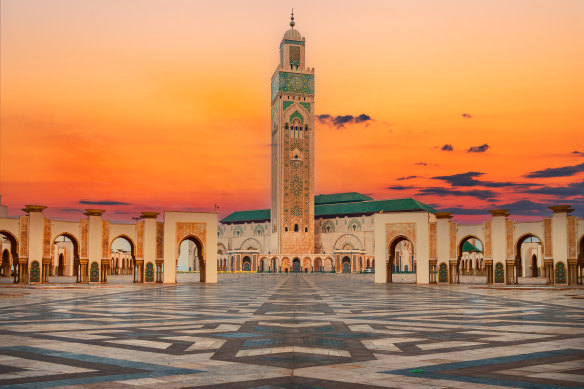
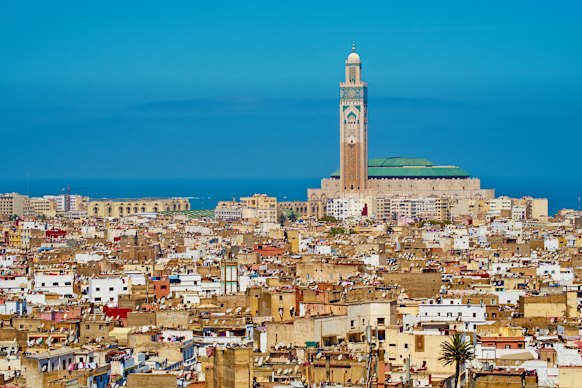
Plenty of attractions are exquisitely Moroccan. The Hassan II mosque, built on the Atlantic oceanfront, has glorious views out to the horizon. Opened only in 1993, it was built to commemorate Mohammed V, the revered last sultan and first king of Morocco, who steered the country to independence from the French.
It was designed to be the second-biggest mosque in the world after Mecca but funds – donated by the public and contributed by other countries – couldn’t run to such a grand vision. With 35,000 people working on its marble, plaster, stone, wood and granite, it ended up one of the biggest in Africa instead, with capacity for 25,000 devotees inside, and another 80,000 in the surrounding plaza.
“King Hassan II wanted Casablanca, Morocco’s largest city, to have a proper monument to show its importance,” says guide Hicham Bennis. “He wanted it to be unique, too, so he built it over still water to represent an iceberg on the sea. Beneath it was a swimming pool.”
As one of the few mosques in the nation to allow visitors, it’s an absolute must-see, and is a breathtaking monument to one of the nation’s most modern and forward-looking leaders.
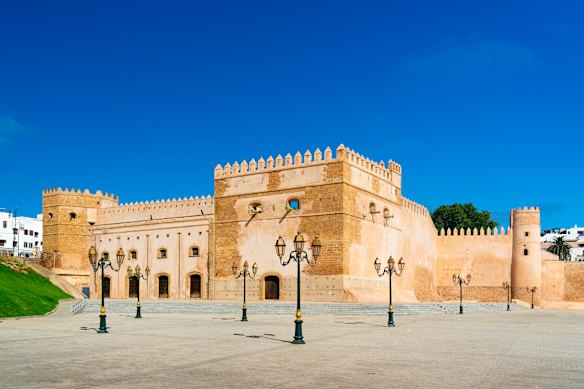
From here, we drive to the capital Rabat, home of one of the country’s most astonishing kasbahs. The Clash’s 1982 hit, Rock the Kasbah! was actually about the ban imposed on Western music by Iran, but it’s difficult to stop humming the catchy tune every time you come across a kasbah, and Morocco has thousands.
The most startling, is the Kasbah of the Udayas, built in the 12th century, and now a UNESCO World Heritage Site. It’s an imposing fortress of ochre rammed earth or adobe, high on a hill overlooking the coast, and full of twisting alleyways.
Back when kasbahs were built, they were perched on hillsides to allow people to take shelter in the event of an enemy attack, but today they’re often converted into museums, hotels, tourist destinations or village neighbourhoods.
This one has plenty of market traders selling fresh juices, henna painting, dates, olives and figs, and teems with both locals and visitors.
The Hassan Tower, a minaret erected for a massive unfinished mosque that started construction in the 12th century, also fascinates. Wandering amid stunted columns and imagining what it could have been is wonderfully atmospheric but, sadly, the patron died and his dream died with him.
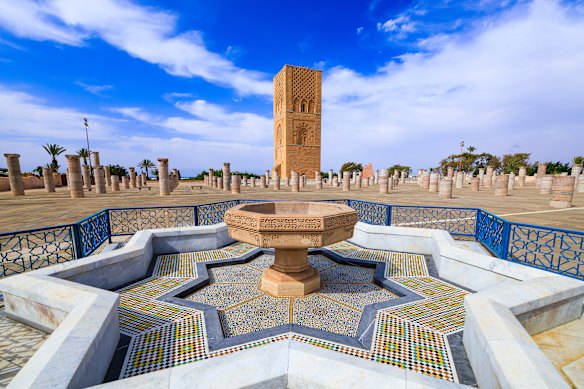
Next to it is the (completed) 1971 Mausoleum of Mohammed V, holding his remains and those of his successor, King Hassan II. Watching over all its entrances and exits are enormously tall, elaborately dressed, guards, some on horseback, who are happy to have their photos taken with visitors. They make you feel tiny.
Mohammed V is also venerated for his response to demands from Vichy France that Morocco’s 250,000-strong Jewish population be deported to ghettos and death camps.
He replied to the collaborationist government, in power in France after its defeat by the Nazis, with an elegant note of just two sentences. “There are no Jews in Morocco,” he wrote. “There are only Moroccan subjects.”
Morocco has always prided itself on being a harmonious melting pot of many cultures, from indigenous Berbers, Arabs, Jews, the Haratin and Gnawa descendants of slavery, West Africans, and the progeny of Spanish and French settlers.
Today, this has given it a reputation as a solidly peaceful, welcoming multicultural country presenting the best of the north of the African continent.
DAY THREE AND FOUR: Chefchaouen and Volubilis
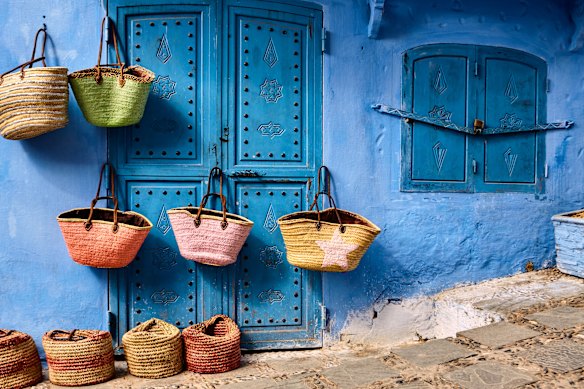
Feeling blue? You soon will, but in a lovely way. Chefchaouen is the renowned blue city in the Rif Mountains, dating from the 14th century, with most of its walls, doorways, arches and often even the walkways, washed in a gorgeous indigo.
The city has become one of Morocco’s hottest destinations, and quite rightly so. It’s a beautiful place to explore, from the Spanish Mosque sitting high on a ridge, to the winding streets and stairs that lead to spring waters where city folk once gathered to bathe.
Local Abdeennour Oulad has lived here all his life, with his family inhabiting the same house since 1927, and he can’t imagine living anywhere else.
“It is a wonderful mix of Berber, Arab, Spanish, Mediterranean and Andalusian culture,” he says. “We work late and sleep late, and our motto is, la velocidad mata, or speed kills.”
“Everywhere, we have squares and mosques where we pray five times a day, a hammam where we go on Thursdays, a communal wood oven where we cook barley bread and tagine twice a week, and we make couscous on Fridays and paella on Sundays. It’s a peaceful life.”
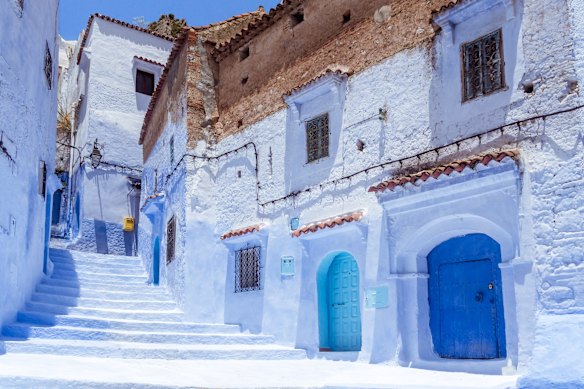
The reason for the town’s hue, a feature only since 1960, is a matter of debate. Abdeennour says it was to change the mood of the locals after an economic crisis, repelling mosquitoes, keeping homes cool in summer, pushing away the evil eye and reflecting the sea.
Whatever the reason, the look is unique, the fame is global and the place is gorgeous. Our Hotel Parador is modest – except for its stunning balcony and pool overlooking the whole valley, with its patchwork of blue roofs, walls and streets.
Just 160 kilometres away is another surprise. We all know Caesar’s Veni, vidi, vici – “I came, I saw, I conquered” – and the Roman Empire came this far to conquer. After Claudius annexed the Berber kingdom of Mauretania in 44 AD, the city of Volubilis grew substantially.
It’s now a haunting site to visit, with relics including a triumphal arch (just as in Rome), a basilica and temple. A UNESCO World Heritage Site, it’s also known for fabulously intact mosaics.
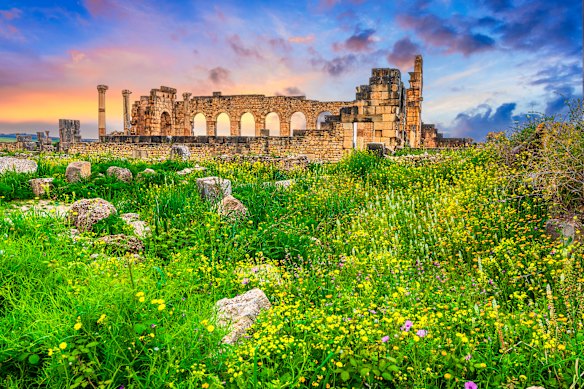
“The Romans treasured Volubilis because it was a great source of green gold – olive oil,” says local expert Rouijel Majid. “They had presses here for its manufacture and were then able to deliver it to trading posts across the Roman Empire.”
“Volubilis was protected by the mountains, and at one point, covered 42 hectares. But an economic crisis meant the Romans imposed extra taxes on the population and the people revolted and pushed them out.”
The Romans left in 280AD and much of the city was later destroyed by a massive earthquake in 1755. More than 62 per cent of the city has yet to be excavated.
DAY FIVE: Fes
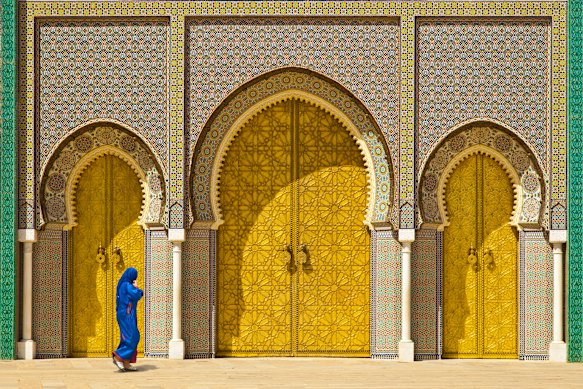
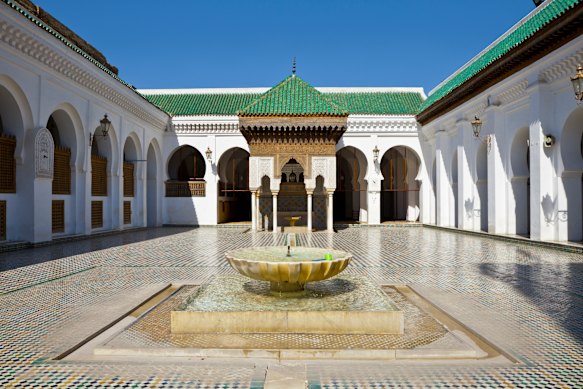
Many describe Fes as a feast for all the senses. Those tiny 8th-century corridors, just wide enough for a Western body, open up to the world’s largest car-free urban area, filled with historic sights, souks and landmarks.
In pride of place is an 11th-century outdoor tannery, with all manner of animal hides – cows, camels, goats and sheep – being stripped, cleaned and dyed by men who often work waist-deep in water. Take the mint you’re given to mask the stink, and marvel at the quality of the leatherwork for sale.
Here are the world’s oldest university (859AD), schools, cave-in-the-wall homes, dancing musicians with donkeys, silk weavers, pots and pans, meat – avert your gaze from the camel heads – fruits, vegetables and local delicacies.
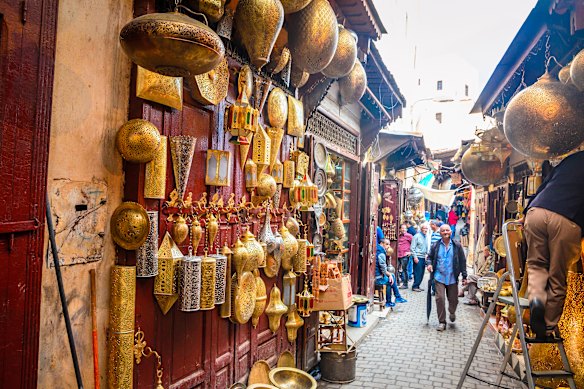
“Fes used to be our capital but it was moved to Rabat by the French,” says local tour guide Laila Tijal. “This medina, or oldest part of our city, is made up of 10,000 streets and alleys compressed together, divided by the river which today looks more like a canal. And don’t worry about all the meat left outside the fridges. That just shows how fresh it all is.” Er … right.
By the time you emerge from the gates, you feel like you’ve been pounded around the head by everything you’ve seen, heard and smelled. The sensory overload is both thrilling and exhausting.
The exquisite hotel, the traditional Hotel Riad Al Makan, with its 19 individually decorated rooms, its elaborate tiled lobby and restaurant, and its own hammam or bathhouse, is a wonderful retreat.
DAYS SIX AND SEVEN: The Sahara Desert
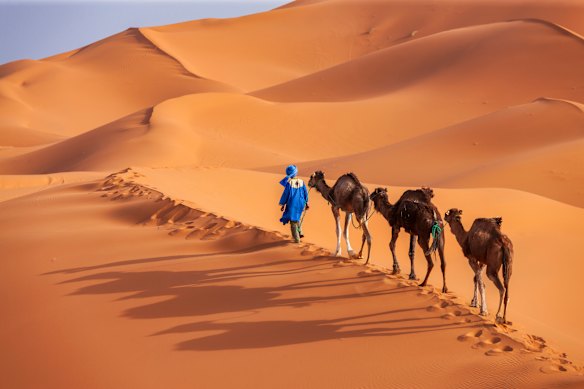
This is the high point of my visit to Morocco. Not just the crossing of the snow-topped Atlas Mountains, but the sweeping desert vista as we arrive.
The Sahara’s vast dunes coil around each other, tower up and plummet down; its burnt orange sand shimmers and changes hue as light hits it differently at every time of day.
Our Riad Madu hotel rooms in Merzouga, a town on the edge of the desert, look out over the sands, and a glistening pool edges on to the vast barren sands. In the distance, camel trains trek over the mountainous dunes in a timeless trudge of man and beast.
After a night there, we explore the town, then climb aboard our transport – yes, camels, for our journey to our desert camp. We thread our way around the dunes, then up and over them before scrambling down the other side, to finally arrive as the sun sets in a blaze of glory. We don’t feel quite so glorious. Most of us can barely walk afterwards.
The five-star Sahara Sunny Luxury Camp, among the Erg Chebbi dunes, is a fantastic experience. Its beautifully designed glamping tents have glass doors on one side, an in-room toilet and shower and a verandah sofa. That evening, we dine in the restaurant tent and then sit around the fire pit, listening to drummers beating away the shadows, as a million stars shine overhead. Bliss.
DAYS EIGHT AND NINE: Todra Gorge and Dades Valley
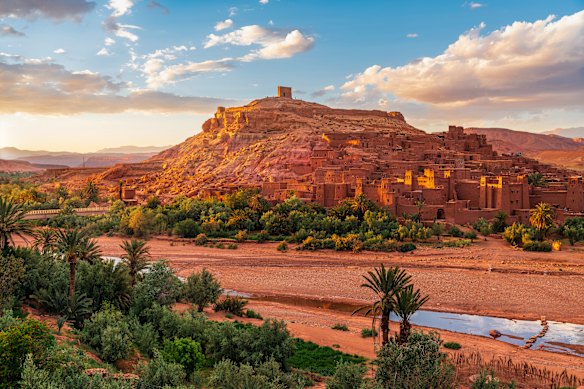
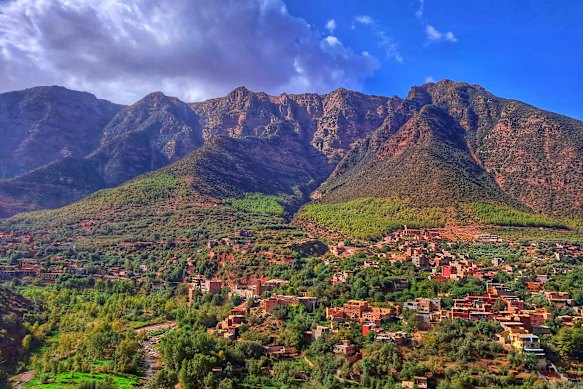
On the road to Marrakesh, we take in the spectacular 250-metre-high Todra Gorge, and stop to hike through the Dades Valley, savouring its views and meeting the locals on the way.
There’s also the Ait Benhaddou, a fortified village, topped with an 11th-century kasbah. It looks instantly familiar and the reason soon becomes obvious – it’s been the location for dozens of movie shoots, from 1954’s Ali Baba and the Forty Thieves to The Jewel of the Nile, The Mummy and Gladiator, and Game of Thrones.
The drives can be long, but there are many stops at service stations that sell excellent coffee and hot chocolate. There are carpet workshops, spice and herbal medicine markets and craft collectives making rose perfumes and creams and weaving silk. Furniture carvers include fossils, from the time when the Sahara was once an ocean, in their work.
DAYS 10 TO 13: Marrakesh and Essaouria
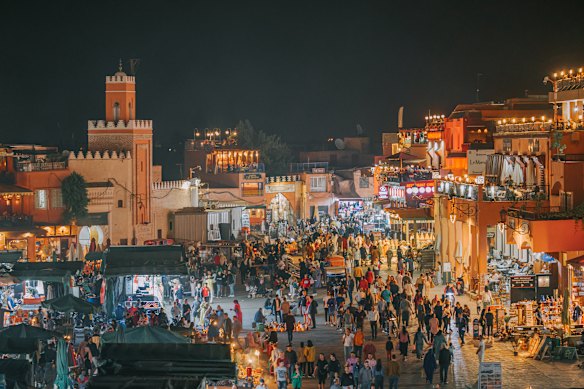
Arrival in Marrakesh is an absolute delight. The new part of the city is slick and smart, while the old section has a large, open marketplace, surrounded by winding streets. The merchandise could come from an Ali Baba fantasy, in every colour under the sun.
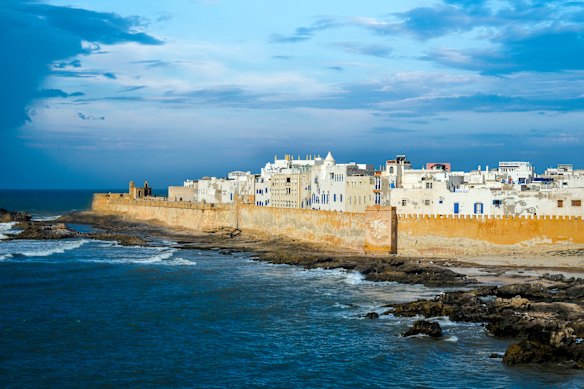
Our final stop is Essaouira, a relaxed coastal city with a lively resort feel, beautiful beaches, great seafood and lovely walks along the ramparts. Known as a creative hub, it has a laid-back feel, less frenetic than Fes or Marrakesh.
It’s a wonderful place to chill and savour all you’ve seen, before repairing to Casablanca for the flight back to Australia.
FIVE MUST-KNOWS BEFORE YOU GO
Attire It’s customary for women to dress modestly, with no high-cut shorts or low-cut tops. Carry a scarf to cover the hair for a visit to any mosques that admit non-Muslim foreign females.
Eating If you’re eating with your hands, only touch food with your right hand, never your left.
Gratuities Moroccans in hotels and restaurants aren’t paid well and often depend on tourist tips, anything from 5 per cent to 15 per cent, depending on both the quality of the establishment and the service.
Climate Temperatures can plunge at night in the desert, and during winter there’s snow on the Atlas Mountains. In winter, take plenty of layers of clothing that you can reduce when the weather heats up.
Alcohol Alcohol is rarely served outside upmarket restaurants, bars and hotels. Excessive alcohol consumption is frowned upon, as is drinking in public, such as in the street.
THE DETAILS
TOUR
Inspiring Vacations’ 15-day Magical Morocco Premium Small Group Tour is a fully escorted tour of no more than 14 travellers with an English-speaking guide and local experts along the way. It includes 13 nights in four-star hotels and boutique riad accommodation, breakfasts, six dinners and three lunches. From $3695 a person, land only. See inspiringvacations.com
FLY
Emirates, in normal times, operates daily flights from Sydney and Melbourne to Casablanca via Dubai. See emirates.com
MORE
visitmorocco.com
smartraveller.gov.au
The writer travelled as a guest of Inspiring Vacations.

















































