3 months ago
5
3 months ago
5
Melbourne’s City Square has been called the city’s greatest blight, but the opening of the Metro Tunnel this weekend has given the public space a much-needed “glow-up”.
The square opposite the Town Hall has been closed for eight years and will reopen on Sunday.
Craig Guthrie, principal landscape architect and urban designer on the Metro Tunnel at Hassell, said he hoped the City Square’s newest iteration would turn it into a gathering space.
“There is the new station entry, quite a grand station entry, which you can already see now,” he said. “The rest of the square will be a new community space for events, informal and formalised events, with lots of seating around the edge to look into.”
Guthrie said the removal of the Burke and Wills statue, which is in storage, with plans to relocate it to the Royal Society of Victoria on La Trobe Street, signalled a new focus on First Nations history in the square.
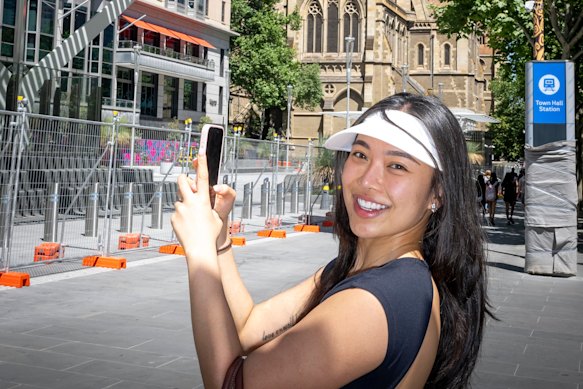
Southbank resident Tina Kuang at the soon-to-be reopened City Square. Credit: Eddie jim
“The previous designs of the City Square have been very colonial, so this will be giving a completely fresh outlook about the history it’s expressing,” he said.
Mel Dodd, dean of art, design and architecture at Monash University, said the space was “a bit of a sad square” and she hoped the volume of people travelling through the City Square to access the Metro Tunnel would breathe new life into it.
“Providing the function of a transport interchange gives it some functionality that I think civic spaces often need,” she said. “Before that it had the sense of being a square without necessarily a strong purpose except being adjacent to the edge of a large hotel.”
Dodd says even though the square is relatively small, it could still provide an important function in the CBD by providing a green space and public realm.
“It’s like a little lung for Swanston Street and Collins Street, it’s a gap, you can have a breather,” she said. “It’s not rocket science. It’s just about people having a reason to dwell and to sit down and to enjoy a moment of respite in what is otherwise just an urban grid with trams and cars and so on.”
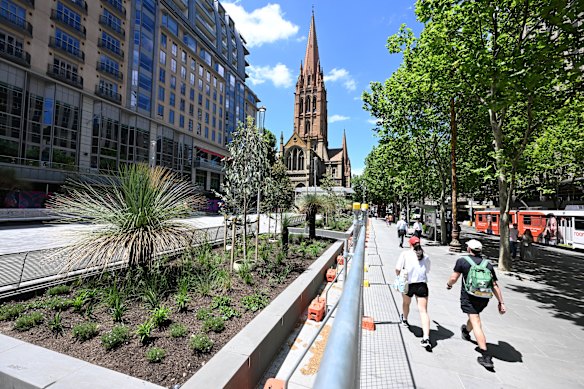
City Square will open permanently to the public on Sunday.Credit: Joe Armao
The hoardings are down at the square, and through the wire fence passers-by can get their first look ahead of the Metro Tunnel’s official opening.
Familiar features like the Mockridge fountain, the statue of Burke and Wills and the Brunetti cafe are all gone, and the space is now dominated by a large canopy with a white slatted roof, which sits over the entrance to the new Town Hall station.
The Mockridge fountain has been replaced by a digital artwork, which features waves of digital lights that cascade down, imitating water.
The retail tenancies along the Westin hotel are still boarded up, but on this side of the square there is a smoking ceremony dish developed with Wurundjeri elder Aunty Joy Wandin Murphy.
Around the station entrance Wurundjeri text is carved into the stone with an English translation underneath: Wominjeka Kirrip, Welcome Friends.
The centre of the square is covered by 12,000 custom-laid grey stone pavers and lined with metal benches on each side.
Southbank resident Tina Kuang has been watching the construction at the City Square for the past few years and stopped to take a look at the completed construction on Tuesday.
“I’m quite amazed, especially the modern building’s link with the church,” Kuang said. “You see the history and the modern city combining.”
At the side facing St Paul’s Cathedral there is a small visitors’ hub building, while on the Collins Street side five escalators lead down into a two-tiered concourse, which contains a “square beneath a square” with shops and food outlets.
These will include a Brunetti Oro cafe, Sushi Jiro, McDonald’s, Starbucks, KFC and an IGA supermarket.
A small number of Melburnians got a brief look inside the City Square on the weekend, when it hosted a surprise Jimmy Barnes, Kate Ceberano and Ian Moss concert.
Premier Jacinta Allan announced the gig by posting to social media the concert would be “live and free at Metro Tunnel’s new City Square”.
Rory Hyde of University of Melbourne’s faculty of architecture, building and planning said Allan’s language was interesting.
“It’s like the square now belongs to the Metro Tunnel, which shifts the whole hierarchy,” he said. “Does it just become a kind of foyer to the train, rather than a space of democracy or protest or speeches or coming together, which is what a really important city square should do.”
Transport Minister Gabrielle Williams described the redevelopment as “a serious glow-up” for City Square, which she said was greener and more welcoming.
The square is a relatively recent addition to Melbourne. When surveyor Robert Hoddle laid out Melbourne’s grid design in 1837, he did not include a major central square.
This was a deliberate design choice to avoid the open spaces that had become places for mass protest elsewhere.
The square was eventually retrofitted into Melbourne in 1968 after the City of Melbourne acquired the land opposite the town hall to build a “truly serene and noble city square”.
The square was opened by Queen Elizabeth II in 1980, who drew back a curtain to start a giant water spillway, a feature of the square, along with the bright yellow five-metre-high Vault sculpture known as “the Yellow Peril”.
However, the square was a confused space made more so by a brief from the conservative city council to architects Denton Corker Marshall to restrict the public area in size to discourage anti-war demonstrations.
Reports in The Age over the years described it as “sad”, “grey and desolate”, “a large and well-watered expanse of grey stone: thick on ornament, thin on comfort” and the city’s “greatest blight”.
The public space survived a push by the council to build a “small casino” in the square in 1991, along with a new home for the Melbourne Theatre Company, but was further crunched in 1993 when part of the square was sold off to a consortium led by David Marriner to make way for the Westin hotel.
Hyde said it was good to see native planting at the square and lots of seating, but the size of the square and its domination by the Westin was an ongoing challenge.
Loading
“I think it probably always will be awkward,” he said. “It always feels sort of tortured or compromised once they sold off half of it to the hotel ... built like a sort of forecourt to the hotel.”
However, he said the square could play an important role in the CBD as a place for Melburnians to relax and meet up.
“What we need is an incidental public space, and I hope that the City Square – in its unassumingness and its subtlety and its shade and its spots to sit – can play that role.”
Start the day with a summary of the day’s most important and interesting stories, analysis and insights. Sign up for our Morning Edition newsletter.
Most Viewed in Politics
Loading