3 months ago
26
3 months ago
26
Five lines. That is all there is engraved on an unassuming Elkington & Co silver ashtray, one of thousands made in the 1930s.
But the story behind the inscription and this ashtray has inspired books, documentaries, a TV mini-series and made this piece of memorabilia arguably the most valuable Ashes artefact aside from the actual urn.
“He loved it. He was so proud of it because it was given to him by Mr Jardine.” That is Mary McGrath talking. She is the middle one of Harold Larwood’s five daughters and is now 87, her voice quiet but her memory sharp, and over the course of a day in Sydney, details come flooding back of her father and the many famous cricketing figures that were part of family life: Jack Fingleton, Frank Tyson, “Bertie” Oldfield and Keith Miller.
I am surrounded by members of Larwood’s family, gathered for a rare viewing, even for them, of the ashtray that was a present to Harold from Douglas Jardine – two men forever linked in cricket history – more than 90 years ago.
It is in immaculate condition, lovingly polished and cared for by Harold who kept it in pride of place on his mantelpiece for the rest of his life. “He would show everyone who came round,” says Mary. Now it is my turn.
What started out as a personal quest to see the ashtray several years ago turned out to become something more substantial. Today it will be a shared journey; me to look at the ashtray that is a symbol of cricket’s greatest controversy summed up in one word: Bodyline. For Mary and her family the day will end at the SCG, where we have arranged for her to see her father’s name on the Honours Board in the away dressing room for the first time – 93 years on from his 10 wickets in the first Bodyline Test of 1932-33.
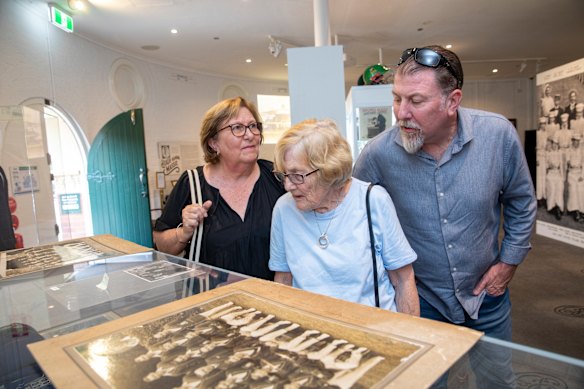
Larwood’s daughter, Mary, with two of his grandchildren, Andrew and Janet, at the SCG Museum and Members Pavilion.Credit: Quentin Jones/Think Mammoth
With us is Andrew, Mary’s son and Harold’s grandson, and together we have learnt about Harold and the Bodyline story.
We travelled to Trent Bridge when Andrew and his wife Bex visited Europe last summer and to Nuncargate, the mining village 16 kilometres north-west of Nottingham where Harold lived, to see his statue and the house where he was born.
Now it is a sunny Saturday in Sydney in late November and the Larwood family’s turn to show off their treasures, a crown jewels of cricketing memorabilia, and not just the fabled ashtray.
Andrew also has the personalised Parker Beacon gold lighter presented to all the players by the MCC for the 1932-33 tour to Australia and a pencil with an engraved gold band, a gift Jack Hobbs gave to all his Surrey teammates, including Jardine, to commemorate his 100th hundred. Jardine presented it to Harold the night before he emigrated to Australia.
There are also photos of Andrew as a child with his grandfather in the garden of the Larwood bungalow in Kingsford, not far from the SCG – Harold in old age pretending to bowl with his knee-high grandson next to him. It is simply signed “Grandad”.
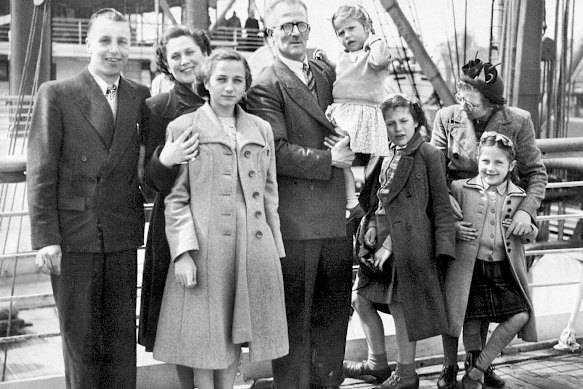
Larwood arrives in Sydney in 1950 with his wife Lois and daughters.
But first of all the ashtray; after all that is what has brought us together. To Harold it meant so much because it was a gift from a captain he called “Mr Jardine” for the rest of his life. It represented the loyalty of one of the few men to stand by him when the cricketing establishment cast Harold out, scapegoating him for Bodyline in order to save relations with Australia.
Larwood carried it with him when he moved from Nottingham to Blackpool to run a sweet shop, and packed it in his suitcase when he emigrated to Australia in 1950. He would proudly show it off to visitors to his bungalow in Sydney, whether they be England cricketers, journalists dropping by for an interview or devoted fans that would knock on the door and ask for a chat and an autograph.
Now, 30 years after his death, his family are gathered around a kitchen table with the ashtray carefully removed from its blue box and protective bubble wrap.
Harold had five daughters and 13 grandchildren. Mary, Andrew and Becky have met me at the house of another Larwood grandchild, Janet Neville. Her daughter and granddaughter – more Larwoods – pop in and out as the family heirloom is put on a display and the photographer snaps away.
My interest in the ashtray was sparked 30 years ago by a column in The Guardian by the legendary sports journalist, Frank Keating, when he interviewed Harold while covering the 1993-94 Ashes tour. He wrote: “On the mantelpiece is a small silver ashtray. I tap my pipe out on it. The old man hears the clink. ‘I think you’ve just emptied your ash in my most treasured possession,’ he says, though without any trace of admonition.”
We will allow the great Keating some artistic licence, tapping his pipe out on Harold’s ashtray was a good line too hard to resist. Nobody was ever allowed to use it, confirms the family. Reading that as a student with aspirations to be a sports journalist, and then a decade or so later consuming Duncan Hamilton’s superb Larwood biography, an ambition was sparked to one day track down the family and see the ashtray for myself.
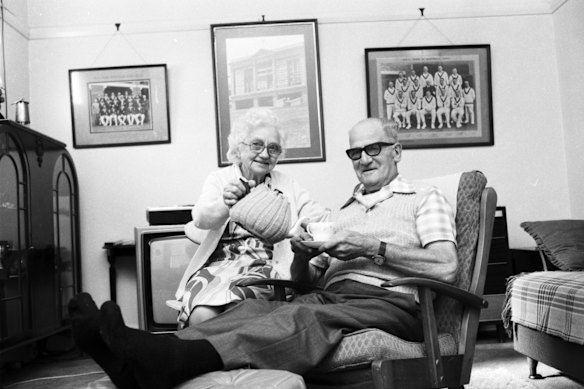
Larwood at his home in Kingsford, in Sydney’s east, with his wife Lois in 1984.Credit: Robert Pearce
Ashes tours came and went. The timing was never quite right to locate the Larwoods. In 2017-18 I left it too late, waiting until Sydney and the final Test to start the search and getting nowhere, mainly because the Larwoods are no longer called Larwood, the daughters all married and took new names. Plans to do so for the 2021-22 tour were ruined by COVID and the restrictions in Australia at the time. This time I started earlier, taking no chances.
Correspondence started last January. Nottinghamshire put me in touch with Stephen Roper, a Larwood grandson who until this summer was the most recent family visitor to Trent Bridge, and has given interviews in the past about Harold. He lives in Port Macquarie in NSW, about five hours north of Sydney, and shared a few Harold stories over the phone, but was not in possession of the ashtray.
Via email, he passed me on to his cousin Andrew McGrath. At the age of four Andrew and Mary moved in with Harold and Lois. He grew up living with his famous grandfather. Now aged 54, he was on his own Harold quest to find out more about his life; our paths crossed and led to this, but even he was not sure if the ashtray would be available for viewing.
Two days before we were due to meet up for this interview, he phoned. “We’ve got the ashtray. We’ve sorted it for you. And Mum is happy to talk.”
Apart from a stint on show at the Bradman Museum in Bowral, the ashtray has never left the family’s possession. I have agreed not to reveal its permanent whereabouts for obvious reasons, and Janet had to work hard to persuade a relative to part with it for the day to show me. She promised to guard it closely.
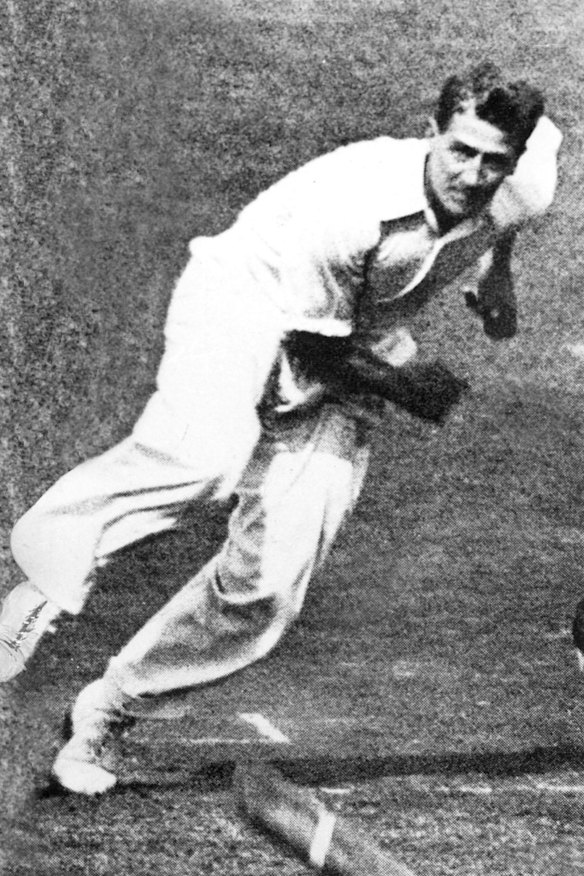
Larwood in his prime.Credit: Archives
The Larwoods (I will call them that for ease of identification) have inherited Harold’s modesty and humble nature. Andrew is surprised at the power of the press when I arrange a visit for him to the MCC when he was in London to see the Bodyline archives, then a trip to Trent Bridge and finally the SCG so Mary can see her dad’s name embossed in gold on the honours board. But it was the Larwood name that opened doors; nothing was too much trouble for Harold’s family. His legend lives on.
First of all, the story of the ashtray. On Whit Monday, 1933, in front of 5,000 people at Trent Bridge, Jardine, who was still England captain, presented Larwood with a “gilt-edged security certificate”, in the words of the Nottingham Evening Post, worth £388 (around £24,000 or $48,500 these days), the result of a shilling fund run by the local papers for him and his Bodyline partner Bill Voce.
A front page report in the local paper covered the story in detail, nestled next to one about Margaret Scriven winning the French Open tennis and another on the longest solo flight over the Atlantic.
A photograph of Jardine, in suit and tie, talking to the crowds on the balcony of Trent Bridge also includes the detail of a telegram sent that day by Plum Warner, the MCC’s manager of the 1932-33 tour, expressing his “warmest congratulations and wishes for the future” to Larwood and Voce. That brings a snort from the family, given what would transpire.
“None of you here can have any conception of the mental courage which your two Nottingham heroes displayed in Australia,” Jardine told the crowd.
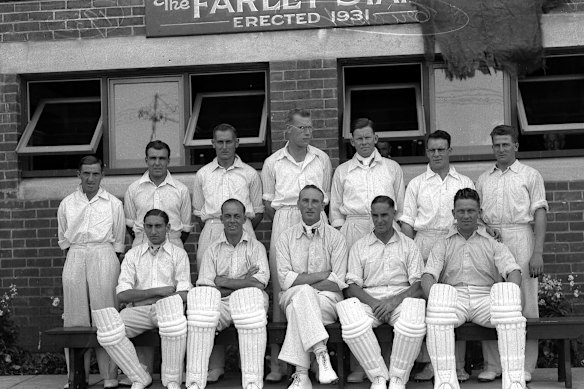
The English team for the opening match of the Bodyline tour. Harold Larwood is at the right end of the back row while Douglas Jardine is in the centre of the front row.Credit: The Fairfax Photo Library
Harold replied: “Our skipper, Mr Jardine, is certainly one of the finest men I have ever had the privilege of meeting – a magnificent captain, a great sportsman and true friend”. Loud cheers and “for he’s a jolly good fellow” rang out to toast Jardine.
In private, away from the cameras, Jardine gave Larwood and Voce an ashtray each he had paid for from his own pocket and had engraved, and it is Harold’s that we are looking at today.
It weighs a few ounces, is about five inches in diameter and a classic of its time. Elkington & Co made ashtrays for the White Star Line shipping company and they were common features in hotel bars and lobbies. “At the end of his life when he was losing his sight he was a bit more guarded about it,” says Janet. “Nana was always there to look after it in case someone took it with them.”
The family have never had it valued nor considered parting with it, the only time it has left their sight is the loan to the Bradman museum, ironic given the relationship between the two men. It did thaw as they reached old age but even now, long after both died, when I mentioned Bradman’s name over the kitchen table, everyone shifts a little awkwardly. The Larwoods are still sensitive about offending Australians about their great hero; this is combined with gratitude for the fresh start Australia gave Harold and his family as they escaped post-war Britain.
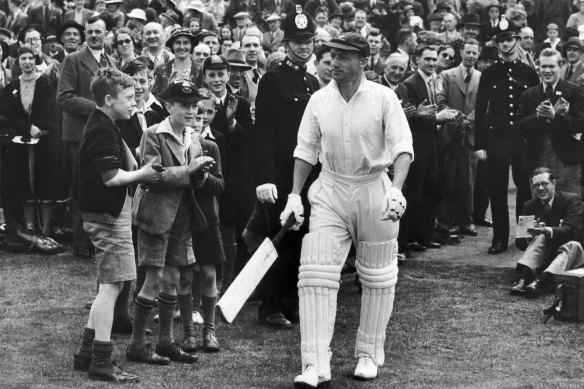
Sir Donald Bradman and Larwood bumped into each other on a Sydney street when Larwood was Christmas shopping.Credit: Getty
Mary was there the day Larwood and Bradman bumped into each other for the first time after Harold had moved to Australia. They had not seen each other for years and both were long retired. The chance meeting in the street in central Sydney between two men who were international news at the time of Bodyline, passed un-noticed. Nobody batted an eyelid; no camera phones then. Mary is the only eyewitness.
“Dad and I went into the city to buy a watch for myself and my sister for Christmas. Dad said: ‘Look who is coming here.’ It was Bradman. I don’t know who saw who first. They had a chat. When they parted Dad said something along the lines of ,‘Imagine that. Us having a chat and nobody noticing.’”
We talk about their family life in Sydney, how Harold became an Australian, embraced the country and lived anonymously, apart from the cricket fans who would knock on the door or send letters from all over the world some addressed simply: Harold Larwood, Cricketer, Sydney. They would always find their way to the house, Harold replying to each personally. But Bodyline never went away.
“Mum used to take shoes to the bootmakers to be repaired,” says Mary. “She would never leave the name Mrs Larwood. She would always leave another name.”
Janet chips in: “Where I used to work, I would be introduced as Harold Larwood’s granddaughter. ‘Just be careful who you tell,’ I’d say. Some people might not be happy with that.”
Andrew grew up with the greats of Australian cricket and world cricket popping round to see grandad. Alan Davidson and his wife Betty would look after him at the SCG when his grandad was off talking to supporters.
Mary would answer the phone to one of the most famous Australians of all, a man who had huge respect for Harold. “A voice would say, ‘Tell him it’s Keith Miller,’” she remembers with a smile, still looking thrilled to be speaking to the great Australian all-rounder. “He was a hero.”
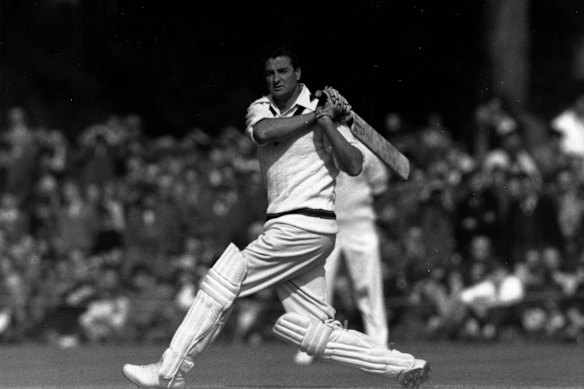
Keith Miller kept in contact with Larwood.Credit: Getty
On the 1954-55 tour, Frank Tyson popped round to pay homage. “He wore a shirt and tie,” says Mary with a laugh. “Mum would say to Dad: ‘Go and put a clean shirt on.’ My dad would say: ‘They are coming to see me, they will take me as I am.’ He would still go and change his shirt though.”
“My earliest memory is of these huge feet” says Andrew. “It was Chris Old sitting in the garden with Grandad. I remember we had an outside toilet and going out there one day as a teenager I saw Richard Hadlee having a chat with my grandfather. Graham Gooch, Darren Gough all came round. Len Hutton, he offered to put me up in England but he died before I could go. Chris Broad came round too with a baby, I think it was Stuart. After they left Nan found a little glow-worm, a stuffed toy. She was horrified. She thought we had to get it back to him. She wrapped it into brown paper and sent me to the SCG to knock on the door and hand it over.”
Of course, we talk about Bodyline. “He always called it fast leg theory,” says Andrew. We chat about the hurt Harold carried around for the rest of his life when he was ostracised and his Test career ended for not apologising for bowling Bodyline, despite just following captain’s orders.
“He was just so disheartened by it. He was hurt. Australian cricketers would come to visit him and he would always say he was treated better by Australians than he was by the English,” says Mary. Oldfield became a great friend, and Andrew has a photo of him as a child posing with “Bertie” and a cricket bat. At the Adelaide Oval Oldfield top edged a ball from Harold on to his head and staggered from the crease, the moment when the England players feared for their safety from a baying mob in the crowd. “Bert told Dad it wasn’t his fault,” says Mary.
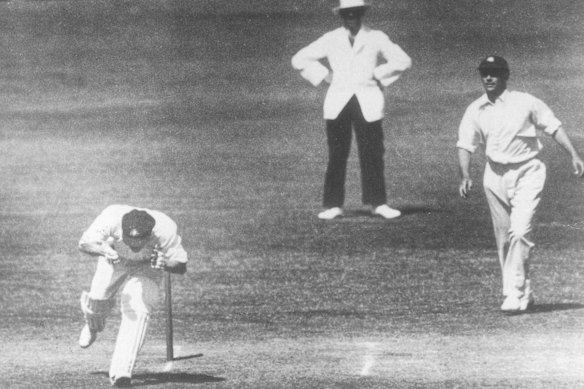
Australian cricketer Bert Oldfield is struck in the head by Harold Larwood during the 1932-1933 Ashes series. They later became firm friends.
Mike Atherton remembers Harold showing off the ashtray when his England side visited towards the end of Larwood’s life in 1994-95. By then he had lost his sight. “Nan was Grandad’s eyes, he was Nan’s ears,” says Andrew. Bodyline never left him. “He still felt it. He was still hurt by it. He said it was not his fault. He just did what Jardine told him – he said he just followed orders,” says Mary.
In September Andrew and Bex visited Lord’s and were shown the archives and scorebook from the Bodyline tour, most of the important documents detailing what went on in committee rooms and how Harold was made the fall guy are missing, thought to have been destroyed by Warner during the war to protect his reputation.
Andrew was surprised to see a portrait of Jardine in the pavilion, but not one of his grandfather – an oversight the MCC should do something about to rectify. It would be a nod to the egregious treatment handed out to Larwood in one of cricket’s great establishment stitch-ups if they were to commission one now.
“My surprise was more at the fact that my grandfather was made to feel as though he was in the wrong and asked to apologise for simply following and executing the instructions of his captain yet there is a portrait of his captain in such a prominent place. Why isn’t there also a portrait of our grandfather as an acknowledgement of his achievements as an English cricketer?”
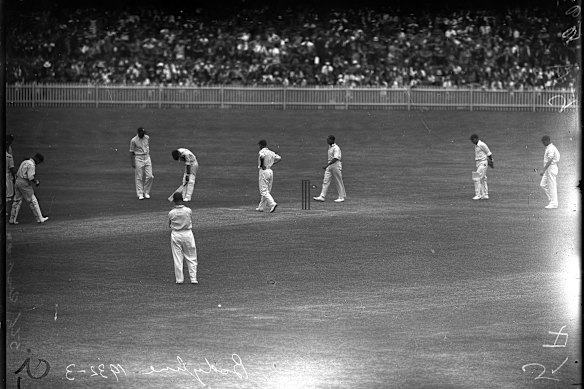
Australian Stan McCabe doubles up after being hit by Larwood in the shoulder at the SCG. His family say he was made the fall guy for criticism of the English tactics.Credit: Staff
The Larwoods are all Australia fans, understandably. Harold himself was split between the two. He never lost his thick Nottinghamshire accent. While we were at Trent Bridge, Alan Odell, the club’s senior tour guide, played us an old 78rpm recording of Harold talking about Bodyline in the months after the series. “I haven’t heard his voice for years,” said Andrew at the time. “He sounds more Nottingham now than in my memory.”
A short drive to Nuncargate and Andrew poses for a photo next to his grandfather’s statue as the sun sets. There are three statues outside the library and opposite Morrison’s supermarket: one of Larwood bowling to Bradman stepping to the off side or ready to duck and Bill Voce crouched fielding, improbably, at short cover.
We wrap up taking pictures. Mary poses with the ashtray and Janet takes from frames on the table by the front door, photos of her grandfather as a young man, looking debonair as he takes a drag on a cigarette.
It is time to end the trip and take a short drive to the SCG. Phil Heads, the club’s head of media, meets us at Gate Two, we park next to Richie Benaud’s statue so Mary does not have to walk far.
There is a match going on, an SCG XI club game. The players have been warned to expect a special guest and make sure they are decent when Mary walks in.
They stand back as she looks at the honours board in the away dressing room that will not have changed much since Harold used it, and played his last game for England here (there were two Sydney Tests in the Bodyline series). She sees Harold’s name, there for his five for 96 and five for 28 in a 10 wicket England victory in the first Test.
“There he is,” she says when she spots his name. “I’ve lived here all my life and not seen it.” But then the Larwood name strikes again. The captain of one of the teams politely introduces himself.
Loading
“Excuse me. I once met your father,” says Bruce Hocking, a long time SCG member, and farmer from Gunnedah, up country NSW. “I knocked on your dad’s door and even though I was a nobody and didn’t know me from a bar of soap, he took time out to talk to me. We had a good yarn and he showed me his things. You know what? He gained more respect from Aussies for not saying sorry.”
After lunch, Andrew shows me the lighter and the Hobbs pencil. The night before he emigrated, and after Jardine gave him the gold and brown pencil inscribed: “To D.R Jardine. From Jack Hobbs, 1925.”
Harold decided he had to go and see Jack Hobbs one more time. He went to his sports shop in Fleet Street, eventually finding the great England batsman in the Cheshire Cheese pub, the pencil in his inside pocket. The pair drank champagne, and Larwood showed him the pencil. “It is an honour to know you have it,” Hobbs said. It is another remarkable piece of cricket history.
Andrew gives me a lift to the airport, on the way driving past Harold and Lois’s bungalow where he grew up. “To some people he was a hero, to others he was a villain, but to me he was just my grandad.”
To Jardine he was a great bowler, a cricketer who cut down the Don and won a series at great personal cost. All just “For the Ashes”.
The Telegraph, London