3 months ago
33
3 months ago
33
Opinion
January 26, 2026 — 3.13pm
January 26, 2026 — 3.13pm
Australian Open with 4K on Stan Sport.
Every match, live & on demand.
Tennis finally joined the modern sporting world in 2025, allowing players to receive on-court coaching during matches – if desired. It’s a civilising move: less skulduggery, fewer hand signals masquerading as nose scratches, and a tacit admission that elite athletes might benefit from a pow-wow now and then.
It’s all very orderly now. Coaches sit in designated pods. At the Australian Open they’re courtside, so players can approach them for pearls of wisdom before returning to their position on court, ready to pulverise their opponent.
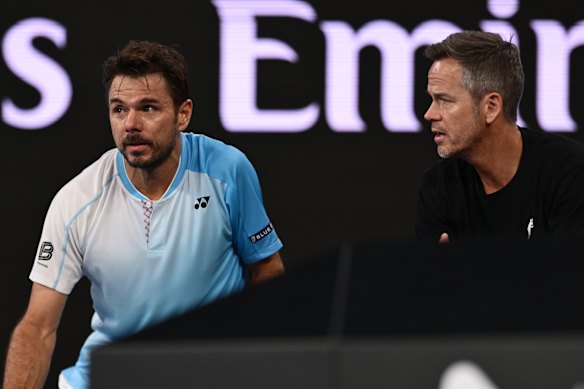
Stan Wawrinka seeks support from his coach Magnus Norman during his third round loss to Taylor Fritz during the 2026 Australian Open. Credit: Getty Images
It wasn’t always like this. Unlike the footy coach who contacts players through a fungi-like network of runners and pony-tailed drink girls, unlike captains who rally round their team, hugging one and all at quarter time, the tennis player was a lonely figure standing behind the baseline, flicking away Christmas beetles and light-drunk moths to the laughter of the crowd.
Of course, coaches could communicate with their charge, but they had to do it via a code only they would understand should authorities issue warnings and penalties. Tugging their right earlobe might mean serve to the left – ha, that’ll trick em. Waving away imaginary flies might suggest a rush to the net. Scratching the head was surely “Dump plan A. Abort, abort, abort.” Secret walky-talky stuff. In the 2018 US Open final, 2018, Serena Williams famously lost her mind and was docked a game after being warned for a sneaky move-forward hand gesture by coach Patrick Mouratoglou.
So, now everything’s out in the open. Conchita Martinez was able to sit in the front row and calmly guide eighth seed Mirra Andreeva through a tight patch in round three, flattening her hand and murmuring tranquila when things got tense. It’s reassuring, humane – and overdue.
But why, in the name of shaved Dunlops, do some players still take it out on their coaches? Even now, when the coach is visibly present and clearly supportive, essentially saying “you’re not alone anymore, mate; we’re (literally) right behind you” – certain players still crack the proverbial. Whether they’re mad at themselves or mad at instructions, the reaction’s the same. And it’s the professional punching bag coach who cops it.
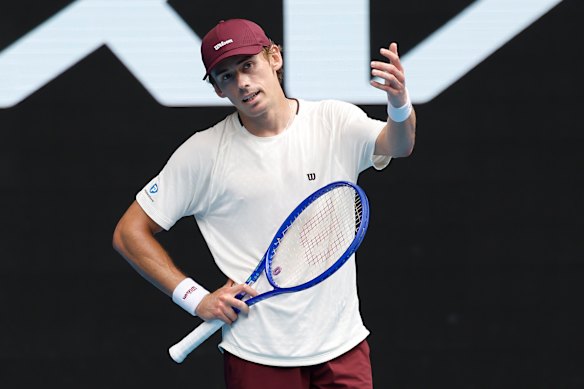
Alex de Minaur expresses frustration during his first round match at this year’s Australian Open. Credit: Getty Images
A stark example came in the second round of this year’s Open when France’s Elsa Jacquemot turned on coach Simon Blanc. Blanc once coached her opponent, Yulia Putintseva, and Jacquemot reckoned he’d been withholding key intel. Down 5-0 in the first set, Jacquemot openly complained of Blanc: “He coached her for years and there are weaknesses he never even told me about, it’s insane.” Blanc was having none of it and left the court in a fit of, how to say … pique. You have to wonder why more coaches don’t do the same when publicly skewered. Oh yes, they’re being paid for it.
World number one, Aryna Sabalenka is notorious for coach-bashing, and her antics were not softened by the open-coaching policy in her semi-final against Iga Swiatek at Roland Garros last year. Her coach, Joe Stacy, said the coaching team just cop it on the chin: “We have a very simple saying, Don’t fight it. Don’t feed it.” In other words, try to keep this wild cat cool, baby. When the new rules were introduced, Sabalenka asked the team to stay in the traditional player’s box in the stand rather than the courtside pods. Perhaps distance makes the heart grow fonder.
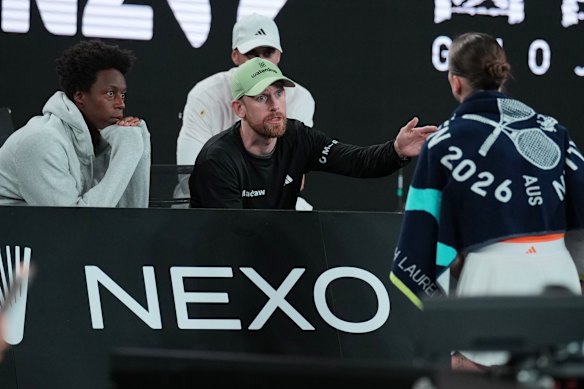
Twelfth seed Elina Svitolina listens as her coach Andrew Bettles and husband Gael Monfils, left, give her advice during her fourth round match against Mirra Andreeva on Sunday. Credit: AP
The worst offender at this year’s Open (so far) would have to be Serbia’s number three, Hamad Medjedovic. His first set against Alex de Minaur in the second round was sublime. The Demon hardly got a look-in. Medjedovic seemed energised by his little chats with the team. Life was good. Then bang. He slides back in the second and wants to fry his guys for dinner.
Was he peeved by his performance or that of his tribe? Either way, he shot arrows of despair directly at the pod, muttering, ranting, shouting, shaking the head, placing hands on hips, and unleashing the dreaded death stare whenever he missed a point. In the Channel 9 commentary box, John McEnroe wisely noted: “His head is not in this right now.”
Even the Demon couldn’t resist a sarcastic thumbs up or two to his group. A kind of “that would have been nice if it had gone to plan, mate”.
Is the tension worst with parent-coaches or parents who fancy themselves as coaches? In a moment of anger, Stefanos Tsitsipas made his dad, Apostolos, bleed when he accidentally struck him with his racquet as he sat courtside at the 2020 ATP Cup in Brisbane. And Andy Murray’s loud rants at his ever-loving ma were legendary. She, who breastfed him from birth and taught him how to lob at three. She would be left looking sad and stoic in the player’s box as she copped a shellacking from her second born. Again.
It’s excruciating. Ungrateful. And a little bit rude.
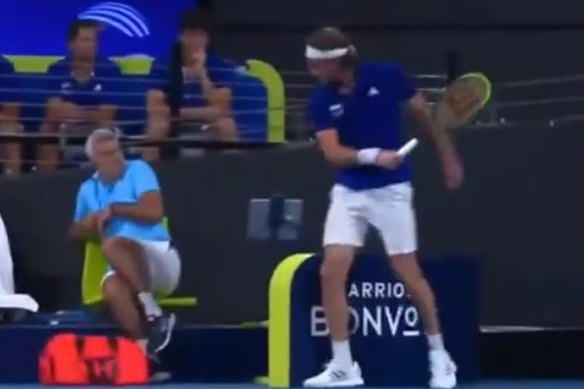
Stefanos Tsitsipas accidentally hurt his coach father, Apostolos Tsitsipas, when slamming his racquet during the 2020 ATP Cup.Credit: YouTube
Look, I know some players fret about their performance. And that they take it out on close ones because they’re the idiots who told them to go cross court when down the line was wiser. Players in other sports get frustrated too. It’s part of the gig. But they don’t get habitually pickle-faced. I’m trying to imagine that nice Cameron Green, for example, halting a Test match to chew out Captain Cummins.
Legal on-court coaching has improved the channels of communication but hasn’t greatly changed the snit-fits. If anything, it’s exposed how easily some crack it with those most invested in them. Here’s an idea. Scrap coaches altogether. Players can roam the court all on their ownsome. If they overhit, mishit, sink balls into the net or trip on their shoelaces, let them self-combust. And if they play brilliantly, may they pump the air or pull a Lleyton Hewitt duck sign of success.
Either way, it’ll be sensational entertainment.
Jo Stubbings is a freelance writer and reviewer.
The Opinion newsletter is a weekly wrap of views that will challenge, champion and inform your own. Sign up here.
Most Viewed in Sport
Loading