2 months ago
17
2 months ago
17
Hundreds of thousands of young Australians have been booted off apps such as Instagram and Snapchat, while others have evaded the federal government’s social media ban on its first day and left messages mocking Prime Minister Anthony Albanese on his TikTok page.
But the prime minister declared victory on Wednesday as he gave a formal address at his Kirribilli residence that heralded the under-16 social media ban as one of Australia’s greatest ever reforms that would soon lead to change across the globe.
“This will make an enormous difference. It is one of the biggest social and cultural changes that our nation has faced. It’s a profound reform which will continue to reverberate around the world, in coming months, to assist not just this generation but generations to come,” Albanese said.
“It won’t be perfect. This is a big change ... Success is the fact that it’s happening. Success is the fact that we’re having this discussion. Parents are talking to their children around the breakfast table. Teachers... will be speaking to their students.”
About a million teenagers between 13 and 16 woke on Wednesday wondering whether their social media accounts would be deleted on the day that 10 tech platforms – Facebook, Instagram, Snapchat, Threads, TikTok, Twitch, X, YouTube, Kick and Reddit – were required to stop under-16s signing up and show proof they were removing underage accounts.
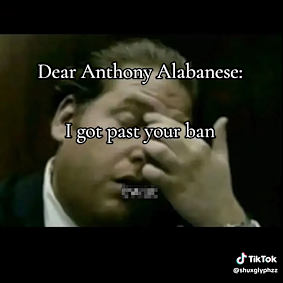
Children are bragging online about still being able to access social media
Content creators made farewell videos on their pages – some set to the lyrics of Adele’s Skyfall, when she sings “this is the end” – while others triumphantly noted their continuing presence on the apps. They posted comments with timestamps saying they were “still here”, or quoted lyrics to Elton John’s hit I’m Still Standing.
“It didn’t work bud,” one underage user commented on Albanese’s TikTok post about the ban.
Albanese, Communications Minister Anika Wells and eSafety Commissioner Julie Inman Grant all stressed the ban’s first months would be messy and families shouldn’t expect perfection, as teens bragged online about escaping the first round of deactivations.
Australian users are facing a disjointed mix of AI analysis, video selfies and government-ID checks to prove they are over 16. X, formerly known as Twitter, is taking a unique AI-driven approach by relying on its Grok model to estimate user ages based on account behaviour, a wildly different approach from competitors relying on biometrics.
Loading
Meta and TikTok have begun enforcing “verify or purge” mandates using third-party facial age-estimation tools, while Snapchat is routing users through banking-grade digital ID systems like ConnectID.
Wells said teenagers who retained their account access on Wednesday shouldn’t expect to stay undetected until they turned 16.
“Just because they might have avoided it today, doesn’t mean they will be able to avoid it in a week’s time or a month’s time. The social media platforms have to go back and routinely check under-16 accounts,” she said.
The minister said she was measuring success in three ways: having a national conversation about social media habits, the fact 10 other countries have said they will follow Australia’s lead, and the number of deactivated accounts.
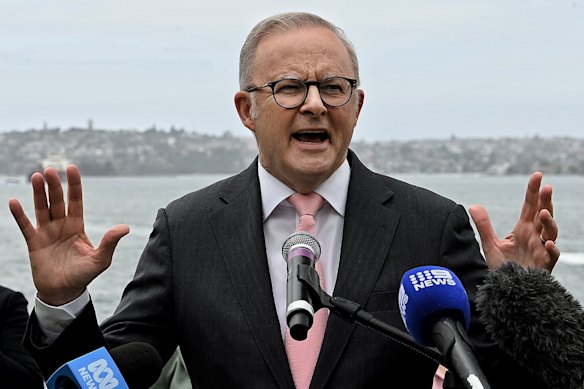
Australian Prime Minister Anthony Albanese at Kirribilli House on Wednesday.Credit: Kate Geraghty
Tech platforms and the eSafety Commission on Wednesday said it was too early to share data, although Wells said 200,000 TikTok accounts had already been removed.
“We’re going to see hundreds of thousands [more] across the next few days and weeks,” she said. “We are measuring that through writing to the platforms tomorrow... We’re going to them every month to make sure that downward trend is happening.”
Wells told radio earlier in the day the transition would be rough for teenagers, but “for very good reason”.
“We hope that teens will be feeling the effects of real-world connections and won’t be feeling so shackled to the online life,” she said.
Fourteen-year-old Ryan Angler spent his first day without social media riding his bike after he was banned from Snapchat.
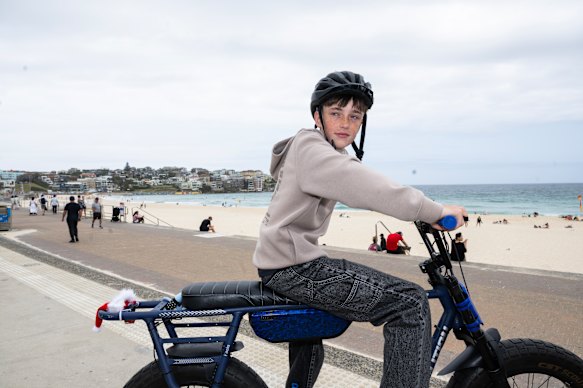
Ryan Angler, 14, rides his bike at Bondi Beach after the social media ban began.Credit: Louise Kennerley
“I just wanted to meet up with all my friends, but I couldn’t really because I don’t have their numbers before we lost social media,” the Sydney teenager said.
“Now I’m going to try to get all the numbers from school.”
Ryan said he was bummed to lose access but was now looking to other activities. “I’ve just been riding around on my bike, playing games on my computer and laying down on my bed [since the ban] because I couldn’t do anything,” he said.
“I’ll probably do more fishing, I want to do it more. I’m keen to have more time to focus on it.”
But it was a more difficult day for 11-year-old Wyatt Thompson, in the regional NSW mining town Broken Hill. “There’s a lot of implications there to not having any access to it,” his mother, Krystle Evans, said.

Wyatt Thompson, 11, who lives in Broken Hill, says his main way of contacting his friends is through social media.Credit: Em Jensen
Melbourne teaching assistant Tania Kaniz said some students were feeling anxious. “I don’t see anyone who’s really happy. Some of the students are saying, like, ‘They shouldn’t ban it – but I’m OK’,” she said.
Alternative social media apps that are not covered by the ban, Lemon8, Yope and Coverstor, dominated the Apple app store’s list of top free apps in Australia on Wednesday.
Inman Grant said she would issue notices to the 10 platforms on Thursday already included in the ban, requesting data about the number of accounts that were deactivated, releasing that information to the public before Christmas.
Loading
“It will form the baseline against which we’ll measure compliance,” she said. “As we said many times, we’re not expecting flawlessness. We have built in allowances for that. Enforcement will target systemic failures after rigorous investigation and under our own terms and our own time.”
“These isolated cases of teenage creativity, circumvention, spooling, and other ingenious ways that people will push boundaries will continue to fill newspaper pages, but we won’t be deterred, we’re playing the long game,” she said.
Most Viewed in Politics
Loading