3 months ago
8
3 months ago
8
New York has hot dog stands, Ho Chi Minh has banh mi, and Delhi has samosas. But it was the Mexican street food classic, the taco, that Lawrence Diaz had to bring to Sydney.
“It’s my favourite food. It’s something I enjoy as much as a fine dining restaurant for a fraction of the price,” says Diaz, owner of Papi’s Birria Tacos food truck in Haberfield. “We have people returning four or five times a week – that’s what makes me realise people are appreciating it. It’s affordable.”
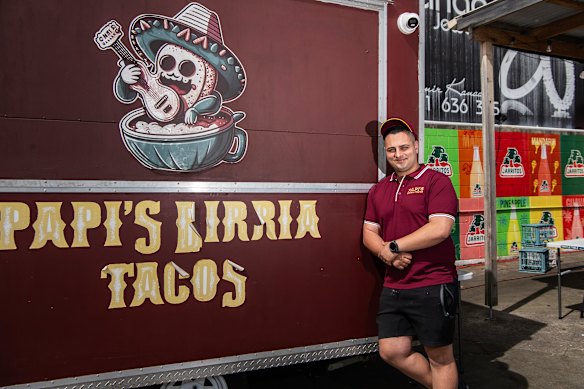
Lawrence Diaz in front of his first food truck shop in Haberfield. Now, he has opened a restaurant selling the same food in Darlinghurst.Credit: Steven Siewert
Next to a petrol station, diners sit on plastic chairs beside foldable tables and chomp down on birria tacos – cheesy tacos full of shredded meat, dunked in a smoky and spicy broth – while looking out onto Parramatta Road.
Diaz’s food truck is one of 1988 across Sydney.
However, while suburbs in the city’s western fringe are served by hundreds of food trucks, four of Sydney’s most affluent local government areas contain zero permanent ones, data obtained by the Herald shows.
North Sydney has 20 to 30 temporary trucks but doesn’t allow permanent operators. Lane Cove Council also allows only temporary operators. Woollahra and Hunters Hill councils allow permanent vans, but don’t have any. Mosman residents, meanwhile, have a solitary food truck to fight over.
The data reflects the number of food trucks registered to each council. Waverley and Burwood councils did not provide data.
Canada Bay Council, one of the city’s smallest, has experienced the sharpest rise in food trucks over the past three years, from seven in 2022 to 51 in 2025
But, 60 kilometres south-west of the CBD, Campbelltown is Sydney’s food truck mecca. Here, there are four times the average number of food trucks for the city’s local government area, with 322 vans.
One of those trucks belongs to Sohee Park and her husband, Charlie Shin, whose Australian-animal and anime-inspired fairy floss designs have become so successful that their food truck, SomSom Candy, is a full-time gig.
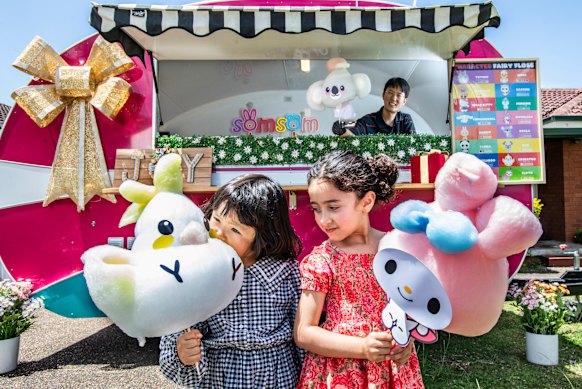
Food truck owner Charlie Park in the Campbelltown LGA, which has more food trucks than any other council area in Sydney.Credit: Steven Siewert
“It’s busy, especially in the morning because that is when parents come,” Park said. “I think people just love to take photos, and they’re very happy with our fairy floss. Whenever we go to a festival, I think ours is the biggest.”
The family brought trendy anime fairy floss from South Korea to Australia when they migrated in 2004. But they did not expect to start a new trend themselves.
“[Charlie] spent a lot of time developing the Australian animals – because no one else does that. Koalas, kangaroos, cockatoos and wombats,” Park said.
“The character fairy floss started in South Korea, and it was cute, and he wanted to make it here. But now, Korean people want to copy his fairy floss.”
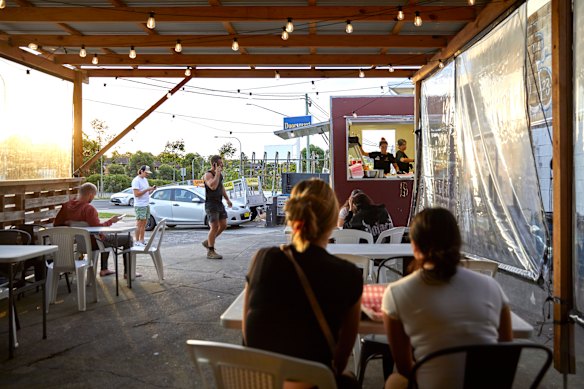
Beside a cheap petrol station, diners sit on plastic chairs at foldable tables to enjoy Papi’s Birria Tacos with a view of Parramatta Road. Credit: Jennifer Soo
Centre for Western Sydney chief economist Neil Perry (not to be confused with the chef of the same name) said the prevalence of food trucks reflects an area’s income and the socioeconomic status of Sydney.
“For most goods, demand increases with income. But for some things, like frozen pizzas, when income rises, the demand for those things goes down,” Perry said.
Loading
“It looks like that’s the case here for food trucks ... if income is higher, people go to more normal restaurants; where there’s a lower-income area, it’s correlated with more food trucks.”
Committee for Sydney head of corporate affairs Matt Levinson said that the popularity of food trucks reveals how Sydney is establishing a street food scene heavily influenced by migrants.
“Every generation of migrants is deepening and enriching culture in unexpected and amazing ways, which is why [a rise in] food trucks in the broader street food culture is so exciting,” he said.
According to Levinson, while other countries’ street food cultures are influenced by walkability, Sydney’s is being shaped by empty main roads and vehicle access.
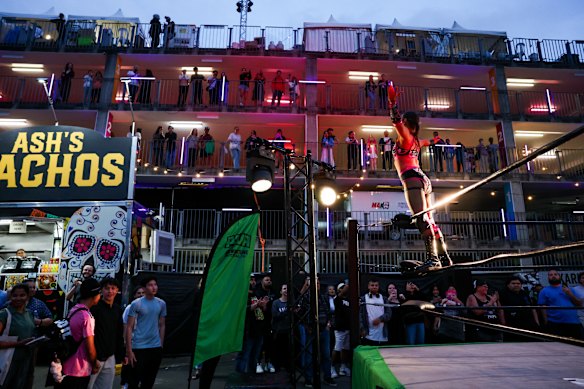
Street food culture in Sydney’s west at Parramatta Lanes festival last month.Credit: Edwina Pickles
“Street food culture in other cities is so centred on the walking environment, walking down the street in New York and getting a pretzel, or in Mexico City and getting a taco. When we look at Sydney, there’s this really amazing food culture that is spiking up on main roads.
“We’re seeing this group of food trucks popping up in the side streets around Sunnyholt Road in Blacktown ... it’s land along these main roads that’s not utilised that well at night, and what it offers these operators is a place to park their truck, access to power, access to water and lighting. There’s a bit of car parking, so people can stop in.”
But Diaz says food trucks reached their peak last year, with many now listed for sale on Facebook Marketplace.
“I know personally, a lot of people struggle – it’s not an easy industry. The expenses aren’t as low as they need to be, especially with rent, and unless you’re extremely busy, it’s really rough.”
Most Viewed in National
Loading