2 months ago
16
2 months ago
16
Opinion
December 13, 2025 — 1.21pm
December 13, 2025 — 1.21pm
There’s nothing quite as awkward for a professional sporting group as being seen enjoying life when you’re getting trounced. The public believes anyone getting paid outrageous sums of money for losing games should adopt a permanent frown and a hangdog, slumped-shoulders appearance.
Regretful poses are expected. To enjoy a bonding beverage, sink a birdie or take a bike ride is seen as an overt sign of not giving a toss about winning or losing, even if the reality is somewhat the opposite.

England players are taking a break from their Ashes preparations at Noosa.Credit: Seven News
Misery loves company, and there is plenty to go around within the Barmy Army at the moment. Fans revel in the euphoria when their team triumphs, so the troughs of disastrous defeat can seem bottomless. Treating those two imposters just the same is a neat trick, but easier said than done. Brendon McCullum has preached the Kipling approach through entertainment over result, but the problem is that the hit of euphoria hit from an entertaining victory has a short shelf life, especially when you’re on the road.
Since 1882, winning the Ashes has never been about entertainment – the very conception of the trophy makes that clear. Douglas Jardine was rare among touring England captains in that he had a thorough and merciless grasp of that concept.
Of course, life would be a misery if we allowed our jobs, or our sporting teams, to determine our daily state of mind. Sports psychologists champion mindfulness, level-headedness, balanced emotions and so on to ensure there are more peaks than trough. Maybe McCullum is on to something with his beach trips and stress-free environment, although some players often need stress to bring out their best.
Ben Stokes and Steve Smith are two of that ilk. Unshakeable belief in a proven system works well in a fixed environment – but when the environment changes, the systems have to adapt, too.
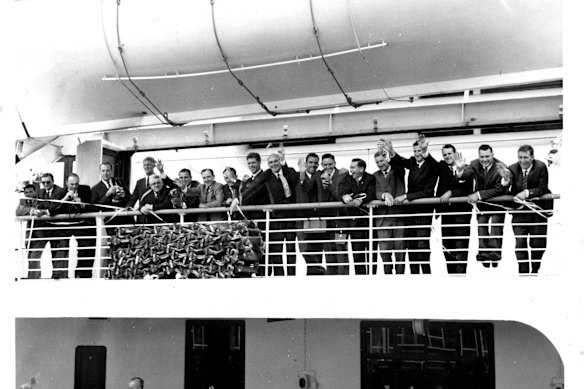
Australia’s 1961 touring party departs Fremantle in Western Australia, bound for their months-long trip to England. Credit: Fairfax Media
Cricket tours are famously long and arduous, although I had a chuckle when a contemporary player described this one as “lengthy” when in fact it is one of the shortest Ashes tours – just 47 days from day one of the first Test to day five of the fifth Test (if it goes that far), with no first-class warm-up games, no ODI series, no T20s.
It used to take longer just to travel to Australia. When England began playing series overseas, players were often away from home for over nine months.
In the 1980s, a tour to the United Kingdom began in late April and finished in September. It included 18 or so first-class games, some one-dayers and a couple of side games against the minor counties, The Club Cricket Conference, the Duchess of Norfolk’s XI and an international sortie to Ireland or Scotland. Now that was a tour!
Loading
Sure, there was a bit of golf played on the odd day off, but the only trip to a beach was Brighton’s pebbled version, where the waters of the English Channel were cooler than the beer. Getting away from the stresses and excesses of the game was a lot easier in those simpler times. There was no social media (thank goodness) – just tabloid reporters, who would often chase a story into a public house.
Today, every fan has a camera and the means to publish anything they like, which brings a highly porous boundary fence to de-stress time.
In the 80s, a couple of players might be excused from a tour game and sent to Scarborough, Weston-super-Mare or some other exotic location to refresh, but there was never enough spare time between matches for the whole team to rest. The players with time off had to pay their own way. Ryanair was yet to commence £20 flights to Paris or the Costa del Sol. Solace in defeat was spread among teammates. Families were not allowed on tour. Different times, same emotions.
The England players of 2025 find themselves pilloried for resting rather than training – or maybe, more importantly, playing competitive matches. You don’t have to train harder or train more when you lose, but you certainly have to train smarter. On the old tour, the learning process was undertaken in the middle in a match, where techniques and tactics came under competitive stress.
Net sessions are of considerable inconsequence. Rarely has a method been devised that is so inappropriate for the training of an open field sport, but that’s about all there is when you don’t want to practice under match conditions.
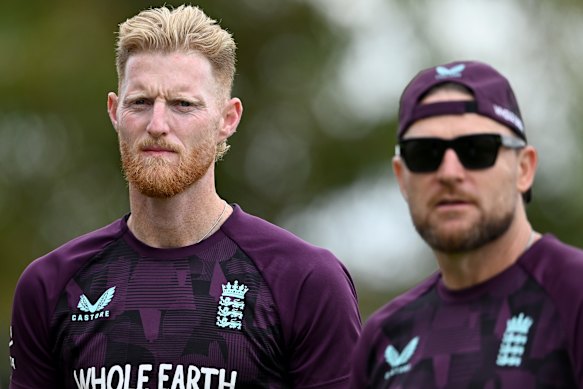
Skipper Ben Stokes and coach Brendon McCullum have a lot on their plate heading into the third Test in Adelaide.Credit: Getty Images
Touring the West Indies had its swings and roundabouts. While there was every chance of getting bruised, battered and beaten during play, the evenings were balmy and the rum punch plentiful. The team stayed in beachside resorts because they were the only accommodation available. Hence, there was no extra media scrutiny when players snatched a couple of hours of downtime on the sand. You didn’t have to go to Noosa – Noosa came to you.
The locals were more likely to buy you a Red Stripe or fried flying fish while good-naturedly deriding your ineffectiveness against the short ball than demand a selfie with a derogatory poster. In any case, photos took a week to develop, so no one bothered. Did I mention that social media didn’t exist?
Loading
Tours can be great if you’re winning and purgatory when you’re losing. They can bring teams together in adversity or in victory – but if it’s the former, then the captain and coach had better find a way to restore morale on the field before it’s too late.
For this England team, “too late” is approaching at the rate of a Mitchel Starc toe-crusher.
Most Viewed in Sport
Loading