3 months ago
23
3 months ago
23
Opinion
December 26, 2025 — 9.25am
December 26, 2025 — 9.25am
You have to give them credit – today’s tech lords thought about the future when many in democracy had forgotten about it.
We hear constantly how rising productivity growth drives living standards. Without it, the magic stops and fear and doubt take over as the driving emotions. Technological breakthroughs commonly drive great leaps in productivity.
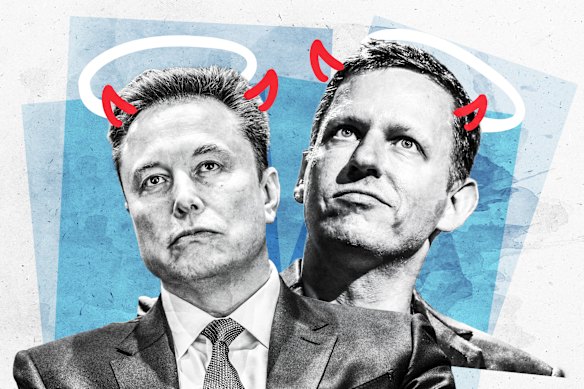
Elon Musk and Peter Thiel: would-be engineers of the human soul.Credit: Michael Howard
So it matters that Peter Thiel invested in technology aimed at eliminating disease, extending life and creating new sources of energy. It’s important that Elon Musk envisioned – and then produced – reusable rockets and internet from outer space. These are the building blocks of a more abundant future.
Much of this tech innovation began a decade ago, before Donald Trump’s disruptive entry into the White House. Ten years on, Silicon Valley, for now at least, is willingly embracing Trump’s White House.
But the emergence of the “tech right” has repositioned founders such as Thiel and Musk as “evil geniuses” for many in the democratic public.
While the tech right is doing what it does best – exploiting a first mover’s advantage (seeing how social media can influence public), working in small, trusted groups (think the Doge guys), disrupting the status quo (backing Trump) – where has the left been?
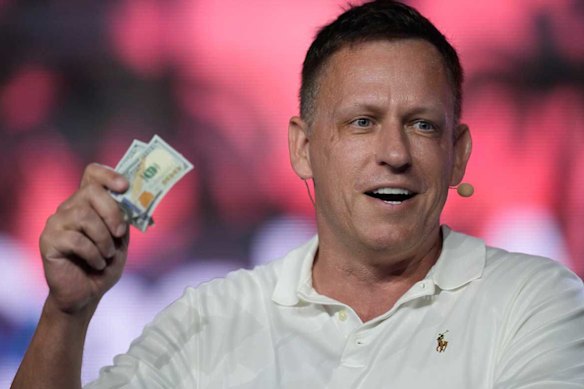
Peter Thiel supported Donald Trump in 2016.Credit: AP
The American political scientist Ruy Teixeira writes: “The left’s 21st-century project has not been techno-optimist, tending to focus instead on mitigating the negative effects of technological change.”
Beginning in that pivotal year of 2016, the left has been in a state of permanent reaction and outrage, first over social media in the aftermath of Trump’s win, and now over AI.
“Rapid technological advance is key to fast productivity growth and rising living standards,” Teixeira writes. “But the left has been lukewarm at best about the possibilities of new and better technologies, leaving techno-optimism to the libertarian-minded denizens of Silicon Valley.”
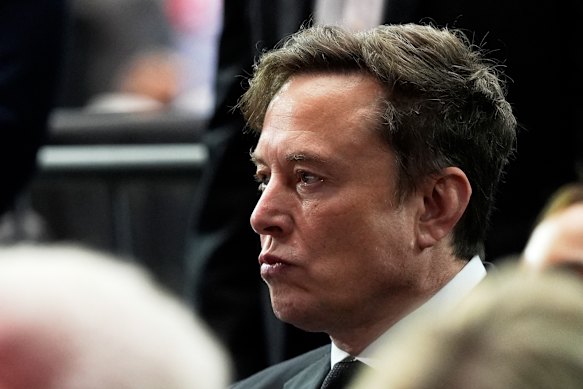
Elon Musk continues to reach for the stars.Credit: AP
It was Thiel who led the way in 2016, when he broke ranks with the gauzy Obama-leaning liberals of Silicon Valley to endorse Trump at the Republican Convention. This gave moral permission for others in the valley’s “founder” class to follow suit.
Impatient with bureaucracy and lowered expectations for our technological future, tech execs increasingly looked to Trump as an agent of positive disruption. Musk wants to make “life multi-planetary” for its own survival. Thiel this year said: “I think if we don’t find a way back to the future, I do think that society ... It unravels, it doesn’t work.”
University of Durham research fellow Carla Ibled says Musk and Thiel enshrine the concept of “the founder” as “the perfect model of the ruler in a post-democratic age”. Both Musk and Thiel insist “they offer their public a new and necessary ‘hope’,” she adds.
The problem is that the personality cult of the founder clashes with liberal democratic ideals.
Loading
In a system that relies on a respect for law and limits on power (liberal democracy), the tech-Trump axis brings a new corrosive element.
People such as blogger-to-the-founders Curtis Yarvin now propose replacing democracy with a political structure run by – you guessed it – a monarch-like CEO.
Surely fear and loathing of the tech right’s aspirations may explain part of the public’s recent souring on Silicon Valley.
Another cause may be the jarring character of founders who cast many important challenges facing the world – inequality, policing, health care, social mobility – merely as matters of engineering.
Thiel laments the inability of the government to carry out visionary efforts such as the Manhattan Project (to build the World War II-ending atomic bomb) or the Apollo space program. They were projects whose coherence of mission sustained them because they fulfilled a shared and popular political objective (ending World War II, defeating communism).
The “founder” class place their hope in reconfigured code and hardware to save the West, make its citizens strong and to compete with China. A continual parade of apps and platforms instrumentalise their users, often without their consent.
Sign up for Starlink and you’re required to agree to reject Earth-bound governance of Mars (see clause 11, “Governing Law”). It sounds like a science fiction joke today, but in times ahead, this may matter. A path to the future is sketched out, and the public’s role is already decided without its consent.
The tech elite veer from what they know – numbers and code – mistaking political reality for yet another start-up, another series of nodes in a network to be simply changed by engineering. Listening to Musk and fellow South Africa-born crypto maven David Sacks lecture the world about Russia’s invasion of Ukraine highlights the expertise gap. Some call it “engineer’s disease”, the tendency of individuals with an engineering mindset to think their problem-solving skills are universally applicable.
Loading
Another word for it is arrogance.
Yes, Silicon Valley founders have figured out the technological means to convey their messages, but they fail at the moral means. And 10 years after Thiel began backing Trump, helping set in train a series of dramatic political events, the democratic public knows political legitimacy can’t be engineered.
The Business Briefing newsletter delivers major stories, exclusive coverage and expert opinion. Sign up to get it every weekday morning.
Most Viewed in Technology
Loading