3 months ago
31
3 months ago
31
Red flags will be raised under new gun control reforms if anyone applying for a licence or in their networks raises security concerns, Home Affairs Minister Tony Burke announced on Monday, a direct response to one of the Bondi terrorists accessing guns despite his son being investigated for links to Islamic State.
New details on the government’s legislative response to the December attack – which Prime Minister Anthony Albanese said he hopes will pass when parliament is recalled early next week – came as Albanese said state and territory leaders would have to answer to their constituents if they opposed a jointly funded gun buy-back program previously announced.
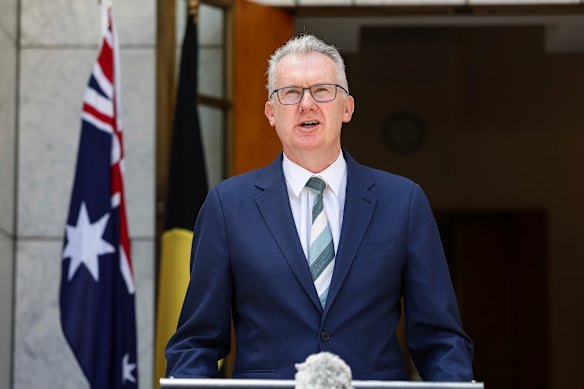
Home Affairs Minister Tony Burke addressing a press conference on Monday. Credit: Alex Ellinghausen
“The legislation will allow us to use the AusCheck system ... to effectively create a pathway where states and territories can have a two hurdle process before someone is issued with a gun licence, the final hurdle remaining the fit and proper person test that states already have,” Burke told journalists at Parliament House.
AusCheck is a service within the Department of Home Affairs that issues background checks and identity cards on behalf of the government. Burke said the measure will “allow the intelligence that is held by ASIO and by the Australian Criminal Intelligence Commission to be able to [be used] to create the extra layer of caution, if somebody is themselves a risk when they’re applying, or if the risk resides in a member of their family or a member of their household”.
Bondi shooter Sajid Akram was issued a firearms licence in 2023, four years after his son Naveed Akram was investigated by ASIO for links to Islamic State. Sajid was shot dead by police at the scene, and Naveed was taken into custody and subsequently charged with 59 offences. Six guns belonging to Sajid were seized following the attack.
The new screening measure will sit alongside an already announced national gun buy-back program, the largest of its kind since the 1996 Port Arthur massacre.
“There are more guns now in Australia than there were at the time of the Port Arthur massacre. That is not good enough,” Albanese said. “The terrorists at Bondi Beach had hatred in their minds but guns in their hands. This law will deal with both, and we do need to deal with both of these issues. These are complex laws, and our focus is ensuring they are effective and practical.”
On Monday morning, Tasmanian Police Minister Felix Ellis pushed back against the program, saying communities had not been consulted and that the state could not handle the expense of the program.
“For small states like Tasmania, this can be really impactful in terms of the cost of delivering these programs when really, when we talk about these kind of events, the key is about making sure that [guns] don’t fall into the wrong hands,” Ellis told ABC Radio National.
Loading
He said that taxpayers’ money could be better spent on programs such as “greater policing, accelerating the National Firearms Register, and a whole range of other areas that make sure that firearms aren’t in the hands of terrorists and people that would harm our community”.
Tasmania has the second-highest per capita gun ownership rate of any Australian jurisdiction, behind the Northern Territory, with 0.27 guns per person. The state’s gun owners collectively hold more than 156,000 firearms, far below Queensland and NSW, which host more than 1 million guns each.
Asked if he was confident about support for the program from state and territory leaders, Albanese said: “Well that’s up to the states to speak for themselves, but I think that states who don’t participate will have to justify that to their own people.”
The gun reforms will be combined into a joint bill alongside hate speech legislation, a move that Opposition Leader Sussan Ley has expressed distrust in.
“We are deeply sceptical of the prime minister’s decision to introduce a single bill that will attempt to cover multiple complex and unrelated policy areas; for example, issues of speech are clearly separate from the ownership and management of firearms,” Ley said.
“As is so often the case with this prime minister, he is squarely focused on what he perceives to be his political interests, not the national interest. This is a political decision, aimed at fostering division, not creating unity,” Ley said.
Albanese said the combination of the bills was not a political move, but rather “about getting it right”.
Cut through the noise of federal politics with news, views and expert analysis. Subscribers can sign up to our weekly Inside Politics newsletter.
Most Viewed in Politics
Loading