2 months ago
15
2 months ago
15
Herald: The Wallabies had one win from five Tests on their spring tour, which deflated the buoyant mood of Australian rugby in the middle of the year. There were 15 Tests in 22 weeks, including a Lions series, and Joe Schmidt said he’d never dealt with something like that … in hindsight, was 15 too many to schedule?
Waugh: No. One of our biggest challenges in our market, which we’ve had a lot of feedback around, and when we compare our high-performance calendar to others, is that we don’t play enough rugby. And so as we think about 2027 and work backwards, given the maturity of our squad, the schedule we had this year – whilst testing – will hopefully prepare the squad well in years to come. Equally, the schedule we had allowed us the opportunity to work our way into that top six (world rankings). So whilst it was demanding, we’re comfortable we’re putting the right amount of pressure in the system to optimise the performance in 2027.
Some of the wins were spectacular, but the Wallabies ended up with only five victories from 15 Tests. It can’t be described as a successful year, can it?
It’s the level of consistency we’d like to see a lift in. Even the Test matches we lost, we had patches where we could have outplayed any opposition right around the world. We saw that the team has the capability to beat the best teams in the world. It’s just that level of consistency to apply themselves for 80 minutes, week in, week out. Whilst the win/loss is disappointing, and not reaching our target of being in the top six was disappointing, we got a huge amount of confidence. We’ve got the capability to beat anyone in the world. It’s just about the level of consistency to do it repeatedly.
So you believe the Wallabies are in a stronger place now than a year ago?
Yeah, without doubt. From where we were 12 months ago and the amount of experience we had, we have more depth, we’ve got a higher level of resolve, and we have a higher level of inner belief you can’t fake when it comes to competing with the best teams in the world.
Are you satisfied with the coaching handover from Joe Schmidt to Les Kiss proceeding as planned at the end of July, or should the band-aid just be ripped off and Kiss take over from July 1?
Given the growth the team has had under Joe, and the similarities between Joe and Les, we’re very comfortable with the plan. We think Joe has been doing an excellent job in terms of embedding behaviours and the culture within the squad, and we’re very confident Les will pick up from where Joe leaves it at the back end of July.
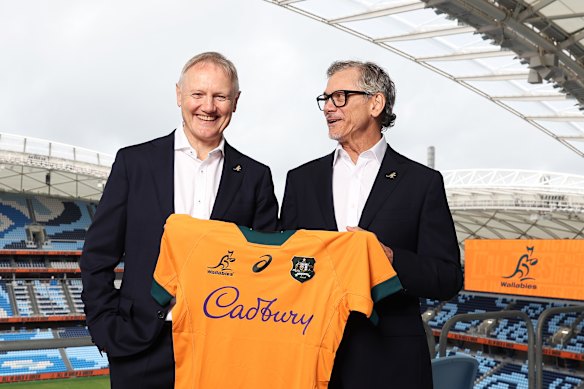
Current Wallabies head coach Joe Schmidt (L) and incoming Wallabies head coach Les Kiss.Credit: Getty Images
From what we know, Les Kiss is pretty hands-off. Should he be fully on board from the start of 2026 in terms of planning and strategy, and even selections?
Joe has clearly got a very long history with Les, and they’re talking frequently. So publicly and outward facing it might look like Les is quite hands-off, but the conversations happening with Joe and Les are fairly detailed. Equally, we’re conscious we don’t want to blur lines of Les’s responsibility to win the Super Rugby Championship with the Reds before he joins the Wallaby environment.
Les should at least sign off on the July squad, though, shouldn’t he?
I don’t think so. The conversation will be pretty thorough, I would have thought, between Joe and Les, but our focus is to beat Ireland, France and Italy and set ourselves up for a strong Nations Championship, and Les picks the team up after Italy and runs with it into Japan. We’re very confident in the plan, and Joe’s got the reins until he doesn’t.
Were you surprised R360 delayed its launch until 2028? Do you think they’ll ever get off the ground?
There was no surprise from a timing perspective when you think about potential opportunity for players post a Rugby World Cup.
In terms of the actual concept itself, it’s been no secret that most domestic leagues around the world are challenged financially, and there’s an opportunity for disruption with the product. We’ve been trying to do that as much as we can within Super Rugby, and from a product perspective and entertainment perspective we saw the growth this year in some of those initiatives, and how the match officials are really embracing that opportunity to entertain.
The concept is sound in terms of disruption. But it’s then around global calendar, how does that fit in, what does it mean to domestic leagues beneath the international game and how does that impact them? We’ll continue to have an open mind and be agile, but we’ve made our position clear at this point.
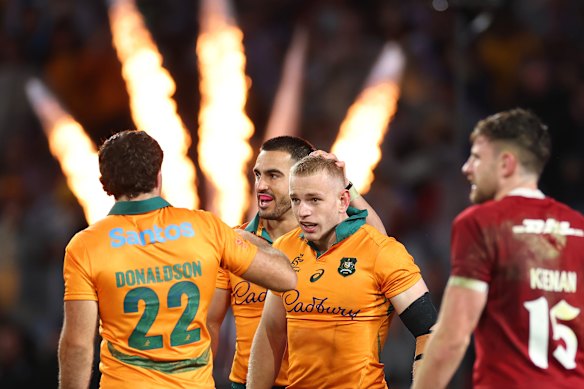
The Wallabies celebrate Max Jorgensen’s stunning try in the third Lions Test.Credit: Getty Images
Are you confident you’ll be able to keep Max Jorgensen?
Max is an outstanding player and an outstanding ambassador for rugby, and is a big part of our 2027 Rugby World Cup plans and the future of the game here in Australia, and again we’ll be fair and reasonable in how we negotiate with players and agents, and hopefully the proposition from a player welfare, player opportunity and remuneration is compelling.
How will you stop the exodus of players after the Rugby World Cup when that lure is no longer there? And particularly after it was made apparent that there’s now no barrier to playing for Australia from overseas?
We’ve been very clear in the fact our preference is to always pick players committed to Australian rugby and you’ll go through the teams that we’ve selected, and it’s been very rare that we’ve selected outside of players based here in Australia.
That being said, due to the fiscal responsibility we have to set the game up in perpetuity, we’ll continue to be pragmatic around the landscape. In terms of the player welfare, we’ve got the world’s best practice in terms of keeping players in the game for a long period of time. So for us, it’s about creating cultures across our four Super Rugby clubs that players want to stay.
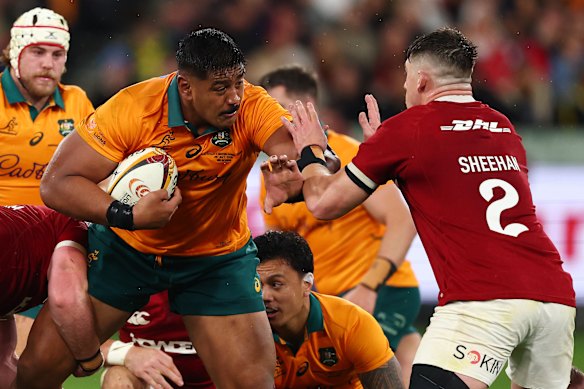
Will Skelton was outstanding for the Wallabies but only played four of 11 possible tests allowed under regulation 9.Credit: Getty Images
Using Regulation 9 to select a Wallabies team will only become more important in the future if more players go overseas. This year it felt confusing and even ad hoc. Do you need to establish a more consistent approach so clubs, players and everyone else knows where you stand?
That’s a fair observation. I see it as reasonably transactional in how you adhere to Reg 9 window, and all players anywhere in the world are available for international rugby within that window. To your point, it’s probably been a little bit confusing due to different dynamics with different individuals, and going forward we will be far more transactional with the way we look at the Regulation 9 window.
What’s the status of legal action between the Melbourne Rebels and RA?
We have been very transparent around our position on the matter. We’ve got a very firm view and legal advice on our position. It’s in front of the courts and scheduled to be heard in 2026.
Was there a mediation this year that wasn’t successful?
Yes. We’ve always been very pragmatic around trying to solve the issue for what’s in the best interest of the game.
Depth seems to be a consistent issue in Australian rugby. Is RA doing enough to be in that fight against the NRL and the AFL for junior talent? And I’ll particularly ask you about the bush, where clubs like the Panthers and the Giants have built up sophisticated recruitment systems.
Looking at recent history, in terms of the U20s’ performances in the TRC, our Under-18 Schools (win) against New Zealand, and our 16s and 19s programs, we’re certainly investing a lot in that area. It’s probably more of a sniper rifle approach than a shotgun approach in terms of how we’re capturing that best talent. But we do need to be working with our programs to identify talent younger, and then give those girls and boys a clear pathway to representing Australia. We’ve acknowledged it, and we have a similar view of the public, in the fact that we can be doing better in that space.
Ultimately, it comes down to investment. We need to ensure, and back to the probably macro level of fiscal responsibility, that we’re investing in the right areas for the right athletes.
The Lions tour seemed to be a big success, and we’ve heard you were able to pay down $60m in debt. How much did Rugby Australia end up making?
We’ve certainly surpassed our budget and our expectations on the success of the Lions tour. The commercial impact, as well as just the broader sentiment and engagement, exceeded all expectations. We carried some debt into 2025, and we were able to extinguish that on the 29th of August this year. So it certainly exceeded expectations. I’d have to get back to you on exact figures.
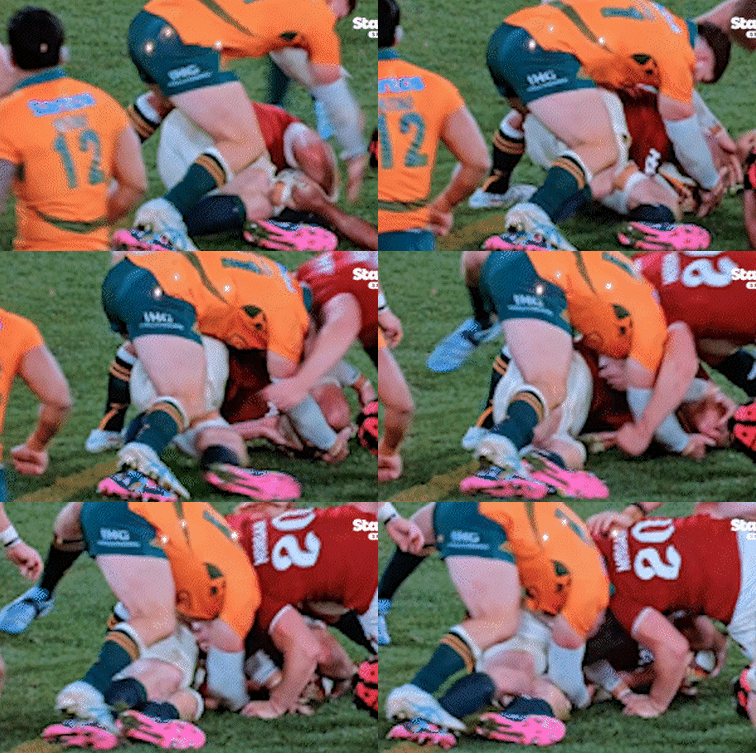
Carlo Tizzano and Jac Morgan collide at the breakdown.Credit: Stan Rugby
A refereeing decision at the end of the second Test could have swung the series differently. You backed Schmidt’s criticisms of the decision and said you’d seek accountability from World Rugby and refs boss Joel Jutge. Did you get it?
No. That area of the game, it has been well recognised, is creating challenges for all unions. World Rugby are well across the challenges and they’re well across the feedback we’ve provided throughout the year. Pleasingly, they’re responding to similar challenges from other national unions around the world, to really lean into getting that area of the game to a (higher) level. It’s never going to be perfect. But I don’t think it’s been any secret there’s been some real challenges.
So you weren’t satisfied with the answers you were given?
No, we’re still in the same position as what we previously clarified.
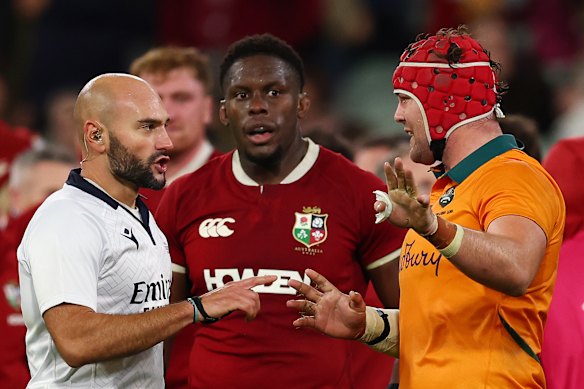
Harry Wilson speaks to referee Andrea Piardi about the end of the second Test at the MCG.Credit: Getty Images
Is it difficult as a national union to find a balance between being supportive of referees but critical when warranted?
It’s World Rugby’s role and the unions’ roles to support the match officials and that’s really important.
But one of our most important roles is we take the product to market, and I don’t think we necessarily make it easy for our referees in terms of some of the guidance we give that area of the game. So we’ve done a fantastic job in terms of development of referees in our country. Other countries probably aren’t at that same level of match official development, but we continue to invest in that space because we see the importance of what (refereeing) has on the product, and the overall ecosystem of rugby. By no means is it a criticism of World Rugby, we’re just saying we think one of the critical roles of World Rugby is this specific area of the game.
Can you give us your perspective of the Wallaroos’ World Cup campaign – they made the quarter-finals, obviously – and what are your plans to strengthen women’s rugby in Australia ahead of the 2029 World Cup?
In terms of the journey from ’22 through to ’25, that was a journey of great transformation. As we think about the investment across the coaching structure, contracting the Wallaroo squads, we made great progress. But equally, those that finished ahead of us at the World Cup invested similarly, and kept that gap between where we’re at and where they’re at. So that that continues to be a challenge for us in terms of closing that gap.
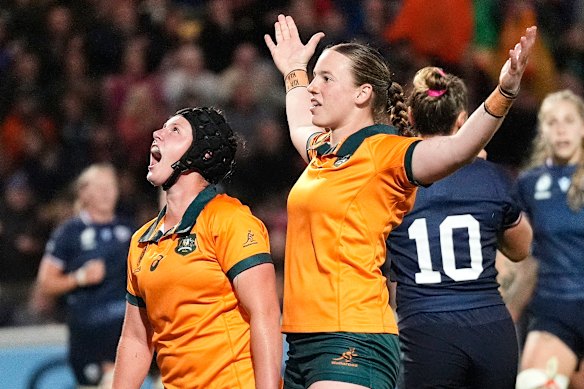
Teenage Wallaroos fullback Caitlyn Halse was outstanding the Rugby World Cup, where a 31-all draw with rivals USA saw Australia make the quarter-finals. They were then knocked out by Canada.Credit: AP
As we go through the next cycle and through to 2029, one of the core goals is to compete on the final weekend in 2029. We know we need to invest appropriately to get there. We’ll have 10 Test matches next year. We’re conscious that the more Tests we play against quality opposition, the better we’ll get as a Wallaroo group. The other area of opportunity is around the integration of our sevens athletes with our fifteens athletes. Where that’s been done well globally, it’s been really effective, and we haven’t been as active in that space as others. I see a real opportunity there.
Underpinning all of that is Super W, and what the domestic footprint looks like to build out depth, to push up into that Wallaroos environment. We just announced that there’ll be a single round competition with semi-finals, final and a crossover (final) with Aupiki (New Zealand’s women’s rugby competition) in 2026. But we’re also very conscious that ideally we get to a position where we can invest even more into the competitions that underpin the international game.
Why is there still only a single round of Super W in 2026?
It’s to that broader focus on the financial sustainability of the game. We continue to invest material amounts across different programs, right across from pathways through to the Wallaroos. Ultimately, you’ve got a funding envelope that we need to be really disciplined with, so the game can be sustainable. Then it’s around prioritisation (on) how we ensure that we’re going to meet those objectives of winning a gold medal at LA in 28, and going through the final weekend in the Rugby World Cup in 2029. And through the high-performance consultation, and consultation with our rugby clubs, the most effective pathway for 2026 is the schedule that we’ve put in place. And then we’ll re-assess 27, 28, 29.
Looking towards a home World Cup in 2029, and with domestic rivals increasing their spending, is this not the time to increase investment in women’s rugby? It sounds like there’s a decrease. Is that wrong?
No, that’s wrong. There’s definitely not a decrease in funding. So we said 2025 was by far the most we’ve ever invested in women’s rugby, which is not inconsistent with what we do in a men’s Rugby World Cup year.
For 2026, player contracting has all been worked through, consistent with what 2025 was. We will have 10 Test matches in ’26, first time we’ve ever toured USA, and we’re going to Europe. And then we’ve kept the Super W competition the same as how we delivered it in 2025. That’s a really compelling player proposition in terms of the schedule. And we’re very confident it sets us up to invest as much as we possibly can in 2027 through to 2029.
Loading
The 2027 Rugby World Cup draw was held last week and we got New Zealand in our pool. The debate is whether the opening game should be Wallabies-All Blacks in Perth. Do you have a personal view?
I’d be happy for it to be the final game as well. No, look, I actually don’t have a view. We will talk through with World Rugby as to what would make the most sense and a decision will be made.
The draw is the draw. You have to be good enough. Every World Cup there are different paths to get through to the final weekend, and you just have to make sure you are good enough to win.