3 months ago
28
3 months ago
28
Revealed: The extra Sydney commuters expected to flock to Metro
We’re sorry, this feature is currently unavailable. We’re working to restore it. Please try again later.
The number of commuters boarding services on the final stage of the M1 metro line is forecast to be almost a quarter higher when it opens next year than the double-deck trains which previously ran along the rail corridor in Sydney’s southwest.
New figures show 8600 passengers are predicted to pass through gates at stations between Bankstown and Marrickville from 8am to 9am when the final stage opens – a 22 per cent jump on the 7030 commuters who used the line on average during the same period when double-deck trains operated.
Bankstown station is expected to have 2300 commuters walk on and off metro trains during the 8am-9am peak on weekdays, followed by Campsie with 1600 passengers and Marrickville at 1100.
The forecasts from Sydney Metro for the first day of services by driverless trains along the final stretch between Sydenham and Bankstown of the M1 line are regarded by the agency as conservative.
Longer-term growth in patronage will hinge on the extent of new housing development along the corridor, or how many people choose to forgo their cars for trains if journeys on the latter are faster or more convenient.
A 13-kilometre stretch of the T3 rail line used by double-deck trains was closed in September last year to allow it to be converted to carry metro trains along the final section of the M1 line.
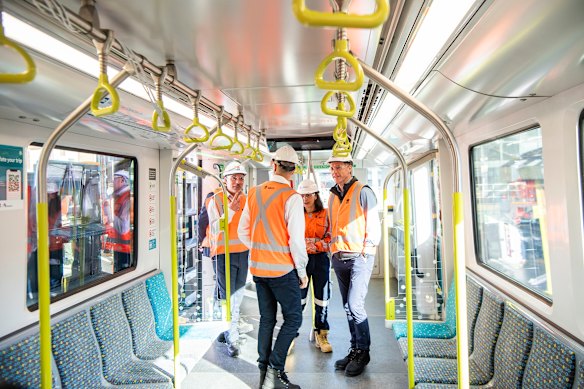
Premier Chris Minns (right) and other ministers on a metro train recently at Bankstown station.Credit: Steven Siewert
Sydney Metro expects a higher frequency of services than on the old heavy rail line, together with much faster journeys between Sydenham and the CBD and north shore, will boost patronage on the M1 line, which extends to Tallawong in the city’s northwest.
It is expected to lead to similar passenger loads on the M1 line to and from the southwest to what is already experienced on services between the city’s northwest and the CBD.
University of Sydney transport expert Geoffrey Clifton said the patronage targets for the southwest section of the M1 line were “quite ambitious” as demand across the city’s rail network had been stagnant due to people working from home and service disruptions earlier in the year.
“In the first month, they’re going to have a lot of people trying the [Metro] network out, and maybe they can achieve those figures, but … they’re on the ambitious side,” he said.
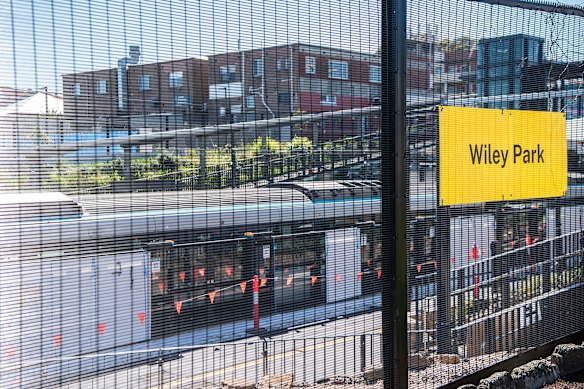
A metro train at Wiley Park station during testing on the final stage of the M1 rail line.Credit: Steven Siewert
Clifton said construction of apartments near stations in the southwest and more people travelling to their workplaces, instead of working from home, would be key to driving patronage demand over the medium term.
“If governments and businesses start cracking down more on work from home, then we’ll see those rail patronage numbers increasing,” he said.
“The Metro is doing well, but that’s come at the expense of the rest of the rail network. If people are able to make the whole journey on the Metro, then that would encourage them to use it, but some people will have to switch from Metro to another service, and that brings back the unreliability [factor].”
Loading
Sydney Metro chief executive Peter Regan said the city’s southwest was set for exponential business and housing growth over the next few decades, which would be facilitated and supported by the metro line.
“Our modelling shows we are expecting an initial shift towards public transport on day one as people opt to leave their cars at home and jump on the metro. However, that is set to increase significantly over time as business and housing growth in the area flourishes,” he said.
Commuters will have to wait until at least April next year for the M1’s final stage to open, which has been blamed on the complexity of converting the old heavy rail line to metro train standards and disruptions from industrial action.
The opening of the final section is also at risk of further delays due to a dispute between Sydney Metro and Fire and Rescue NSW over a lack of fire hydrants on platforms at nine stations.
The forecasts for patronage at stations along the southwest section represent typical patronage on weekdays while schools and universities are open. The metro line can carry up to 40,000 passengers an hour in either direction during peak periods.
Start the day with a summary of the day’s most important and interesting stories, analysis and insights. Sign up for our Morning Edition newsletter.
Most Viewed in National
Loading