3 months ago
20
3 months ago
20
Electricity retailers warn new rules requiring them to offer three free hours of power every day could bankrupt smaller providers or force them to hike rates at other times, unless the federal government urgently reforms network tariffs as well.
The energy regulator is set to begin consultations with power companies after Climate and Energy Minister Chris Bowen last week unveiled the government’s so-called Solar Sharer scheme, a policy that will require retailers to offer free electricity to households for three hours in the middle of the day when sunshine typically floods the grid with more power than it needs and causes wholesale prices to crater.
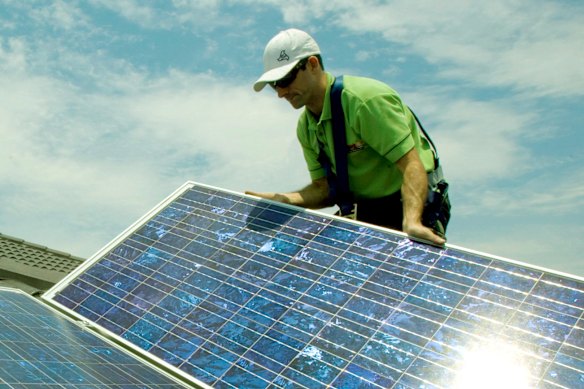
Australians will get three free hours of power from mid-next year under the government’s Solar Sharer scheme.Credit: AFR
Retailers indicated they supported the intent of the reform: encouraging more people to use power when cheap renewable energy is most abundant could ease demand surges after sunset and smooth out volatile price swings.
Wholesale electricity prices often soar in the evenings when solar panel output recedes just as people begin returning home to fire up their appliances, placing strain on the grid. The new Solar Sharer plan will be opt-in, and initially available to residents in NSW, South Australia and south-east Queensland, where the regulator sets the default standing offers for people who do not take up special deals.
However, smaller and medium-sized electricity companies cautioned that the new policy must be accompanied by urgent reforms to ensure retailers are not saddled with hefty underlying costs that cannot be passed on to customers, such as network tariffs for the use of power line infrastructure, which account for around one-third of a customer’s bill.
Loading
The industry doesn’t magically deliver free power to customers “out of the air”, said Adrian Merrick, chief executive of power retailer Energy Locals.
“Someone somewhere is paying for this,” he said.
To ensure the scheme worked sustainably, retailers needed commitments that network tariffs would be reduced to zero for the three-hour period; an exemption from buying environmental certificates to demonstrate their use of renewable energy during that time; and the ability to increase rates at other times of the day to recoup losses, Merrick said.
“If all you are doing is forcing out an artificial concession at a retail level … then all you are going to do is break the market,” he said.
Officials from the Australian Energy Regulator and the federal energy department are seeking feedback from industry participants, including on the design of tariffs, and recognise the need for retailers to make a reasonable return.
Bowen has assured retailers the government will “talk issues through” with companies, but vowed that consumers would be put first. With daytime wholesale prices regularly trading at $0 or plunging into negative territory due to Australia’s world-leading per-person uptake of rooftop solar panels, energy retailers were often “not paying for that energy … and I don’t think consumers should therefore pay their energy companies”, he said.
‘We could end up in a situation where the retailers will be more expensive in non-free times to cover those costs.’
Amber Electric co-founder Chris ThompsonOnly a few retailers, including AGL, OVO and Snowy Hydro’s Red Energy, already offer free access to power for some customers in the middle of the day in certain circumstances. Many others, however, have increasingly been rolling out plans built around cheaper daytime rates to run appliances or charge electric vehicles, and financial rewards to store surplus rooftop solar in batteries that can be exported to the grid at night.
Flow Power chief executive Matthew van der Linden said the Solar Sharer offer risked becoming a destabilising intervention in a market in which customers and providers were already heading in the same direction.
Loading
“I would be keen for regulators and governments to be looking for ways to enhance the existing market drivers that are already there, and find a way to reward customers who are taking steps and are participating,” he said.
Amber Electric, a retailer that enables customers to buy and sell electricity at fluctuating wholesale prices rather than fixed rates, said the ability to benefit from vastly cheaper daytime power prices was what it had based its business around for the past seven years.
“It’s cool to see the government moving in this direction,” Amber co-founder Chris Thompson said.
However, he said there were some “question marks” over how the Solar Sharer scheme would be implemented, including whether it would be paired with material changes to network tariffs, and whether those reforms could be made in time for the program’s launch date in July next year.
“We could end up in a situation where the retailers will be more expensive in non-free times to cover those costs,” he said.
The Business Briefing newsletter delivers major stories, exclusive coverage and expert opinion. Sign up to get it every weekday morning.
Most Viewed in Business
Loading