3 months ago
25
3 months ago
25
Elon Musk’s department of government efficiency said it made more than 29,000 cuts to the federal government – slashing billion-dollar contracts, cancelling thousands of grants and pushing out civil servants.
But the group did not do what Musk said it would: reduce federal spending by $US1 trillion ($1.5 trillion) before October.
On DOGE’s watch, federal spending did not go down at all. It went up.
How is that possible?
One big reason, according to a New York Times analysis, is that many of the largest savings that DOGE claimed turned out to be wrong. And while the group did make thousands of smaller cuts, jolting foreign aid recipients, American small businesses and local service providers, those amounted to little in the scale of the federal budget.
In DOGE’s published list of cancelled contracts and grants, for instance, the 13 largest were all incorrect.
At the top were two defence department contracts, one for information technology, one for aircraft maintenance. Musk’s group listed them as “terminations” and said their demises had saved taxpayers $US7.9 billion. That was not true. The contracts are still alive and well, and those savings were an accounting mirage.
Together, those two false entries were bigger than 25,000 of DOGE’s other claims combined.
Of the 40 biggest claims on DOGE’s list, the Times found only 12 that appeared accurate – reflecting real reductions in what the government had committed to spend.
The Times’ analysis helps answer a basic question about DOGE, which was hard to judge in the group’s chaotic heyday, when it had enormous power to cut federal spending and force out government employees who stood in the way. At the time, in the early months of 2025, DOGE listed real cuts alongside fake ones, and made it hard to tell the difference.
That raised the question of whether DOGE, at its heart, was an exercise in budget cutting or in deception.
It had elements of both, the Times found. But among DOGE’s largest claims, the bogus savings were both larger and much more common than the real ones. Similar errors and exaggerations recurred across the group’s work.
The Times analysis shows that, in trying to demonstrate progress toward its budget-cutting goal, Musk’s group turned other promises inside out.
Musk had said that DOGE would be “the most transparent organisation in government ever,” and that it would bring the precision of the tech world to government. Instead, the group became opaque, with its lack of progress obscured by errors, redactions and indecipherable accounting that few private businesses would accept.
Some of DOGE’s employees are still working in the Trump administration, mainly on technology projects. But the group’s budget cutting now seems to be spent, even as the fallout from fired federal workers and former grant recipients persists. The website where DOGE tallied its successes, called the “Wall of Receipts”, has not been updated since October 4.
At the White House, a spokesperson declined to answer specific questions about DOGE’s work, instead sending a broad statement about the president’s goals: “President Trump pledged to cut the waste, fraud and abuse in our bloated government.”
Neither DOGE nor Musk, who left the group in May, responded to questions from the Times. In a podcast interview this month with Katie Miller, a former spokesperson for DOGE, Musk said his group had been “somewhat successful” at cutting spending. But he also said that, if he could go back in time, he would not do it again.
“Instead of doing DOGE, I would have basically built – you know, worked on my companies,” he said.
Big-dollar boasts
To sort DOGE’s bogus cuts from its successes, the Times looked at federal records for the 40 largest items on the “Wall of Receipts”. In at least 28 cases, DOGE got it wrong.
Its errors included:
- Double-counting: DOGE took credit for cancelling the same Energy Department grant twice, adding $US500 million in duplicate savings.
- Timeline errors: One contract that DOGE claimed credit for ending had actually been terminated by the Biden administration, weeks before DOGE began its work. Three more items on DOGE’s list had simply expired. These were pandemic-era contracts with pharmacies that provided free COVID-19 testing for the uninsured. They were originally allowed to spend up to a combined $US12.2 billion, but they never came close to that level. Then, in May, the three contracts ended on schedule. DOGE still claimed credit for killing them, highlighting $US6 billion in savings.
- Misclassifications: Seven programs that DOGE claimed to have terminated are not dead, including four that were resurrected by court rulings.
- Exaggerations: In 16 cases, DOGE greatly exaggerated its cuts. Many, including those two large Defence Department contracts, relied on an accounting trick that produced “savings” with little real-world effect. DOGE lowered the official “ceiling value” of contracts – reducing the theoretical limit on what the government could eventually pay – without changing its actual spending.
“Does lowering the maximum limit on your credit card save you any money?” said Travis Sharp, a senior fellow at the Centre for Strategic and Budgetary Assessments, which studies federal spending. “No, it does not.”
In one case, DOGE made its claim particularly hard to check: It took credit for saving $US312 million by cancelling a US Agency for International Development contract, but declined to identify which contract, citing continuing litigation.
The Times used the few details given by DOGE to identify the mystery item as a tech contract with the firm Accenture. Here, as well, DOGE’s claim was inflated by treating the ceiling value as if it were an IOU that the government had to pay in full, though it did not.
Another case involved a 10-year Pentagon information technology contract with the firm CACI. Musk’s group claimed it had reduced spending on this contract by $US700 million. But again, it had lowered only the ceiling, to $US5 billion from $US5.7 billion.
This summer, CACI CEO John Mengucci told stock analysts that the change was meaningless.
“It doesn’t change a thing for this company,” he said. His company had always expected to be paid about $2 billion over the contract’s lifespan. And even if the contract ever did reach the ceiling, he said, the Pentagon could just raise it again.
“There’s no reduction of revenue,” Mengucci said.
Loading
A Pentagon spokesperson defended these claims, saying contracts often did reach their ceiling values.
But he also said money saved on one Pentagon contract could be shifted to “higher priority investments”, suggesting the goal was not necessarily to cut overall spending.
Other errors on DOGE’s wall have been erased over time.
On the day the list first appeared, the largest claim was an $US8 billion Department of Homeland Security contract that was wrong by a factor of 1000. The contract was worth only $US8 million. That mistake and others were deleted after news reports revealed them.
The power to cut the federal budget was never truly in Musk’s hands – it belongs to Congress. And since the start of DOGE’s work, legislators have only once passed a law devoted to clawing back appropriated spending, defunding foreign aid and public broadcasting. In two mostly short-term spending bills, they have declined to make steep additional cuts.
Musk’s team did not confront the largest – and growing – components of the federal budget: health care programs such as Medicare and Medicaid, social security and interest on the federal debt.
Real cuts, real pain
Despite all that, the DOGE effort led to some actual cuts that closed offices, cancelled programs and deprived people of food, medicine and other aid.
For people depending on those funds, the effects were sudden and devastating.
DOGE initially terminated nearly every contract and grant at USAID and sought to lay off most staff members as Musk put the agency “through the wood chipper”. Some aid programs were later revived. But thousands were cancelled.
For Plan International USA, the cancellation ended work on 13 grants, including one that provided food aid in Ethiopia and an education program in Nepal to keep girls in middle school to avoid early, forced marriages. Its abrupt termination was listed on the wall as saving $US11.7 million.
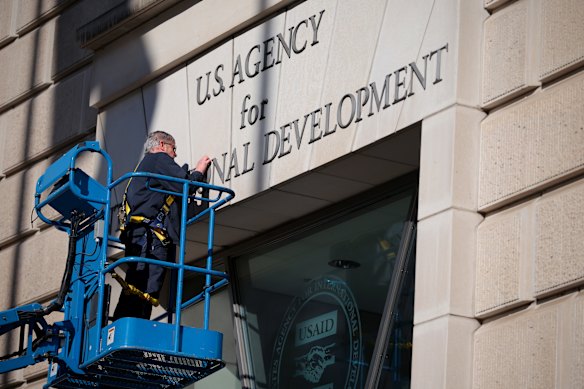
A worker removes the US Agency for International Development sign from its Washington headquarters after DOGE shut it down this year.Credit: Getty
“When we left, a lot of parents could no longer afford to send their children to school,” said Shanna Marzilli, the group’s CEO.
In Sudan, grant interruptions and cuts meant the aid group Alight had to pause offering food and medicine for refugees, though the group ultimately filled the gaps with private contributions. In other locations, including neighbouring South Sudan, the organisation stopped providing services altogether.
Jocelyn Wyatt, the organisation’s CEO, said private donors helped keep her group afloat this year. “I don’t think it’s sustainable,” she said. “And I’m always impressed with the generosity.”
Scott Roehm, senior director for justice and accountability at the Centre for Victims of Torture, said his group received its first stop-work orders for its USAID and State Department grants on Friday, January 24. By this Monday, the organisation had to stop paying 75 per cent of its staff, which forced it to close centres that provided counselling and rehabilitation services to thousands.
Roehm said he was particularly concerned about possible suicides – about a quarter of the torture victims the group served had recently experienced suicidal ideation.
“We know for sure that our survivors we are no longer able to serve are suffering,” he said.
Those dollar amounts were small, compared with DOGE’s largest claims. That is, in effect, how DOGE ultimately saved so little but still caused so much disruption. For small business and local communities, relatively modest sums had major effects.
“It’s the small numbers that hurt people,” said Lisa Shea Mundt, whose company, the Pulse of GovCon, tracks government contracts.
The sheer volume of all these cuts contributed to the sense that DOGE was taking a fine-toothed comb to the government, no waste too small. But in reality, DOGE needed the appearance of the big billion-dollar items because a vast majority of these claims added up to so little, at least in dollars.
In total, the Trump administration terminated more contracts this year than the government did last year. But the actual dollars “de-obligated” – money the government had committed to spend but then pulled back – were at most a couple of billion dollars higher in 2025 than in recent years, according to contracting experts.
For decades, the government has funded outside analysts to study whether taxpayer-funded programs actually work, and how to improve them. It is the kind of work that would seem to serve DOGE’s mission of making government more efficient.
But DOGE cancelled some of these contracts as well.
“It doesn’t feel like any of it has to do with efficiency,” said LaDonna Pavetti, a senior fellow with MEF Associates. Her firm lost several contracts intended to help federal antipoverty programs run more effectively.
A chaotic process
Many of the errors DOGE has left in its wall were rooted in the chaotic process of how it identified cuts – or told agencies to.
DOGE was staffed by outsiders from the business and tech worlds, without much experience in the arcana of government programs. The early approach to measure savings by subtracting spent money from ceiling values helped drive its choices and its high error rate.
Dr Sunny Patel, who was a top official at the Substance Abuse and Mental Health Services Administration, said he and his colleagues were given a dollar target and an Excel formula for calculating savings. DOGE officials suggested contracts to cancel, and agency officials fought to protect ones they viewed as most critical by offering others instead.
“You had to hit the hard number, and there’s only so many things that you can cut,” he said. “So it was like, ‘Oh, I guess we’re going to offer this up,’ because this is the least bad thing to do.”
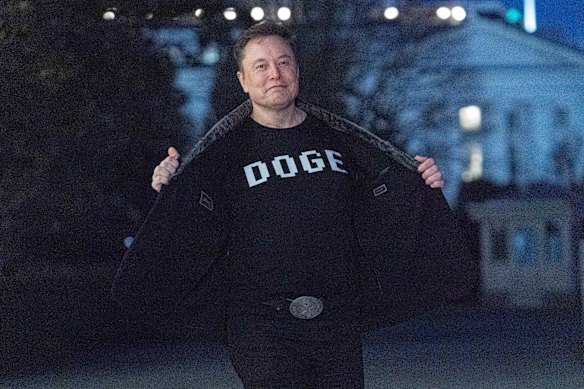
Musk flashes his DOGE T-shirt at White House in March.Credit: AP
In other cases, government workers came to understand DOGE’s process and fed the group nearly finished contracts with high ceiling values rather than contracts that would significantly reduce spending.
Many of DOGE’s initial broad cuts and layoffs were later put on hold or reversed by litigation – a fact DOGE never went back to the wall to update. That litigation also cost the government money.
The Port Discovery Children’s Museum in Baltimore had won a $US200,000 grant from the Institute of Museum and Library Services (IMLS) to fund a program in which museum staff members went into child care centres connected to public schools in Baltimore. There they would teach parents how playing with their children could foster child development and family relationships.
On April 28, the government sent the museum a form letter terminating the grant and half its funds. The program no longer met agency priorities, the letter said, “and no longer serves the interest of the United States”.
“We were serving low-income families in Title I schools,” said museum vice president for development and marketing for the museum Sonja Cendak, referring to a federal program focused on low-income areas and families. “I don’t know what to say.”
The DOGE wall shows that it cancelled more than 1000 IMLS grants to museums, libraries and history centres. States and the American Library Association sued and courts required the grants to be reinstated. The Baltimore museum later received most of its funds.
On December 3, IMLS announced it was reinstating all grants. But those grants still appear as cuts on the DOGE website, collectively “saving” the government about $US134 million.
This article originally appeared in The New York Times.
Lifeline 13 11 14; Beyond Blue 1300 22 4636.
Get a note directly from our foreign correspondents on what’s making headlines around the world. Sign up for our weekly What in the World newsletter.