3 months ago
36
3 months ago
36
28 Years Later: The Bone Temple
★★★
109 minutes MA
Let’s have more sequels that head off on bizarre tangents. Whatever objections might be raised to Nia DaCosta’s 28 Years Later: The Bone Temple, it can’t be accused of lazily repeating the formula established by the original 28 Days Later – which was basically a straightforward horror movie about a zombie virus spreading across Britain, even if director Danny Boyle and writer Alex Garland primly avoided having the word “zombie” spoken on screen.
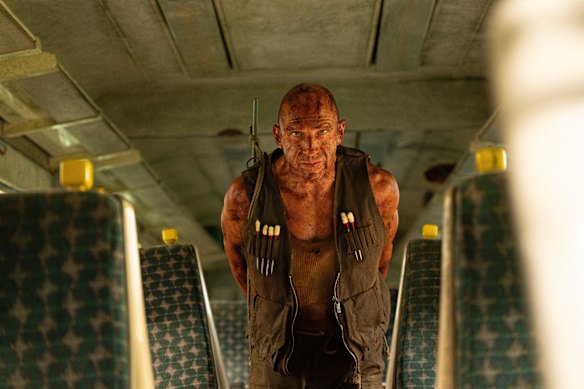
Ralph Fiennes returns as a scientist conducting weird experiments.Credit: Sony Pictures
The Bone Temple is the follow-up to last year’s 28 Years Later, which revived the series after a long hiatus. Garland is the sole credited screenwriter of both these new movies, reinventing his original premise for a post-Brexit world: the virus has been driven back from the European mainland, but civilisation in Britain has collapsed, leaving the semi-zombies free to rampage across the countryside while the non-infected try to keep out of the way.
If all that sounds roughly as expected, other aspects of The Bone Temple go further out on a limb. One of the main plot lines has little directly to do with the virus, instead following the exploits of Sir Lord Jimmy Crystal (Jack O’Connell from Sinners), the leader of a gang of youthful Satanists who model themselves after the late Jimmy Savile, a real-life monster more alarming than most of his fictional equivalents.
There are puzzles here on a few levels, even aside from the question of where the Jimmys source their tracksuits and blond wigs. Once the shock wears off, it becomes clear that DaCosta and Garland have nothing meaningful to say about Savile’s crimes: Jimmy Crystal is evil, but not specifically a sexual predator.
Indeed, in the real world, the bulk of the accusations against Savile weren’t made public until after his death in 2011, meaning presumably that in this parallel timeline he’s still remembered as a beloved children’s entertainer (we’re not told if he was eventually zombified in turn).
The other major plot line centres on Dr Ian Kelson (Ralph Fiennes), an eccentric but staunchly British scientist out of a post-apocalyptic J.G. Ballard novel. In between rocking out to his 1980s record collection, Kelson captures one of the near-zombies (Chi Lewis-Parry), whom he injects with morphine in the hope of restoring some part of his patient’s original personality.
It takes half the film before Kelson and the Jimmys finally cross paths, but the plot twist that brings this about is worth the wait. By that point, it has become evident that The Bone Temple is a divided film in another sense: sequences of hectic carnage alternate with more contemplative interludes, typified by wide shots of Kelson sitting by a rushing stream, pondering the riddles of existence.
There’s a lot of dialogue, too, reminding us that Garland began his career as a novelist (not that cinematic reference points aren’t plentiful, from This Is Spinal Tap to The Wizard of Oz). With Crystal and Kelson speaking up for faith and reason respectively, the film appears to be developing a distinctive personality of its own, even a degree of philosophical ambition, until the fumbled ending restores the status quo.
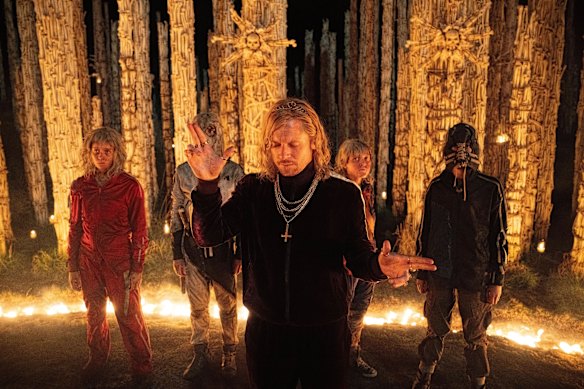
Sir Lord Jimmy Crystal (Jack O’Connell), leads a gang of Satanists modelled on the late Jimmy Savile.Credit: Alamy Stock Photo
All up, The Bone Temple is a bit of a mess, the kind that often points to creative conflicts behind the scenes. But this is a matter for speculation. So is the question of how far the final version truly belongs to DaCosta, an American newcomer to the series whose previous credits range from a middling Marvel movie to an updated Hedda Gabler.
Regardless, the messiness is partly what makes The Bone Temple worth seeing – and with at least one more chapter on the way, there’s happily no way of predicting where the story might lurch next.
Most Viewed in Culture
Loading