2 hours ago
1
2 hours ago
1

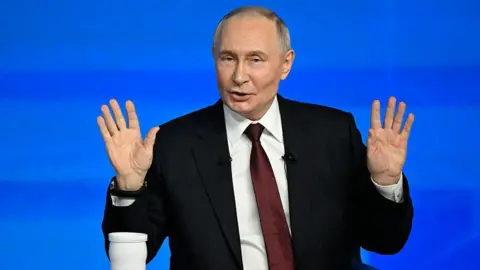 Alexander NEMENOV/AFP
Putin has offered little sign of compromise to end the war, although talks are set to continue in the US
Russia's President Vladimir Putin has said there will be no more wars after Ukraine if Russia is treated with respect - and claims that Moscow is planning to attack European countries are "nonsense".
In a marathon televised event lasting almost four and a half hours, he was asked by the BBC's Steve Rosenberg whether there would be new "special military operations" - Putin's term for the full-scale war.
"There won't be any operations if you treat us with respect, if you respect our interests just as we've always tried to respect yours," he asserted.
His remarks were in line with a recent comment in which he said Russia was not planning to go to war, but was ready "right now" if Europe wanted to.
He also added the condition,"if you don't cheat us like you cheated us with Nato's eastward expansion".
He has long accused Nato of going back on an alleged 1990 Western promise before the fall of the Soviet Union. It was denied years afterwards by late Soviet leader Mikhail Gorbachev.
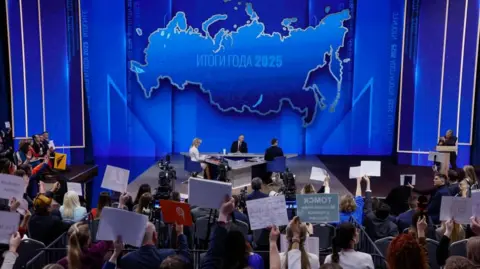
The "Direct Line" marathon combined questions from the public at large and journalists from across Russia in a Moscow hall, with Putin sitting beneath an enormous map of Russia that encompassed occupied areas of Ukraine, including Crimea.
Russian state TV claimed more than three million questions had been submitted.
 EPA
EPA
Organisers of the event said three million questions had been submitted to Putin
Although it was largely choreographed, some critical comments from the public appeared on a big screen, including one that referred to the event as a "circus", another bemoaning internet outages and one that highlighted poor-quality tap water. Mobile internet outages have been blamed by authorities on Ukrainian drone attacks.
Putin also addressed Russia's faltering economy, with prices rising, growth on the slide and VAT going up from 20 to 22% on 1 January. One message to the president read: "Stop the crazy rise in prices on everything!"
The Kremlin regularly uses the end-of-year event to highlight the resilience of the economy and, as Putin spoke, Russia's central bank announced it was lowering interest rates to 16%.
Foreign policy issues were mixed with musings about the motherland, praise for local businesses, fish prices and the importance of looking after veterans.
But the issue of almost four years of full-scale war in Ukraine was never far away and it was often in the background of many of the questions.
Putin again claimed to be "ready and willing" to end the war in Ukraine "peacefully" but offered little sign of compromise.
He repeated his insistence on principles he had outlined in a June 2024 speech, when he demanded that Ukrainian forces leave four regions Russia partially occupies and that Kyiv gives up its efforts to join Nato.
Chief among Russia's demands is full control of Ukraine's eastern Donbas, including about 23% of Donetsk region which Russia has not been able to occupy.
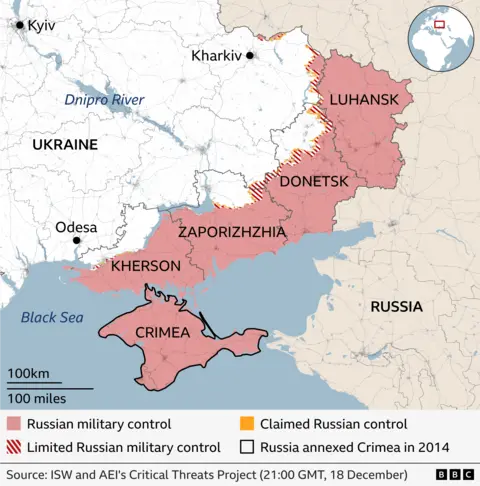
Putin argued Russian forces were making advances across the front line in Ukraine and he ridiculed Volodymyr Zelensky's visit to the front line at Kupiansk last week, when the Ukrainian leader was able to refute Russia claims that it had captured the town.
Putin has also demanded new elections in Ukraine to be included in the peace proposals that US President Donald Trump has submitted as part of his efforts to bring the conflict to an end. At his news conference, Putin offered to stop bombing Ukraine when voting took place.
Ukraine's SBU security service said on Friday it had for the first time hit an oil tanker operating as part of Russia's "shadow fleet" in the Mediterranean. Putin said it would not lead to the result that Kyiv wanted and would not disrupt Russian exports.
Most of the questions from Russian media or from the public made little attempt to challenge Putin, but two were allowed from Western correspondents, Keir Simmons of US network NBC and the BBC's Steve Rosenberg.
When Simmons asked if Putin would feel responsible for the deaths of Ukrainians and Russians if he rejected the Trump peace plan, Putin praised the US president's "sincere" efforts to end the war, but said it was the West not Russia that was blocking a deal.
"The ball is in the hands of our Western opponents," he said, "primarily the leaders of the Kyiv regime, and in this case, first and foremost, their European sponsors."
Trump has said a peace deal is closer than ever and, despite Putin's apparent refusal to compromise, the US president has said he hopes "Ukraine moves quickly because Russia is there".
A Ukrainian delegation is holding talks in Miami on Friday with Trump envoy Steve Witkoff and Trump's son-in-law Jared Kushner. German, French and British officials are also there, days after they met the US officials in Berlin.
Kremlin envoy Kirill Dmitriev is also expected in Miami over the weekend, according to reports.
Putin told the BBC's Russia Editor: "We are ready to work with you - with the UK and with Europe in general and with the United States, but as equals, with mutual respect to each other.
"We are ready to cease these hostilities immediately, provided that Russia's medium- and long-term security is ensured, and we are ready to cooperate with you."
He accused the West of creating an enemy out of Russia. Skating over his decision to mount a full-scale invasion in February 2022, he said: "You are waging a war against us with the hands of Ukrainian neo-Nazis," he added, repeating his regular diatribe against Ukraine's democratically elected leaders.
European intelligence agencies have warned that Russia is only a few years away from attacking Nato. The Western defensive alliance's chief Mark Rutte said this month that Russia was already escalating a covert campaign and the West had to be prepared for war.
While many of the questions were benign, including several from children, from a one reporter from Yakutia in north-eastern Siberia highlighted a tenfold increase in energy prices in the past four years. Putin told her that his team would look into alternative sources of energy and "keep Yakutia in mind".
Towards the end of the TV marathon, Putin was asked a series of quickfire questions, touching on his views on friendship, religion, the motherland and love at first sight. He said he believed in love at first sight - then added that he himself was in love, without divulging any more details.